
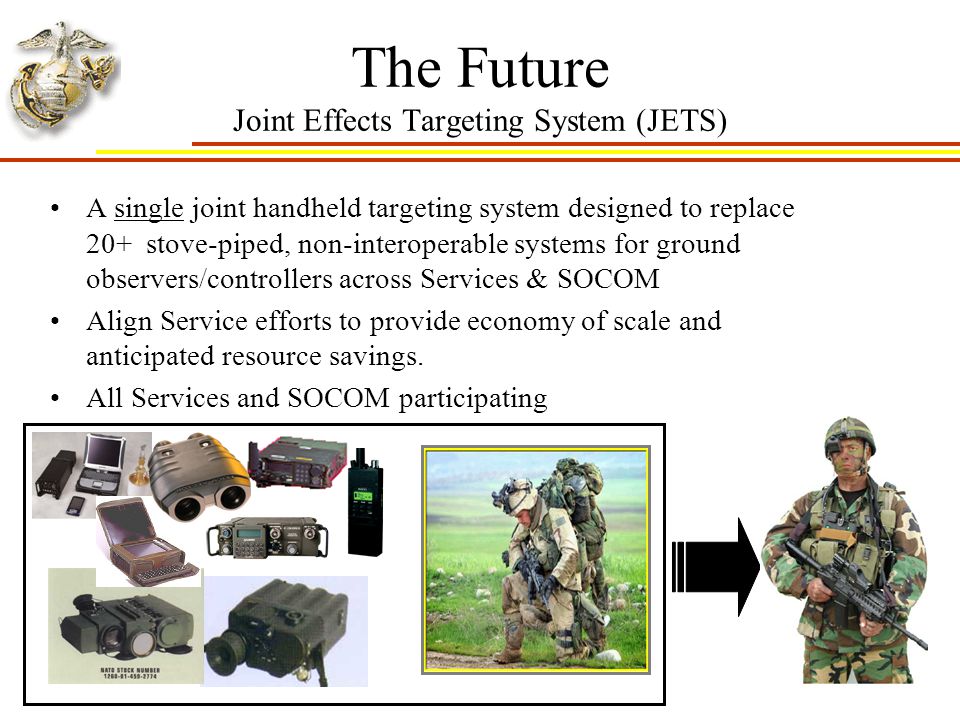

The Joint Effects Targeting System (JETS) Target Location Designation System (TLDS) is an Army-led, Joint-interest program with the Air Force and Marine Corps to develop and field a one-man-portable, hand-held capability to rapidly acquire, precisely locate, and engage targets with precision-guided munitions, and improves the effectiveness of engagement with unguided munitions.
The roughly 5.5-pound JETS system would replace the Lightweight Laser Designator Rangefinder (LLDR) which weighs approximately 35 pounds and is technically a crew-served weapon geared towards static positions. It’s portability allows a forward observer to walk around far and wide with JETS, while LLDR is a two- or three-person system that needs to be set up at a fixed observation point.
The hand-held system includes a GPS; celestial compass; precision azimuth vertical angle module, or PAVAM; and a laser designator to enable forward observers to accurately identify a target and drop precision-guided munitions such as a Hellfire missile or Excalibur 155mm artillery round to within 10 meters of the target, Maj. Robert J. Heatherly, assistant product manager for JETS, told a groups of reporters.
“Forward Observers have a critical role as a key element of a Fire Support Team; providing indirect fire support at the company/troop level, JETS-TLDS allows the FOs to quickly acquire and locate targets for any given fire mission,” said Staff Sgt. Timothy S. Phillips, a Research, Development, Test & Evaluation NCO from the U.S. Army Operational Test Command’s Fires Test Directorate.
It now takes up to half an hour to approve the coordinates and get a bomb dropped once a forward observer has called in a target. But time is precious in a firefight, so the Joint Effects Targeting System cuts that lag time way down.
“Out there on the battlefield, when you need timely effects on target with precision, the process of mensuration can really take a lot of time as far as impacting the maneuver commander’s decision to either deploy those effects or to go ahead and take the objective through force,” Maj. Rob Heatherly told reporters. The key advantage JETS will give forward observers in infantry units is the time it will cut from the current “mensuration” procedure of identifying a target and dropping precision munitions, Heatherly said.
With the Army’s current laser-targeting system, coordinates and images have to be checked and rechecked by multiple targeting warrant officers and a fire support element, which sends the target up to their headquarters. “You’ll still have to get the maneuver commander to release weapons, but as far as the process of having to go all the way through the different levels, refine with imagery, it will cut that step out,” Heatherly said.
JETS trades weight for a more limited range, the new system can only spot up to 2,500 meters, versus LLDR’s 3,700. “The way the system will be utilized out there, the forward observers … will be closer to the fight, so they don’t need that greater range; they need something that can give them that precision targeting capability and quick response.
Lt. Col. Michael Frank, the product manager of soldier precision targeting devices, said bluntly of JETS ability in the field: “I turn a howitzer or a Paladin into a giant sniper rifle.”
The system underwent testing during 2017, including airdrop testing at Fort Bragg in North Carolina in August, when soldiers put the system through several combat-equipment jumps and door-bundle jumps, evaluating its ability to function after hitting the ground.
The Army expects its new Joint Effects Targeting System – a handheld, portable device for target observation, location, and designation – to start arriving with forward-observation teams by mid-2018, according to Army Times.