
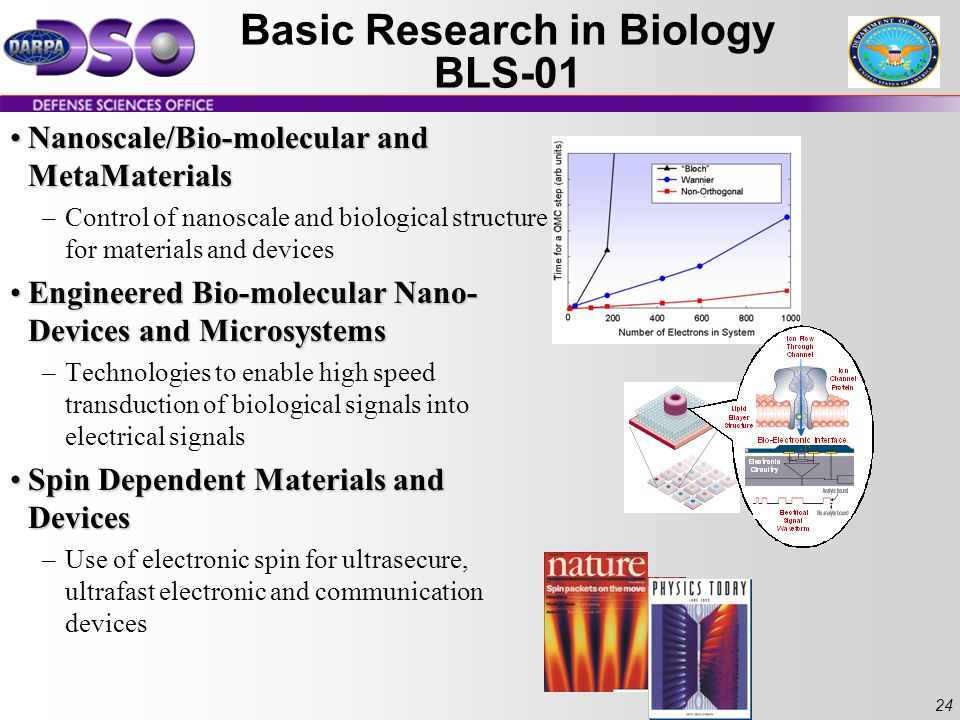

Molecular electronics, also called moletronics, is the branch of nanotechnology where the molecular building blocks are used for the fabrication of electronic components. It is an interdisciplinary area that spans physics, chemistry, and materials science. The smaller size of the electronic components decreases power consumption while increasing the sensitivity (and sometimes performance) of the device. These have wide range of applications in the work areas of chemistry, physics, electronics and nano electronics, technology, artificial intelligence and medical equipment.
As the complexity and volume of global digital data grows, so too does the need for more capable and compact means of processing and storing data. Data storage and processing is central to Department of Defense (DoD) activities across areas including platform design and optimization, sensing, mission planning and logistics, and healthcare. While our current computational architectures remain essential, new complementary approaches are needed to provide advanced capabilities as the complexity and volume of data grows, says DARPA.
To address this challenge, DARPA launched its Molecular Informatics program in 2017 , which seeks a new paradigm for data storage, retrieval, and processing. Instead of relying on the binary digital logic of computers based on the Von Neumann architecture, Molecular Informatics aims to investigate and exploit the wide range of structural characteristics and properties of molecules to encode and manipulate data.
“Chemistry offers a rich set of properties that we may be able to harness for rapid, scalable information storage and processing,” said Anne Fischer, program manager in DARPA’s Defense Sciences Office. “Millions of molecules exist, and each molecule has a unique three-dimensional atomic structure as well as variables such as shape, size, or even color. This richness provides a vast design space for exploring novel and multi-value ways to encode and process data beyond the 0s and 1s of current logic-based, digital architectures.”
DARPA has launched Molecular Informatics program with aim to discover and define future opportunities for molecules in information storage and processing. Molecular Informatics program, seeks a new paradigm for data storage, retrieval, and processing. Instead of relying on the binary digital logic of computers based on the Von Neumann architecture, Molecular Informatics aims to investigate and exploit the wide range of structural characteristics and properties of molecules to encode and manipulate data.
Given radical advances in tools and techniques to sense, separate, and manipulate at the molecular scale, what innovations can be injected into information technology, and what will the resulting systems be able to “compute”? By addressing a series of mathematical and computational problems with molecule-based information encoding and processing, Molecular Informatics aims to discover and define future opportunities for molecules in information storage and processing.
Molecular Informatics approaches must ultimately enable information processing directly on molecular data so that advantages molecules offer (such as ultrahigh information storage densities and inherently parallel processing) can be realized. Approaches that more fully exploit the rich diversity of molecular structures and properties (e.g., complex molecular mixtures, nonnatural polymers, etc.) and offer capabilities beyond binary, digital encoding and serial, logic based computation are of most interest, says DARPA.
“Fundamentally, we want to discover what it means to do ‘computing’ with a molecule in a way that takes all the bounds off of what we know, and lets us do something completely different,” Fischer said. “That’s why we absolutely need the diverse knowledge of many different fields working together to jump into this new molecular space to see what we can discover.”