
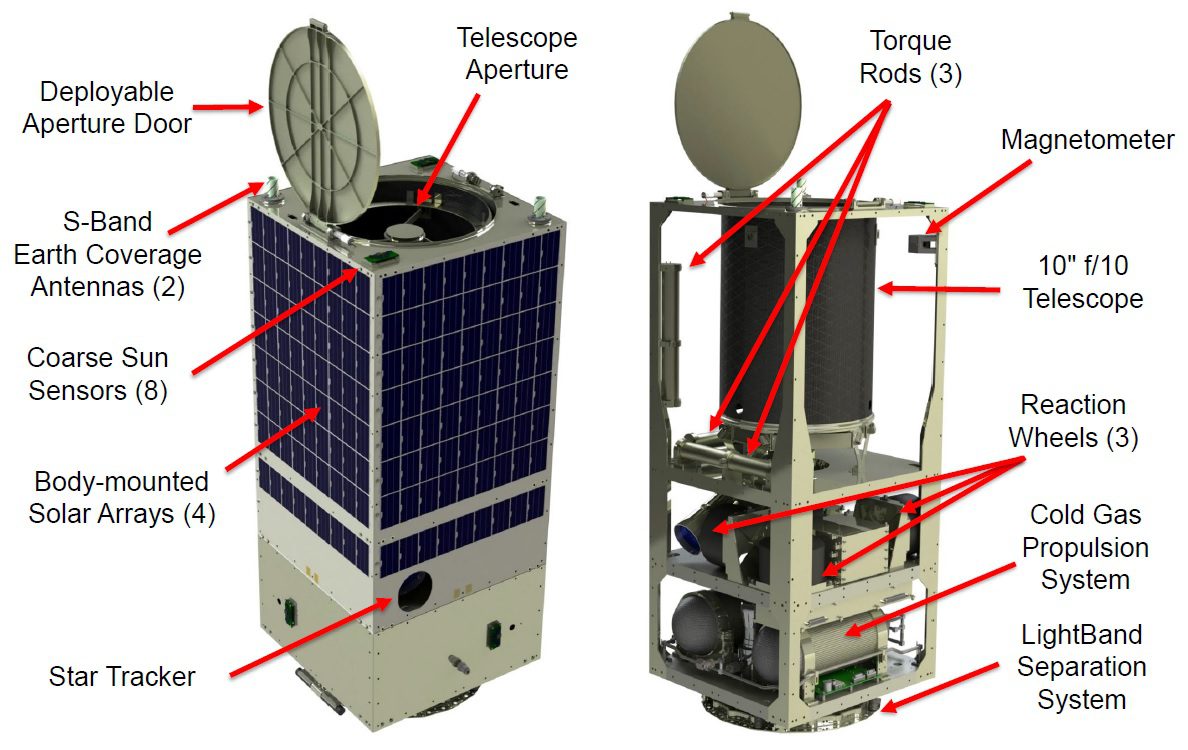

U.S. Army’s Space and Missile Defense Command/Army Forces Strategic Command deployed and activated into space on Oct. 24, the Kestrel Eye microsatellite. Kestrel Eye is a 10 kg, 30.5×10.2×10.2 cm, visible-imagery satellite developed by Maryland Aerospace Inc designed to provide near real-time images to the tactical-level ground Soldier.
Capable of producing 1.5-meter resolution imagery, Kestrel Eye’s data will be downlinked directly to the same Warfighter via a data relay network that is also accessible by other Warfighters in theater without any continental United States (CONUS) relay or data filtering. “Kestrel Eye held the promise of providing on-demand imagery of any spot on earth for the Army, something that had never been available before. And the projected price for a single Kestrel Eye satellite indicated that the acquisition of a large number of satellites to enable persistent coverage could be acceptable.”
Army SMDC focus is on demonstrating the utility of nanosatellites and microsatellites for the warfighter.
SNaP – SMDC Nanosatellite was launched in August 2015 consisting of 5kg mass cube satellite, $500K each, 5 times the data rate of SMDC-One, 3 Axis Stabilization and Propulsion. “This is a Joint Capabilities Technology Demonstration that will focus on voice and data communications beyond line of sight and improved access to high value information.”
“Nanosatellites in low-Earth orbit are traveling approximately 17,000 mph and are about the size of a football which makes them very survivable,” Thomas E. Webber, director, SMDC Technical Center Space and Strategic Systems Directorate said. “Providing the ability for our warfighter to communicate in an environment where traditional SATCOM is unavailable can literally be the difference between life and death.”
Microsatellites like Kestrel Eye provide several advantages over UAVs which are also used for ISR missions. Being at Higher altitudes than UAVs, allow them to provide coverage above denied areas. They are also more survivable compared to UAVs. They are invulnerable to surface-to-air missile threats and less vulnerable to anti-satellite weapons. Their smaller size and greater number and low cost enable affordable, persistent presence, lower probability of detection, graceful degradation so that no single shot launch failure or anomaly causes complete loss of service.