

Unmanned air vehicles play an important role in todays military operations. They are invaluable in locating time critical targets, reporting enemy positions and movements to battlefield commanders, and destroying tactical targets. One important aspect of these operations is the ability to provide persistence in monitoring an area of interest.
Most of the current UAVs are designed to remain in flight for time periods of 20-40 hours, primarily limited by fuel capacity. For example America’s most expensive surveillance drone, the Northrop Grumman RQ-4 Global Hawk, can stay aloft for 32 hours. However, this creates a deployment and logistics challenge for battlefield commanders to maintain eyes on target for extended periods of time, which is usually achieved by deploying multiple waves of UAVs.
The inherent benefits of a long endurance, unmanned aerial vehicle are obvious when one considers the reduced costs involved in a platform not having to consistently return to base, land, refit and refuel before continuing its same mission. The unmanned nature of such systems also does not expose a pilot to unnecessary dangers when traversing over enemy territory. Add in the advanced capabilities of autonomy and a modern MALE UAV can complete multiple missions with reduced manpower committed to its operation and at lower operating costs due to the lessened need for repeat landings in a single sortie.
The Pentagon is now looking for a drone that can fly nonstop for a week or more at a time. In a solicitation published last November, the Department of Defense (DoD) is calling on contractors to submit designs for a low cost, ultra-long endurance UAV that can perform intelligence, surveillance, and reconnaissance (ISR) missions for seven days or more. Specifically, the DoD wants to eliminate the need for launching new waves of drones to replace the ones that have run out of fuel and have to return to base.
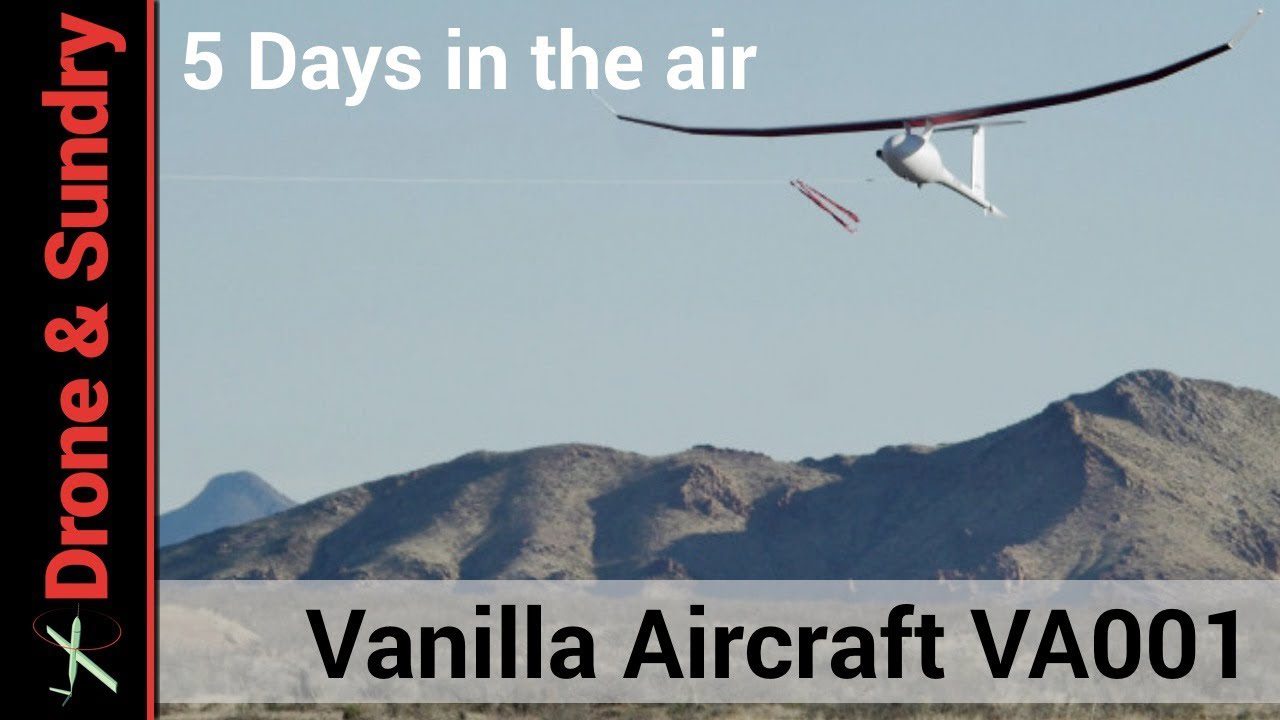
The longest flight record for internal combustion has been 5 days. In Oct 2017, after five days, one hour twenty-four minutes, and traversing over 7000 miles, Vanilla Aircraft’s VA001 touched down at NASA Wallops Flight Facility in Virginia, successfully completing the longest unmanned internal combustion powered flight in history.
One significant weakness in the US’s UAS space is for an ultra-endurance medium altitude UAS. The mid-altitude regime is the one most heavily utilized by all the services. It is best suited to exploitation of available sensors, most notably full motion video cameras, to support ISR and targeting missions, writes Daniel Gouré, Ph.D of Lexington institute. It is the operating regime of choice for supporting counter-terrorist missions. The demands for UAS flights in the medium altitude band continues to grow as the U.S. seeks to counter the rapid spread of ISIS and affiliated groups in Syria, Iraq, Afghanistan, Libya, Somalia, the Sinai and Nigeria.
The Aurora Orion program promotes a drone with 120-hour endurance and operational altitudes of 20,000 feet – outdoing many of inherent capabilities of other UAVs.