

The Internet of things (IoT) is the network of physical devices, vehicles, home appliances and other items embedded with electronics, software, sensors, actuators, and connectivity which enables these objects to connect and exchange data. Each thing is uniquely identifiable through its embedded computing system but is able to inter-operate within the existing Internet infrastructure.
IoT is transforming a wide range of civilian activities by improving their productivity, efficiency, and profitability. These range from management of power and water resources; effective monitoring and coordination of manufacturing, supply chains and transportation systems; precision agriculture, environmental monitoring; monitoring the performance of jet engines, and improved patient monitoring and disease diagnosis. There is great potential for IoT technologies to revolutionize modern warfare, leveraging data and automation to deliver greater lethality and survivability to the warfighter while reducing cost and increasing efficiency.
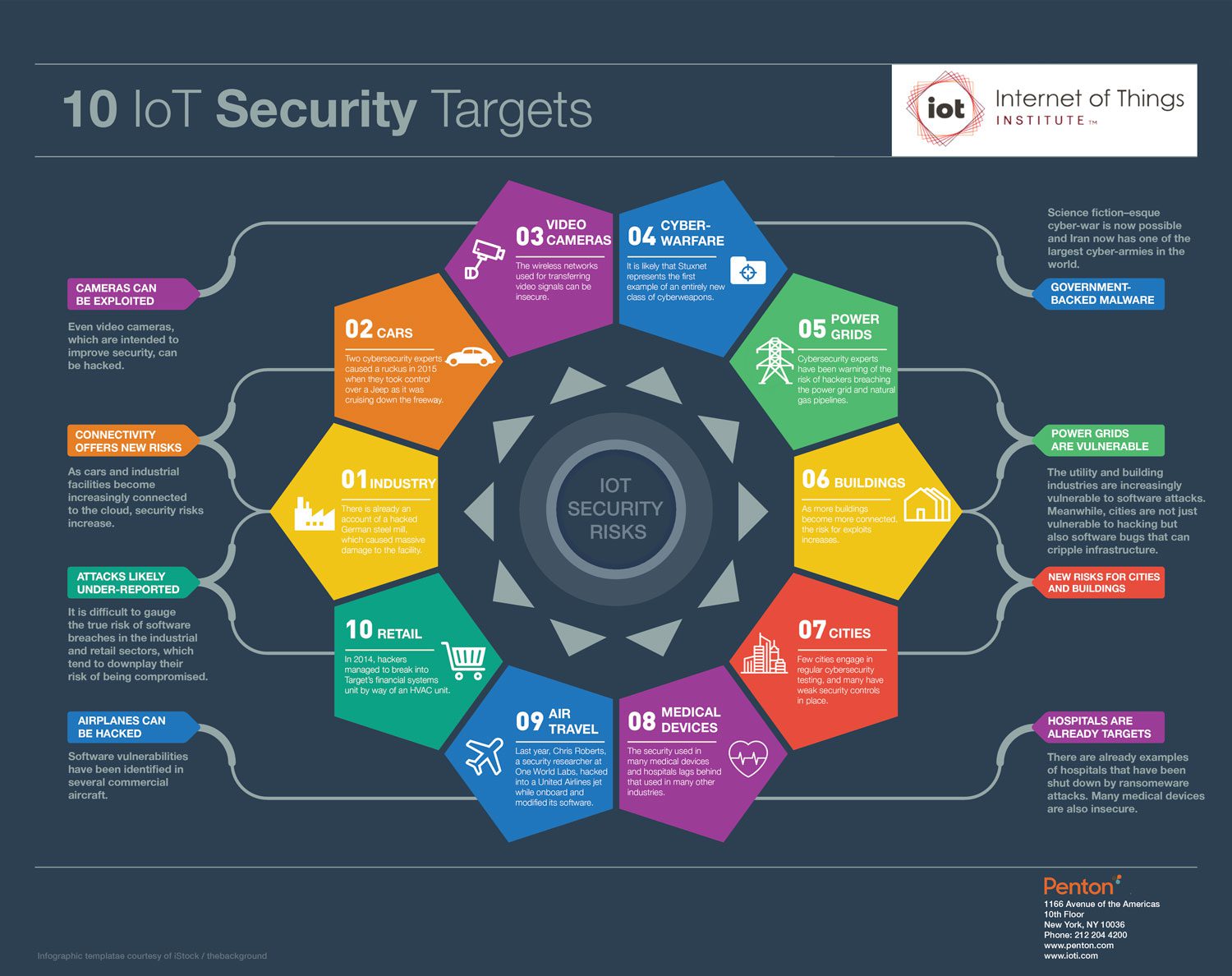
The rapid growth in IOT devices, however will offer new opportunities for hacking, identity theft, disruption, and other malicious activities affecting the people, infrastructures and economy. Some incidents have already happened, FDA issued an alert about a connected hospital medicine pump that could be compromised and have its dosage changed. Jeep Cherokee was sensationally remote-controlled by hackers in 2015.
The implementation of IoT in military domain shall also make military systems and networks vulnerable to cyber and other attacks from adversaries, hackers, and terrorists. There is threat of unauthorized monitoring or even seizure and control of vital networks critical to military operations.
DARPA has launched Leveraging the Analog Domain for Security (LADS) Program for developing revolutionary approaches for securing Military Internet of things. LADS will develop a new protection paradigm that separates security-monitoring functionality from the protected system, focusing on low-resource, embedded and Internet of Things (IoT) devices.
The program will explore technologies to associate the running state of a device with its involuntary analog emissions across different physical modalities including, but not limited to, electromagnetic emissions, acoustic emanations, power fluctuations and thermal output variations. This will allow a decoupled monitoring device to confirm the software that is running on the monitored device and what the current state of the latter is (e.g., which instruction, basic block, or function is executing, or which part of memory is being accessed).