
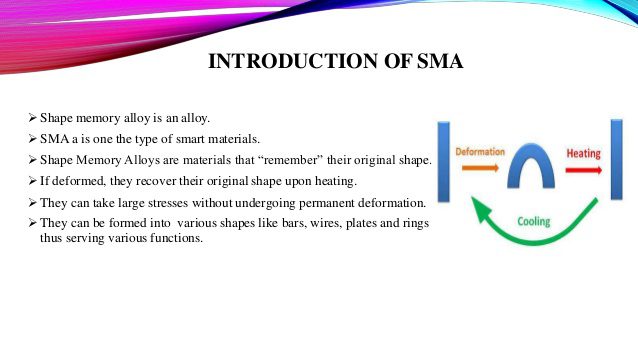

SMAs are materials that can be deformed at low temperature and recover their original shape upon heating. Shape memory alloys (SMAs) belong to a class of shape memory materials (SMMs), which have the ability to ‘memorise’ or retain their previous form when subjected to certain stimulus such as thermo mechanical or magnetic variations. SMAs has found commercial application in a broad range of industries including automotive, aerospace, robotics and biomedical.
Currently, SMA actuators have been successfully applied in low frequency vibration and actuation applications. This material is a lightweight, solid-state alternative to conventional actuators such as hydraulic, pneumatic, and motor-based systems in robotics and automotive, aerospace and biomedical industries.
Compared to conventional actuators, SMAs provide high force (per volume/weight) allowing lightweight compact actuator designs, eliminates extraneous systems (hydraulic, pneumatic, etc.), responds to temperature change, which eliminates the need for sensors and electronics and enables simple, frictionless designs that result in less maintenance
SMAs can be used in passive, active, or superelastic design applications. Passive design applications result from the material heating during normal operation resulting in an actuation force. Active design applications use the material below its transformation temperature and of supplemental heat to provide an on-demand actuation force. Superelastic design applications use the material above its transformation temperature resulting in transformation due to stress.