

All modern forces depend on unimpeded access to, and use of, the EM spectrum in conducting military operations. Therefore, there is a requirement to gain and maintain an advantage in the electromagnetic spectrum by countering adversary’s systems and protecting one’s own systems. Adversary can disrupt and degrade the navigation systems on precision guided munitions (PGMs) and cause missiles to go off course, as well as suppress a country’s air defense systems through jamming.
Electronic warfare provide means to counter adversary’s systems while protecting one’s own systems through Electronic Attack (EA), Electronic Protection (EP) and Electronic Support (ES). EA is the electronic countermeasure which includes jamming and deception of enemy radars, electro-optic and communication systems. It also includes use of anti-radiation missiles (ARM), electromagnetic pulse (EMP) and directed energy weapons (DEW). Electronic protection (EP) is the ECCM including such measures as emission control (EMCON), communication security (COMSEC) and electromagnetic hardening. Electronic support (ES) includes all actions taken for the purpose of real-time threat reorganization in support of immediate decisions involving EA, EP, weapon avoidance, targeting or other tactical employment of forces e.g. Electronic Intelligence (ELINT) and Communication Intelligence (COMINT).
High frequency communications have been used since the 1930s as a means to communicate beyond line of sight. It uses the ionosphere to bounce signals from one point to another. HF communication plays a key role in military, para-military and civilian applications. Using advanced HF radios, beyond line-of-sight (BLOS) communication can be achieved without the need of expensive satellite communication or cellular communication servers.
HF Frequencies range from ~1.8 MHz – 30MHz. HF’s single greatest value is its ability to provide reliable short AND long range Beyond Line Of Sight (BLOS) communications. It can support Point-Point and P-Multipoint data rates up to ~10kbps w/o relays . HF is generally available, rapidly and readily deployable – requires very little infrastructure and can be made extremely reliable.
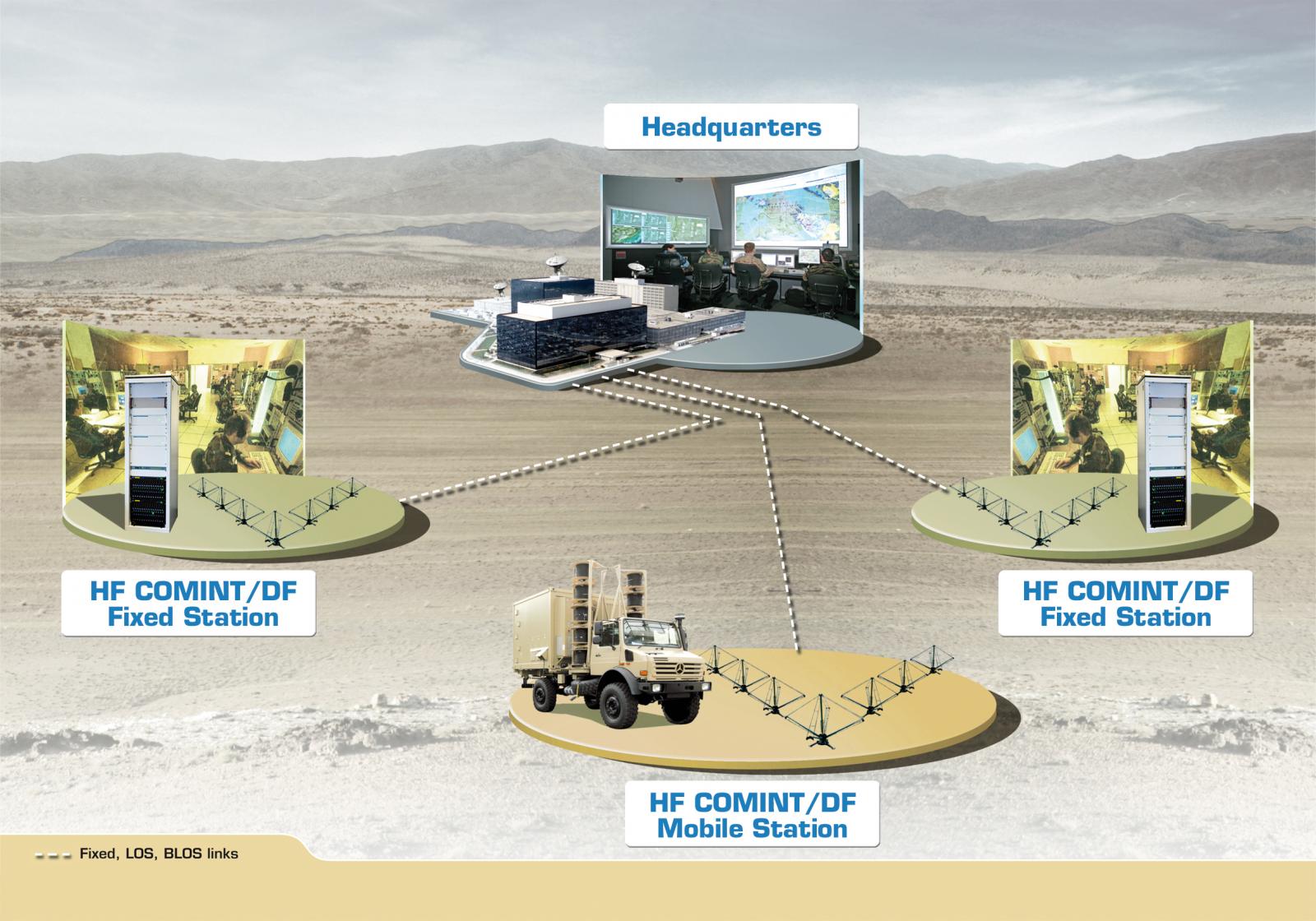
However HF communications is also used by terrorists, illegal immigrants, pirates and illegal fishermen, hence there is need for HF Communications intelligence (COMINT) systems that can gather information from these live signals of interest (SOI) and turn them into actionable signals intelligence. COMINT activities are intended to determine details about the communications such as: who the communicating parties are, where those parties are located, the organizational function of the transmitter, time and duration of communication, frequencies and other technical details of note in the transmission, encryption used and whether it can be decrypted.
COMINT systems should have capability to perform fine-resolution detection, location, collection, classification and archiving of SOI. In addition, Lookback Collection visualization, collection and wideband recording enable operators to view the signal detection history of the entire archive, search and filter by signal characteristics including geolocation and extract signals for playback and further analysis.