
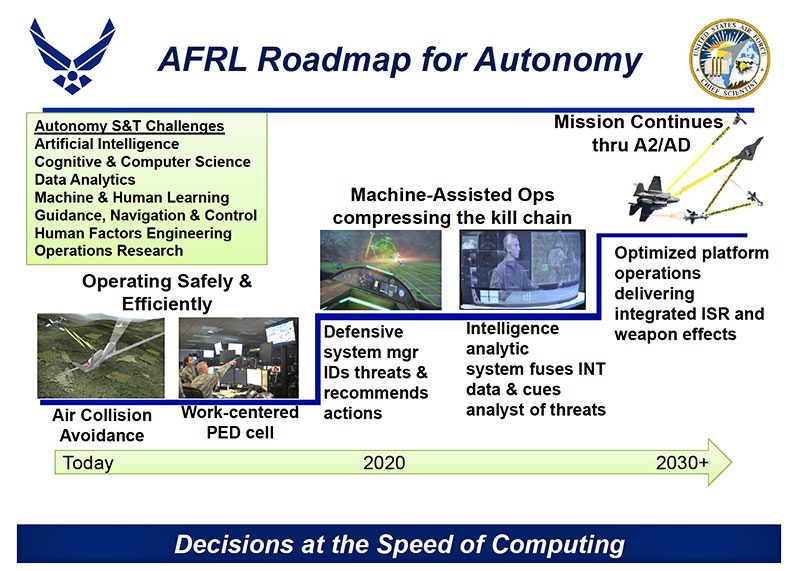

The Air Force is looking to increase the use of autonomous technology and has released a Broad Agency Announcement for industry participation, according to a July 7 agency notice. The objective of Science and Technology for Autonomous Teammates (STAT) program is to develop and demonstrate autonomy technologies that will enable various AF mission sets. The STAT program will push for research to strengthen three capabilities: Multi-domain Command and Control (MDC2); Intelligence, Surveillance, Reconnaissance (ISR) Processing, Exploitation, and Dissemination (PED); and Manned-Unmanned Teaming (MUM-T) in combat situations.
Autonomy is a capability (or a set of capabilities) that enables a particular action of a system to be automatic or, within programmed boundaries, “self-governing.” Autonomous systems provide a considerable opportunity to enhance future Air Force operations by potentially reducing unnecessary manning costs, increasing the range of operations, enhancing capabilities, providing new approaches to air power, reducing the time required for critical operations, and providing increased levels of operational reliability, persistence and resilience. This is the view of Air Force Office of the Chief Scientist that has come with report “Autonomous Horizons Volume I: Human Autonomy Teaming”.
The Science and Technology for Autonomous Teammates (STAT) program is seeking to improve Air Force operations through machine learning that uses human-machine teaming, autonomous decision-making processes, and information analytics research, according to the BAA overview.
DOD has been seeking to advance initiatives that focus on machine learning and artificial intelligence since the “Third Offset” strategy was unveiled in September 2014. The continued efforts are intended to promote technologies and concepts that support the U.S. military’s technological advantage.
The total estimated value is $950 million for the total period of performance, which is based on the following annual estimates: $118 million in FY 2018, $152 million in FY 2019, $159 million in FY 2020, $153 million in FY 2021, $149 million in FY 2022, and $219 million in FY 2023.