
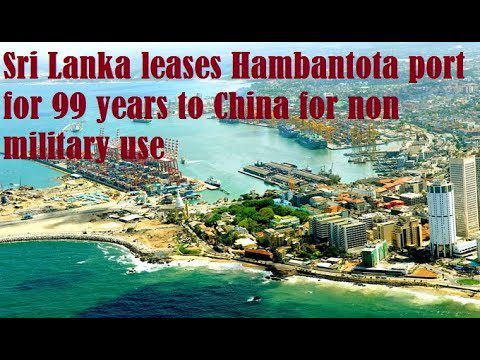

Sri Lanka has signed a $1.1bn (£837m) deal with China for the control and development of the southern deep-sea port of Hambantota. Under the proposal, a state-run Chinese company will have a 99-year lease on the port and about 15,000 acres nearby for an industrial zone. Sri Lanka’s government says money from the deal will help repay foreign loans. With the island nation’s total debt standing at $64 billion (Rs 41,000 crore), almost 95 per cent of all government revenue goes towards debt repayment.
The deal had been delayed by several months over concerns that the port could be used by the Chinese military. The government has given assurances that China will run only commercial operations from the port, on the main shipping route between Asia and Europe.
Opponents of the project said they feared the area being turned into a Chinese colony. There were also concerns that the Chinese navy could use the port as a base. For now, Colombo insists that the Sri Lankan navy will be in charge of security at the Hambantota port and no foreign navy will be allowed to use it as a base. Sri Lanka has a crucial geographical location, at the cross-roads of oil tanker shipping lanes in the Indian Ocean and immense natural resources.
Hambantota port, overlooking the Indian Ocean, is expected to play a key role in China’s “One Belt, One Road” initiative, otherwise known as the new Silk Road, which will link ports and roads between China and Europe. In recent years, China has helped to build a network of ports or facilities in South Asian countries such as Bangladesh, Sri Lanka, Pakistan and Myanmar and secured docking rights in Seychelles. In 2016 its announced its intention to finance and develop jointly with the host nation companies two commercial ports in the Indian Ocean-, the Maleka Gateway in Malaysia and Dquam port in Oman. China is also developing key ports in Kenya and Tanzania in East Africa. However, Experts have questioned the economic viability of many of these projects and point out that they have more to do with military rather than commercial interests.
Chinese nuclear submarines have made several visits to Sri Lanka in September and November 2014, despite strong displeasure from the Indian government. The presence of Chinese nuclear attack submarines in the Indian Ocean reinforces Beijing’s aggression in competing with India for dominance in a region strategically vital to India’s security.
The political and military relations between Pakistan –Sri Lanka are also growing strong. Sri Lanka will become the first foreign country to acquire Pakistan’s multi-role combat aircraft JF-17 Thunder, and the Pakistan Air Force will begin delivery of the fighter to Sri Lanka from 2017, a report said. The relationship between both Pakistan and Sri Lanka, who are also members of SAARC, which are generally warm have gone into strong tie recently.
In March 2017, Two warships from the Pakistan Navy (PN), PNS Nasr and PNS Saif, made a port visit to Sri Lanka’s Colombo port during their overseas deployment to South East Asian countries, said a statement by the Pakistan Navy. The PN flotilla conducted exercises with Sri Lankan warships in the Indian Ocean for enhancing interoperability and operational coordination between the two navies, added the statement.
The relationship also fosters on strong mutual Sino-Pakistan and Sino-Sri Lankan relationship, as China maintains strong mutual interest in the economic and military development of Sri Lanka and Pakistan.