
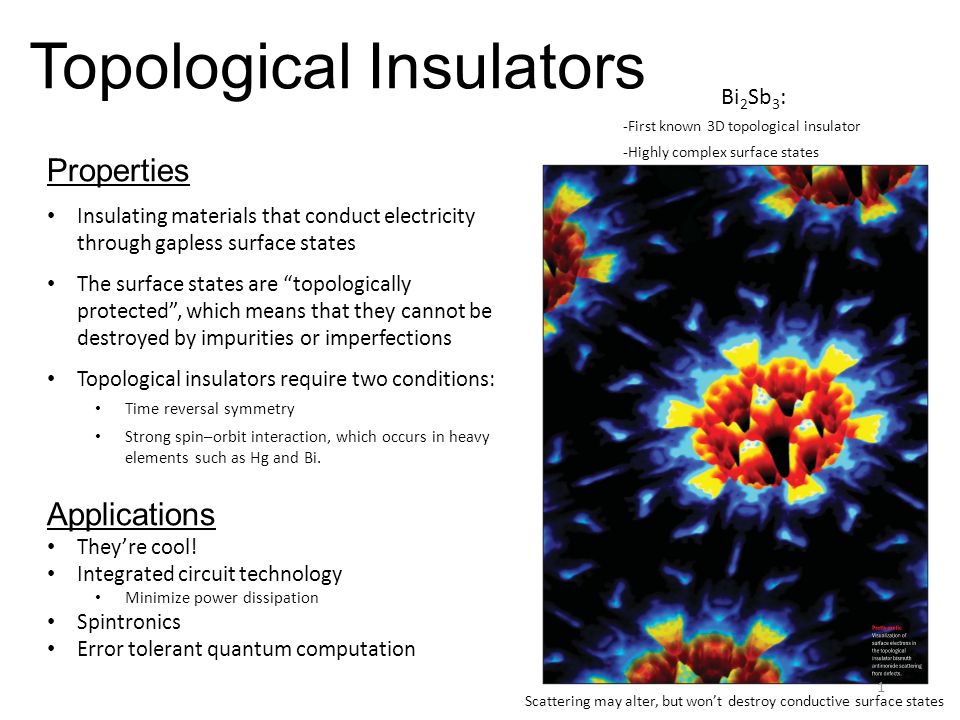

The discovery of topological materials whose properties remain intact even when an object is stretched, twisted or deformed, led to the awarding of the Nobel Prize in physics in 2016 to F. Duncan M. Haldane, and others. Their topological nature means these states are resistant to change, and so stable to temperature fluctuations and physical distortion — features that could make them useful in devices.
“Imagine a rope identified by a number of knots,” Suyang Xu, assistant professor of chemical biology, said. “No matter how much the shape of the rope is changed, the number of knots — known as the topological number — cannot be changed without altering its fundamental identity by adding or undoing knots.” It is this robustness that potentially makes topological materials particularly useful.
Topological materials, hold promise for a wide range of technological applications due to their exotic electronic properties such as ultralow-energy transistors, cancer-scanning lasers, and free-space communication beyond 5G.
“In everyday life we are familiar with conducting materials, such as copper and insulating materials, such as plastic or glass. However there are also topological insulators with very peculiar properties,” says the Utrecht University professor. “These materials are insulating in the bulk, but current can flow along the edges. Furthermore, the conductivity is quantised and varies in discrete steps. This special property, of being both a conductor and an insulator, has had semiconductor researchers excited for computers that operate on ultra-low power, while also being much faster and more reliable.
Just like graphene, electric currents can flow in topological semimetals with virtually zero dissipation of energy, potentially making them useful for ultralow-power electronics, says physicist Masaki Uchida at the Tokyo Institute of Technology. At the same time, researchers can theoretically vary the thicknesses of topological semimetals to tune their properties, whereas atomically thin graphene has finite thickness and thus less flexibility for design purposes, says physicist Yee Sin Ang at the Singapore University of Technology and Design.
A new study represents a significant advance in topological transistors and beyond-CMOS electronics. First time that the topological state in a topological insulator has been switched on and off using an electric field. Researchers proved this is possible at room temperature, which is necessary for any viable replacement to CMOS technology in everyday applications.