
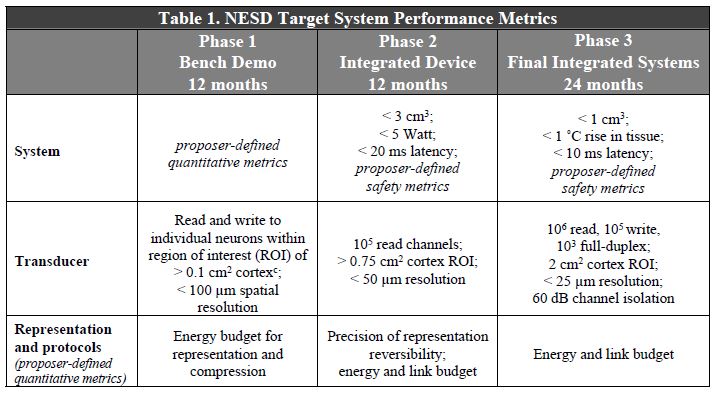

Neural interfaces currently approved for human use squeeze a tremendous amount of information through just 100 channels, with each channel aggregating signals from tens of thousands of neurons at a time. The result is noisy and imprecise. DARPA announced NESD in January 2016 with aim to develop to develop an implantable system able to provide precision communication between the brain and the digital world.
The goal of DARPA NESD program is to develop systems that can communicate clearly and individually with any of up to one million neurons in a given region of the brain. Such an interface would convert the electrochemical signaling used by neurons in the brain into the ones and zeros that constitute the language of information technology, and do so at far greater scale than is currently possible. The work has the potential to significantly advance scientists’ understanding of the neural underpinnings of vision, hearing, and speech and could eventually lead to new treatments for people living with sensory deficits.
“Today’s best brain-computer interface systems are like two supercomputers trying to talk to each other using an old 300-baud modem,” said Phillip Alvelda, the NESD program manager. “Imagine what will become possible when we upgrade our tools to really open the channel between the human brain and modern electronics.”
“The NESD program looks ahead to a future in which advanced neural devices offer improved fidelity, resolution, and precision sensory interface for therapeutic applications,” said Phillip Alvelda, the founding NESD Program Manager. “By increasing the capacity of advanced neural interfaces to engage more than one million neurons in parallel, NESD aims to enable rich two-way communication with the brain at a scale that will help deepen our understanding of that organ’s underlying biology, complexity, and function.”
Although the goal of communicating with one million neurons sounds lofty, Alvelda noted, “A million neurons represents a miniscule percentage of the 86 billion neurons in the human brain. Its deeper complexities are going to remain a mystery for some time to come. But if we’re successful in delivering rich sensory signals directly to the brain, NESD will lay a broad foundation for new neurological therapies.”
The Research would enable highly efficient Brain-computer interfaces that could be applied in neuroprosthetics, through which paralyzed persons are able to control robotic arms, neurogaming where one can control keyboard, mouse etc using their thoughts and play games, neuroanalysis (psychology), and in defense to control robotic soldiers or fly planes with thoughts.
This would also result in efficient in efficient Brain control devices. Researchers at the University of Zurich have identified the brain mechanism that governs decisions between honesty and self-interest. Using non-invasive brain stimulation, they could even increase honest behavior.
Government is also interested in controlling mind control of people to spread its propoganda while disrupting dissent. Military is interested in mind control of soldiers. Whistleblower has recently revealed about secret DARPA project military mind control project at major university.