
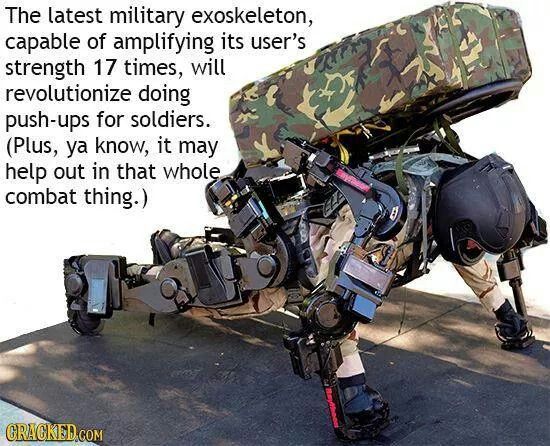

Some of the missions the soldiers perform can take weeks, away from in difficult terrain like deserts and mountains which requires maintaining an incredibly high level of physical fitness. Around the world, armies are recognizing the importance of maximizing the effectiveness of Soldiers physically, perceptually, and cognitively.Exoskeletons can improve the current physical capabilities of a warfighter, allowing them to run faster, lift heavier objects and relieve strain on the body during physical operations.
For in-depth understanding on Augmented Human technology and applications please visit: The Augmented Human: The Rise of “superhumans,” or Human 2.0
Militaries are trying to augment physical performance, through Exoskeletons either through increase in the physical strength of the Soldier or increase their endurance. Today’s exoskeletons allow soldiers to carry 17 times more weight than normal and march with significantly less strain on the body. With an XOS 2 suit, for example, a solider can carry 400 pounds but feel the weight of only 23.5. Practically, exoskeletons are designed to assist soldiers in a wide array of support tasks, including loading supplies and ammunition, getting heavy missiles onto airplanes, and repairing ships.
The exoskeleton systems are more important in an era when the U.S. Army believes its units may have to operate on future battlefields cut off from regular sources of supply. As a result, soldiers can stand carrying heavy weapons longer including shoulder-fired Stinger anti-aircraft missiles and other heavy weapons. Soldiers could also traverse difficult, hilly terrain in places like Afghanistan and Korea with less exertion.
US soldiers shall soon test next-generation self-powered, exoskeleton suits that could revolutionise combat by allowing troops to move faster, carry less and power high-tech weapons and equipment. Designers of the kit, which is worn around the waist and covers the legs, say their technology enhances the mobility of wearers, reduces fatigue and makes it easier for them to haul weight up hills. And now updated versions of the technology are being developed by the US Army – with the aim of potentially introducing them to troops on the front line within the next decade.
The Sarcos Robotics team has been awarded a contract by the United States Special Operations Command in March 2019 to deliver a production version of its Guardian™ XO®. The XO is a full-body, autonomously powered robotic exoskeleton. People wearing the suit are able to comfortably lift 90kg without any exertion or strain. The exoskeleton uses a combination of advanced materials, sensors, and algorithms to give wearers ultimate control.
Norinco, China’s state-owned manufacturer of armored vehicles and heavy ground munitions, has debuted its second-generation military exoskeleton, a body brace designed to help infantry members carry some 100 pounds of weapons, supplies, and ammunition. Compared to a previous Norinco exoskeleton, which came out in 2015, this second generation has a better battery, more robust hydraulic and pneumatic actuators, and a streamlined harness. The new version is also lighter, which will likely reduce strain felt by the exoskeleton’s wearer, making it a better choice for troops in mountainous terrain.
Russian Rostec is presenting exoskeletons for promising combat suits at the International Military-Technical Forum ARMY 2018. The exoskeletons were already tested by the Russian Army under combat environment conditions. A fully operative example of a passive exoskeleton significantly increases physical abilities of a soldier, protects joints and the spine and can be adjusted to the height of a particular soldier. The exoskeletons are developed by TSNIITOCHMASH (the Central Research Institute for Precision Machine Building, part of Rostec State Corporation) and GB Engineering.
The exoskeleton is made of lightweight carbon fiber and supports the musculoskeletal system when a person carries weights up to 50 kg (packs, special gear, armaments and ammunition) during long marches and assaults. It is a mechanical device with levers and swivels in the shape of human joints.
The U.S. Army is also developing soft exosuits using soft robotics. The Department of Veterans Affairs is also seeking research into soft robotics for exoskeletons to aid wounded veteran. Soft robotics differ from traditional counterparts in some important ways: Soft robots have little or no hard internal structures. Instead they use a combination of muscularity and deformation to grasp things and move about. Rather than using motors, cables or gears, soft robots are often animated by pressurized air or liquids.