

Over the past few decades, advances in electronic sensors, communications technology, and guided weapons may have fundamentally transformed the nature of air combat. One of critical technologies was superior situational awareness (SA) when a pilot has a better understanding of the position of all relevant aircraft and their activities in the combat area than an opponent. The ultimate expression of SA is to move into position to attack an opponent without being detected, launch an attack, and escape before other enemies can take counteroffensive action.
For about fifty years, pilots relied on the human eye as the primary air-to-air sensor and machine guns and automatic cannon as their primary weapons. The physical limitations of human vision give it a relatively short effective range as an air-to-air sensor of about 2 nautical miles (nm). Aircraft can be seen farther away if the highly sensitive central vision is focused on them, but with central vision limited to a cone roughly 2 degrees wide, pilots searching for opposing aircraft without some sort of cue to limit their search are unlikely to detect them
until the less acute peripheral vision is able to resolve them at about 2 nm.
By the mid-1960s, new aerial weapons and sensors appeared in conflicts in Southeast Asia, South Asia, and the Middle East. The new weapons included both infrared (IR) and radarguided missiles, while the new sensors were largely air-to-air radars. IR missiles allowed
attacks within a 30-degree cone behind the target at ranges approaching the 2 nm effective visual search radius. Radar-guided missiles, in theory, allowed attacks from any aspect (front, side, or rear) and beyond visual range (BVR). Air-to-air radars were capable of detecting and tracking targets at 15 nm or more. While the early missiles and radars had serious limitations and were unreliable, they offered substantial advantages over guns and the human eye. Guns were displaced by rear-aspect-only IR missiles, which were in turn replaced by
all-aspect missiles, and finally, BVR missiles have come to make up the majority of modern air-to-air engagements.
These trends suggest that over the past five decades, advances in radar and other sensor technologies, missile capabilities, and communication technologies allowed pilots to search effectively much larger volumes of sky and engage targets at ever-increasing range. Most modern air combat engagements were initiated before the aircraft were within visual range with a commensurate decrease in the frequency of maneuvering combat. This means that aircrew SA is no longer primarily linked to what they can physically see through the cockpit canopy, but to what they glean from cockpit displays of sensor output and information passed from offboard sources such as nearby friendly aircraft.
The advent of the air launched missiles greatly changed the dynamics of aerial combat. While Air-to-air missile (AAM) is fired from an aircraft against another aerial platform to destroy it, Air-to-surface missile (ASM) or air-to-ground missile (AGM or ATGM) attack surface targets on land or sea. A major advantage of air-to-surface missile is the stand-off range, well away from the target’s air defences. Most of these are fire-and-forget, thus allowing the attacking aircraft to turn away after launch. The Air-to-Air Missile (AAM) is a potent guided missile that changed the shape of aerial combat forever. Capable of destroying fast and maneuverable jet fighters at ranges sometimes exceeding 100 kilometers, these high-tech weapons dominate the skies.
Air-to-air missiles are divided into three categories: short-, medium-, and long-range. The first consists of missiles designed to engage opposing aircraft at ranges of less than approximately 20 miles (32 km), these are known as short-range or ‘within visual range’ missiles (SRAAMs or WVRAAMs) and are sometimes called ‘dogfight’ missiles because they emphasise agility rather than range. Short-range AAMs have extreme maneuverability (60 G turns) and high speed (around Mach 3 or 3 703 km/h). They can be fired at both fairly distant targets and those within dogfighting range. These usually use infrared guidance, and hence, are also called heat-seeking missiles.
The second group consists of medium- or long-range missiles (MRAAMs or LRAAMs), which both fall under the category of ‘beyond visual range’ missiles (BVRAAMs).
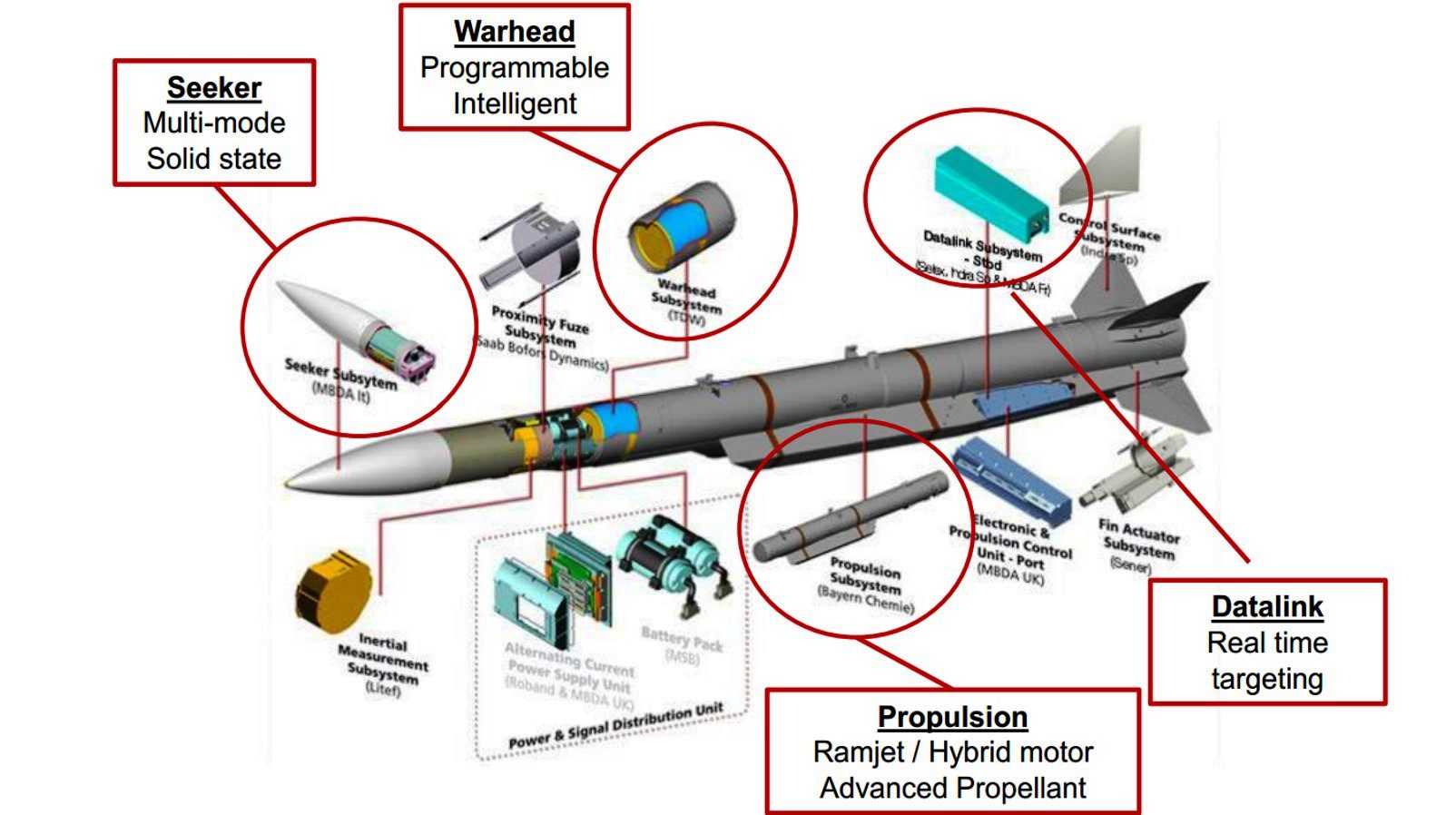
Meteor offers a multi-shot capability against long range maneuvering targets in a heavy ECM environment. It is also intended to equip Eurofighter. The Meteor is currently operated by Czech Air Force, Royal Air Force, French Air Force, French Navy. Medium-range AAMs are similar to their short-range cousins, but tend to have larger warheads, and have a range of around 50 km or more. This means that they can be fired at targets beyond visual range.
Long-range AAMs are, by necessity, the most advanced in the whole class of air-to-air missiles. Even though both types of missiles are being developed by the leading nations/consortiums in the world, the advent of fifth-generation aircraft with inbuilt design features such as stealth, capability to super-cruise and long-range, highly capable active electronically scanned array (AESA) radars, it is the BVR designs which are being pursued more vigorously. The aim is to achieve ‘first-look’, ‘first-shoot’ and ‘firstkill’ capability i.e. to engage and destroy enemy aerial targets even before they sense the presence of own predator aircraft.
With astonishing speed, massive warheads, and tremendous range, they can blow large aircraft out of the sky from over 100 kilometers away. They also use different guidance systems—instead of instantly homing in on targets with infrared, they generally go without guidance to a certain pre-determined point, after which they activate radar homing and chase the target. BVR missiles tend to rely upon some sort of radar guidance, of which there are many forms, modern ones also using inertial guidance and/or ‘mid-course updates’. However, these missiles are difficult to develop and very few have entered operational service.
Since their first deployment in the late 1950s, air to air missile technologies have advanced considerably allowing them to reach targets at longer ranges, with heavier payloads and with greater precision. The speed of air to air missiles has also increased considerably, meaning that while combat jets such as the MiG-25 and SR-71 were all but immune from most air attacks during the Cold War due to their ability to exceed speeds of Mach 3, faster missiles have since been developed which are capable of downing such aircraft with relative ease. While speeds of Mach 4 have today become the norm for high end long range air to air munitions, including the Russian R-77, American AIM-120, Chinese PL-12 and European Meteor, munitions exceeding such speeds are a rarity – much less those capable of attaining hypersonic speeds over Mach 5.
Countries are now developing long range BVR or AAMs missiles today having ranges beyond 200 km. The new fifth generation AAMs are being fielded have many advancements they will significantly expand the ‘no-escape zone’ and increase the range over which air-to-air engagements in future can be fought, enabling pilots to exploit the capabilities of their new aircraft to the full. (The conditions under which a missile cannot be evaded through any combination of maneuvers or acceleration is termed a missile’s no escape zone.)
But China’s latest offering, the PL-15, has a largest range than either. One or two of these air-to-air missiles, can destroy a $150 million aircraft for one or two million dollars. That’s a cost efficient way of trying to level the playing field with the US. Another Chinese air-to-air weapon in development, provisionally known as PL-XX, would strike slow-moving airborne warning and control systems, the flying neural centers of US air warfare, from as far away as 300 miles.
The missile PL-XX, is a very-long-range missile designed to strike enemy aircraft loitering just beyond the edge of an air battle. The point is to shoot down the tankers, airborne early warning planes, and other support aircraft that U.S. combat jets rely upon during wartime. In air-to-air combat, AWACS systems can communicate with friendly aircraft, extend their sensor range and give them added stealth, since they no longer need their own active radar to detect threats.The US E3 AWACS has proved to be a key to victory for the United States in the 1991, 2001, and 2003 campaigns. However long range of PL-XX makes these AWACS vulnerable which may necessitate their operation far away from its range degrading their effectiveness, shifting the air battle in China’s favor.
Without these planes, Stealthy fighter jets would have to fly with their radars constantly on to search for enemies,making them detectable, coordination of the air battle would become more difficult and less efficient, controlled by individual pilots already flying their own combat missions. Deprived of the ability to refuel in midair, targets deep behind enemy lines would become off-limits and fighters would patrol at shorter ranges.