

The war in Ukraine has highlighted the importance of well protected armoured vehicles. The increased use of artillery weapons and precision rocket systems along with strikes against targets of opportunity using drones, caused widespread casualties among infantry soldiers caught out in the open. Such losses are again bringing into focus the importance of armoured personnel carriers (APC) and infantry fighting vehicles (IFV) on the battlefield.
Since the creation of the main battle tank during World War I, there has been a constant arms race between the development of anti-armor weapons and vehicle protection systems, however “Weapons’ ability to penetrate armor, however, has advanced faster than armor’s ability to withstand penetration”. These weapons include modern anti-tank weapons like the Russian Kornet and Chinese HJ-8 guided missiles, as well as Russia’s tandem warhead RPG-29 rocket propelled grenade that can bore a hole into a tank with a molten jet of metal. These weapons are readily available, inexpensive, and easy to use, which has led to proliferation in combat zones in Iraq, Syria, Libya, Lebanon, Gaza, and throughout Africa and Asia. As such, they pose serious threats to armored vehicles.
“As threats became more lethal over the years, the answer was to add more and more armor, especially steel armor, to prevent penetration of the vehicle,” said Mike O’Leary, senior director of business development at DRS Land Systems. “We’re now at a tipping point where combat vehicles simply can’t get any heavier or they’ll be unable to maneuver, traverse bridges, or be transported. As we saw in Afghanistan and Iraq, the weight of some of these vehicles caused roads to give way leading to rollovers.
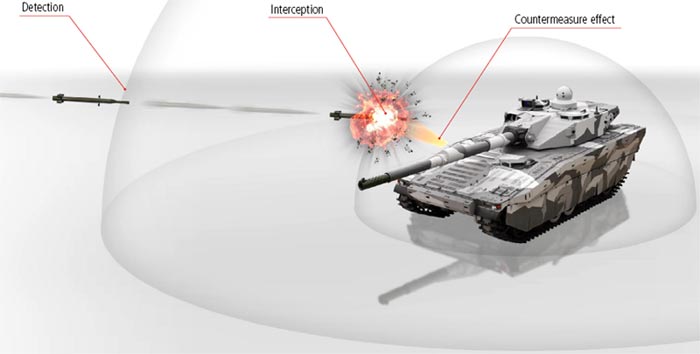
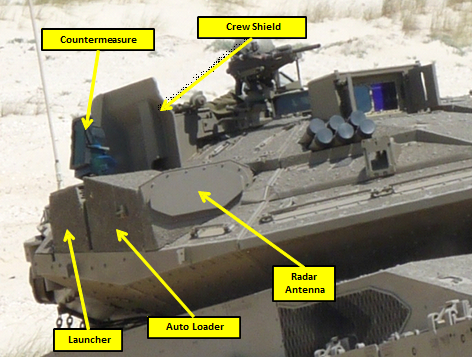
One of the technology militaries are racing to adopt is Active Protection Systems, or APS, to enhance the survivability which augment passive armor by destroying RPGs and missiles in flight before they strike their target. APS typically comes in two flavors, hard kill and soft kill. A hard-kill active protection system detects, engages, and destroys or neutralizes an incoming threat before it can hit a protected vehicle, actively firing some type of projectile to intercept the threat. It uses sensors and radar, computer processing, fire control technology and interceptors to find, target and knock down or intercept incoming enemy fire such as RPGs and Anti-Tank Guided Missiles, or ATGMs.
There’s also a second method for hard kill that competing systems employ. In this case a detector identifies the threat and then launches a proximity fused mortar round at the target. The mortar blast defeats the threat with either an explosion or a blast pressure/blast wave that knocks the threat off course.
Soft kill APS defeats the threat without kinetics. Countermeasures include infrared jammers, laser spot imitators, and radar jammers. They may prevent missile guidance from remaining locked onto the vehicle, causing the missile to miss the vehicle target or prevent it from fusing.
“With APS you don’t necessarily have to add more armor plate to an existing vehicle, and when developing a new vehicle you can reduce the amount of armor required depending on the threat. That gives you a lighter, more mobile and nimble vehicle because you’ve offloaded some passive armor in exchange for an active system.”
An advanced Active Protection System (APS) is critical to achieving operational advantage over our adversaries and is key in enabling the survivability of the Army’s fleet of vehicles. Brigadier Mike Fayers, Head of Military Capability Plans – Army Futures, said: “The threats facing land capabilities continue to evolve, proliferate and diversify in their nature as we have seen most recently in the Ukraine.
World’s top Active protection systems
Israel was the first to experience the increased lethality of modern anti-armor weapons during the 2006 Israel-Lebanon War where its armored formations were basically brought to a standstill by just a few anti-tank guided missile teams hidden in the rocks in the Lebanese Bekaa Valley. The country faced advanced anti-armor weapons again during the 2014 Gaza conflict. In response, Leonardo DRS’ partner Rafael Advanced Defense Systems of Israel developed a system called Trophy that is arguably the most battle tested APS in the world with more than 1,500 systems installed on the Merkava MK4 main battle tank and all major Israeli ground combat platforms.
Russia has introduced Afganit active protection system in its new Armata T-14 tank and is claimed to be a generation ahead of the Shtora, Arena and Trophy APS systems Russian Armata . In the operation to liberate the city of Aleppo, the Syrian army used a company of T-90 MA tanks. The APS on the T-90 MA (Shtora) tanks neutralized American BGM-71 TOW-2 anti-tank missiles. Today Russian tanks make routine and effective use of active protection against Ukrainian anti-tank missiles, with some Ukrainian troops lamenting the Russians’ “magic shield” that stops their shots. China successfully has fielded hundreds of new Type 99A tanks that roughly are similar to mid-generation, digital M-1s.
US Army tanks deployed to Europe as part of the service’s largest exercise in years are rocking a new piece of sophisticated military tech: An active protection system designed to protect against anti-tank missiles. U.S. Army and Marine Corps contracted Leonardo DRS to provide the same Trophy system for M1 Abrams Main Battle Tanks which are being delivered. APS on Abrams tanks, quite naturally, is the kind of protective technology which could help US Army tanks in tank-on-tank mechanized warfare against near-peer adversary tanks, such as a high-tech Russian T-14 Armata tank.
In parallel, Leonardo DRS and Rafael are maturing a lighter weight Trophy Vehicle Protection System (VPS) that is aimed at smaller, lighter platforms like Stryker. Leveraging material and component upgrades, the VPS system has achieved a 40 percent weight reduction and improved power management while retaining its ability to protect against the full range of direct fire, anti-armor rocket, and missile threats.
German arms maker Rheinmetall is rolling out a new Active Protection System (APS) it says should lay Army safety concerns about such systems to rest. The Army is rushing to install anti-missile defenses on its armored vehicles but remains concerned about whether they might accidentally shred nearby civilians or friendly troops. The Rheinmetall system has been tested and certified to meet uniquely stringent safety standards, the company says. It shoots down incoming missiles at the last instant, which they argue is (ironically) safer for surrounding troops than an early kill
Successful fielding of APS will reduce the effectiveness of anti-tank guided missiles and shoulder-fired weapons such as rocket propelled grenades. This will change battlefield dynamics by increasing the importance of cannon, anti-tank guns and tanks,” according to Military Balance 2016 report by the International Institute for Strategic Studies.