
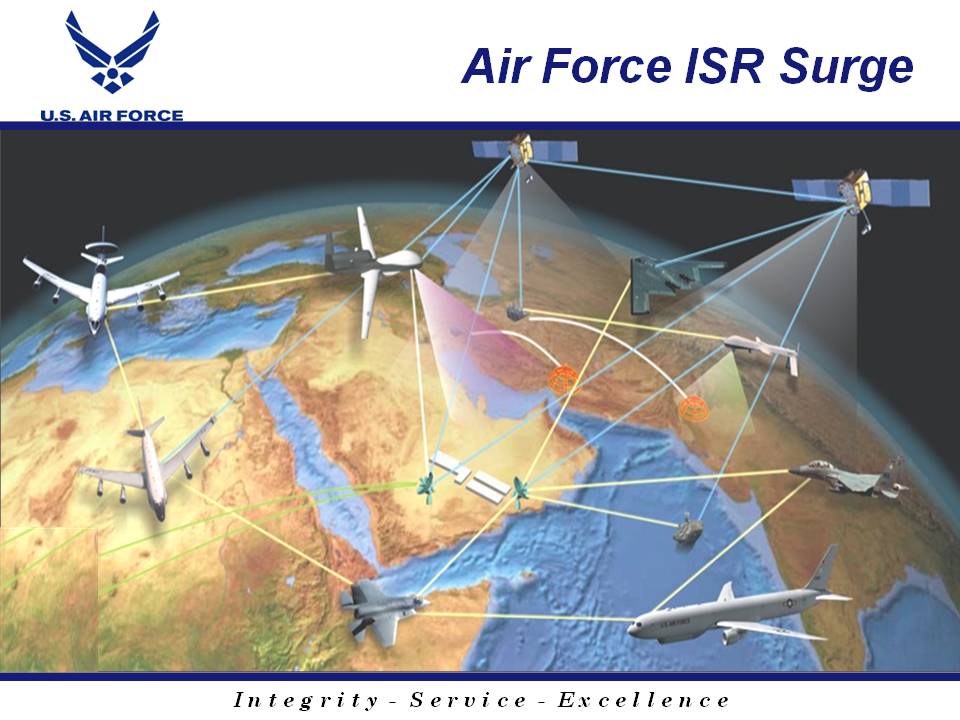

ISR is one of the US Air Force’s five enduring core missions along with air and space superiority, rapid global mobility, global strike, and command and control. AF ISR is integral to Global Vigilance for the nation and is foundational to Global Reach and Global Power. ISR is defined in Joint Publication 1-02, Department of Defense (DoD) Dictionary of Military and Associated Terms as “An activity that synchronizes and integrates the planning and operations of sensors, assets, processing, exploitation, and dissemination systems in direct support of current and future operations. This is an integrated intelligence operations function.” Intelligence, surveillance, and reconnaissance (ISR) is defined as an activity that synchronizes and integrates the planning and operations of sensors, assets, processing, exploitation, and dissemination systems in direct support of current and future operations, according to US DOD.
A significant challenge for Air Force ISR concerns operations in anti-access/area denial environments (A2/AD). These challenges can be addresses through improved sensing, processing, exploitation, data integration, and dissemination technologies. This includes reaching across domains in order to combine the information received from air, space, and cyber sources.
Cross-domain challenges will require cross-domain synergy of ISR capabilities to maintain situational awareness dominance. Synchronizing forces across the three domains in time and purpose for effect is paramount for mission success and a major S&T challenge. The air, space, and cyber domains possess dramatically different characteristics with respect to speed, time, distance, and governing physics and forces.
Contested environments compress decision timelines, which make the relevance and timeliness of ISR products ever more critical. These products must be tailored to meet the requestor’s requirements in order to successfully achieve the commander’s objectives. Additionally, ISR requirements should be timely enough to plan and execute effective operations. Intelligence resulting from timely ISR can provide information to aid a commander’s decision-making and constantly improve the commander’s understanding of the dynamic operational environment. Air Force ISR strategy will require technology improvements to further integrate cross-domain sensing capabilities, including technology to improve automated support to analysts to shorten timelines from tasking through product dissemination.