
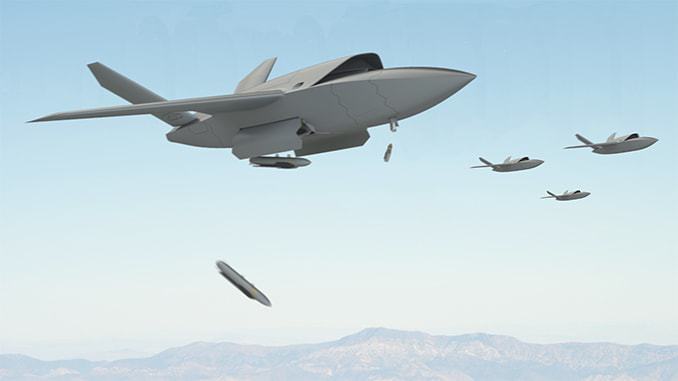

Air Force has released a rendering of what appears to be its vision for concept under the Low Cost Attritable Aicraft Technology (LCAAT) banner. The Low Cost Attritable Aircraft Technology (LCAAT) Initiative is aimed at developing a low cost attritable aircraft design and manufacturing concept costing less than $3M (without mission systems). The goal is to develop and demonstrate low cost design and manufacturing technologies, then validate concepts with a campaign of flight demonstrations.
Chinese military has been engaged in comprehensive modernization of its air, naval, and ground forces, while incorporating a variety of anti-access/area denial (A2/AD) systems and capabilities. “To operate against adversaries with “anti-access / area denial” capabilities the U.S. needs to disperse its forces, disaggregate its capabilities, confuse enemy sensors through decoys and deception, and swarm enemy defenses with large numbers of expendable assets,” says Paul Scharre, Senior Fellow and Director 20YY Future of Warfare.
Future anticipated military threats and tighter defense budgets combine to drive the need for new and innovative solutions towards the development of future low cost unmanned aerospace systems (UAS). As aircraft cost has continued to escalate, the Air Force is interested in UAS concepts that offer dramatic reductions in cost in order to bring “mass” to the engagement, and to achieve a cost imposing effect on future adversaries, says AFRL.
UAS performance, design life/reliability, and maintainability drive the cost of today’s systems, and need to be traded to achieve the optimum capability/cost effects. This effort is directed at the development of an attritable aircraft concept where by virtue of its cost, loss of aircraft could be tolerated. However these aircraft would be intended for reuse with limited life/sorties. Considering the tempo of the engagement and phase of war, the level of attritability that would be tolerated could change with operations as they advance with time.
This low cost attritable aircraft technology (LCAAT) concept will provide long range, transonic, strike capability in remote/ contested regions where forward basing is difficult or prohibited.” “The USAF requires the ability to find, fix, track, and prosecute targets in contested and denied environments, and to provide these capabilities at long range where forward basing is not viable. A long range high performance unmanned attritable aircraft to conduct strike and/or ISR missions would provide a “game changing” capability,” writes Bill Baron is a Principal Aerospace Engineer in the Aerospace Vehicles Division, Aerospace Systems Directorate, Air Force Research Laboratory (AFRL/RQV).