

Federal agencies spend billions of dollars each year to develop, acquire, and build major systems, facilities, and equipment, including fighter aircraft, nuclear waste treatment facilities, electronic baggage screening equipment, and telescopes for exploring the universe. Managing these complex acquisitions has been a long-standing challenge for federal agencies.Many of the government’s most costly and complex acquisition efforts require the development of cutting-edge technologies and their integration into large and complex systems.
The inability of DoD programs to sufficiently reduce technology risk prior to allowing a program to enter formal systems development has, as measured from 2007 to 2012, contributed to a 13% cost growth in weapon systems acquisition, and a 17% increase in cycle time to Initial Operational Capability, or IOC (GAO, 2013). Acquisition cycle time is defined as that span of time from program start to deployment of IOC to the warfighter. When compared to First Full Estimates, the DoD major defense acquisition program (MDAP) portfolio total acquisition cost had grown an average 38%; correspondingly, product cycle time increased an average 37% (GAO, 2013).
Today’s economic climate continues to threaten available DoD funds and underscores the need for streamlined but effective systems engineering. “In the face of decreasing budgets, rapidly evolving threats, and a shift in defense strategy, … it’s imperative that every dollar spent increases warfighting capability,” said VADM David Dunaway, Commander of the Naval Air Systems Command.
GAO has found that in many programs, cost growth and schedule delays resulted from overly optimistic assumptions about technology maturity. Experts have also found that many program managers and technology developers suffer from the assumption that they can deliver state-of-the-art technology upgrades within a constrained budget before evidence is available that the technology will perform as expected in the environment for which it is planned.
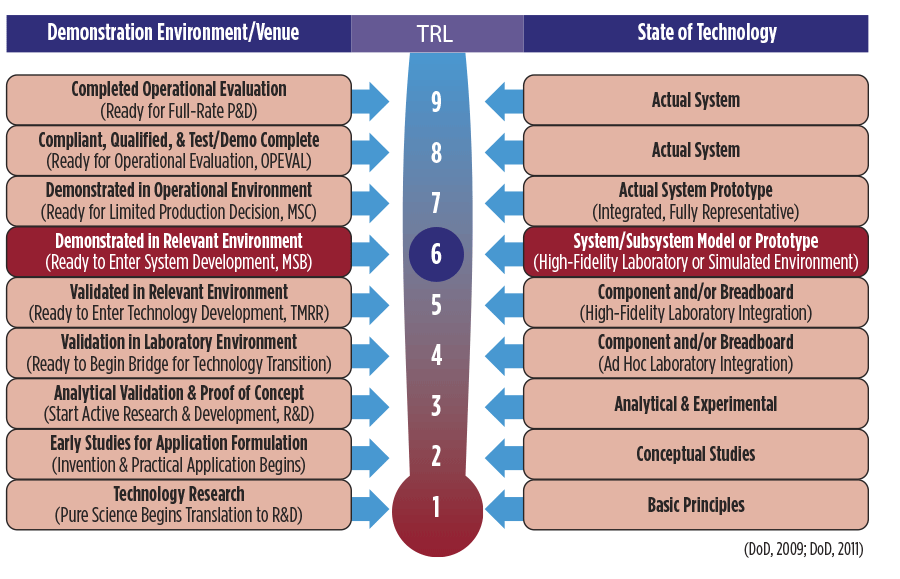
A TRA is a systematic, evidence-based process that evaluates the maturity of CTs (hardware, software, process, or a combination thereof) that are vital to the performance of a larger system or the fulfillment of the key objectives of an acquisition program. A Technology Readiness Assessment (TRA) is a systematic, metrics-based process that assesses the maturity of, and the risk associated with, critical technologies to be used in Major Defense Acquisition Programs (MDAPs). It is a normal outgrowth of the system engineering process and relies on data generated during the course of technology or system development. The TRA frequently uses a maturity scale—technology readiness levels (TRLs)—that is ordered according to the characteristics of the demonstration or testing environment under which a given technology was tested at defined points in time.
The scale consists of nine levels, each one requiring the technology to be demonstrated in incrementally higher levels of fidelity in terms of its form, the level of integration with other parts of the system, and its operating environment than the previous, until the final level where the actual operation of the technology is in its final form and proven through successful mission operations. The TRA evaluates CTs at specific points in time for integration into a larger system. In general, TRLs are measured along a 1-9 scale, starting with level 1 paper studies of the basic concept, moving to laboratory demonstrations around level 4, and ending at level 9, where the technology is tested and proven, integrated into a product, and successfully operated in its intended environment.
In addition to TRAs, organizations use other types of assessments and reviews to examine the technical aspects of acquisition. For example, systems engineering reviews are used to examine the integration of components into systems, test reports are used to detail the outcomes of developmental tests, and manufacturing readiness assessments are used to examine the maturity of the processes that will be applied to manufacture the product.