

Currently, the most widely used technology to detect underwater objects is sound navigation and ranging (SONAR), because acoustic waves can penetrate the water depths to the bottom of the sea. SONAR also suffers from unwanted multipass echoes that are due to reflections from the surrounding terrain. Thus, high-resolution underwater imaging using SONAR is difficult.
Alternatively, 3-D imaging Lidars have emerged as underwater remote sensors for several applications like detection and ranging of submersible targets . They use Lasers operating in the blue-green region of the light spectrum(420 : 570nm). These wavelengths suffer minimum attenuation through water ( less than 0.1 m-1) and maximum laser reflection from estimated target (like mines or submarines) to provide a long range of detection.
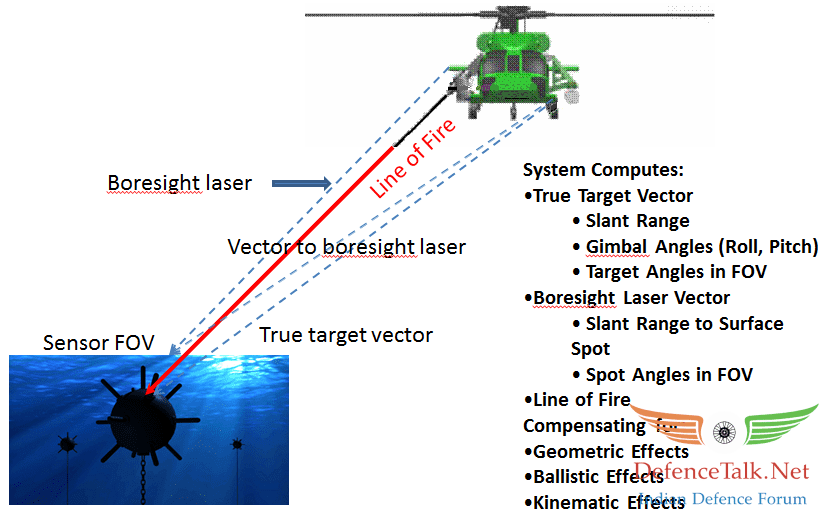
The U.S. Navy has developed ALMDS (Airborne Laser Mine Detection System), designed to operate from the MH-60S helicopter, that uses a Laser Imaging Detection and Ranging blue-green laser to detect, and identify naval mines near the surface. ALMDS operates from the low flying, and smaller, helicopters. Surface mines are either moored (via a chain to the bottom) or floating (a favorite terrorist tactic), and many float just below the surface. The laser works very quickly, and enables the ALMDS equipped helicopter to quickly check out large areas for surface mines.
Researchers from Mitsubishi Electric Corporation and Japan Agency for Marine-Earth Science and Technology have developed an underwater three-dimensional (3-D) imaging sensor using a 532-nm laser.
China is developing a satellite with a powerful laser for anti-submarine warfare that researchers hope will be able to pinpoint a target as far as 500 metres below the surface. Project Guanlan, meaning “watching the big waves”, was officially launched in May 2018 at the Pilot National Laboratory for Marine Science and Technology in Qingdao, Shandong. Five hundred metres is ‘mission impossible’,” said a lidar scientist with the Shanghai Institute of Optics and Fine Mechanics at the Chinese Academy of Sciences, who is not involved in the project.
Experiments carried out by the United States and former Soviet Union achieved maximum detection depths of less than 100 metres, according to openly available information. That range has been extended in recent years by the US in research funded by Nasa and the Defence Advanced Research Projects Agency (DARPA). A device developed by DARPA, for example, was mounted on a spy plane and achieved reliable results at a depth of 200 metres, detecting targets as small as sea mines.