

In July 2019 US Navy ship in the Persian Gulf reportedly used a new, anti-drone system to take down an Iranian drone that came within a thousand yards, according to Military.com. In a statement, the Department of Defense confirmed that the USS Boxer was moving through the Strait of Hormuz when it was approached by a fixed-wing drone which “closed within a threatening range,” which prompted the ship’s crew to take “defensive action.” Iran has denied the allegation.
According to C4ISRNET, the Marines aboard the USS Boxer used a new system called a MRZR LMADIS — a Light Marine Air Defense Integrated System. The system is mounted on a Polaris MRZR vehicle, which has appeared in DoD photos of the ship. USNI News says that it’s the “first known kill by a new generation of electronic warfare and directed energy weapons” by the US.
The incident is just 28 days after Iran shot down a Global Hawk over the Strait of Hormuz. In a statement after bringing down the US drone on June 20, the IRGC said the pilotless plane had switched off all of its communication systems after take-off and flew towards the port city of Chabahar via the Strait of Hormuz in maximum stealth. The costly military plane was shot down by the IRGC when it violated the Iranian airspace near the Strait of Hormuz and began to spy on Iran and collect information during return to the Emirati airbase, the Iranians say.
The IRGC commander said that the successful destruction of a stealth American spy drone changed the equation in favor of Iran and humiliated the US. “The IRGC Ground Force’s drone and missile power has grown considerably compared to the past, and this will boost our power in battles,” General Pakpour went on to say.
In comments on Tuesday, Brigadier General Mohammad Pakpour said the IRGC Ground Force has devised and exercised new strategies for assault on the enemy. The “deep-attack doctrine” has been put on the agenda of the IRGC Ground Force and was even practiced during the “Payambar-e Azam 12 (The Great Prophet)” wargame held on the southern coasts of Iran in December 2018, the commander said. He added that the IRGC Ground Force will strengthen the necessary training programs and equipment on the basis of the new doctrine.
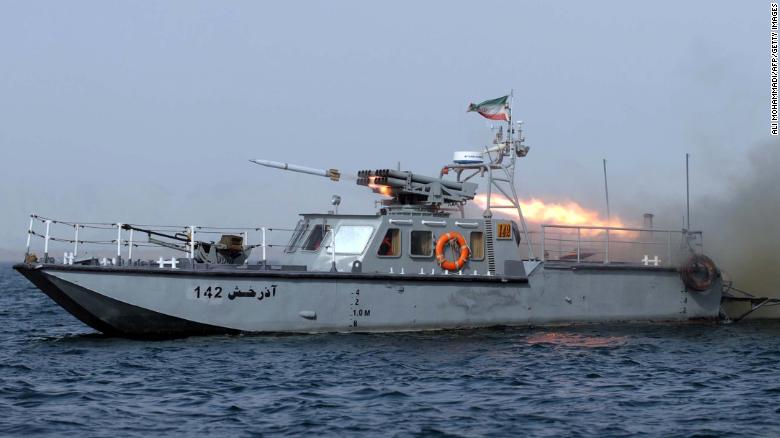
Iran is in full control of the Persian Gulf and the Strait of Hormuz, a top Iranian Navy commander said earlier. “The naval forces of the Army are prepared to defend the waters with their intelligence dominance and monitoring of the enemy’s physical presence,” Gen. Alireza Tangsiri, chief of the Islamic Revolutionary Guard Corps, said. “We have a message to our Muslim neighbors: We have repeatedly stated that we are extending our hand of brotherhood to you and believe that the Persian Gulf is our home for which we can provide security. There is no need for foreigners such as the United States and the countries whose home is not here.”
IRGC Commander Maj. Gen. Mohammed Ali Jafari reinforced Tangsiri’s comments. “The capabilities of this force [the Iranian navy], in terms of technology, tactics and strategies, are up-to-date and geared to the advancement of technologies at the highest level,” Jafari said. “It is natural that the enemy strictly avoids any conflict because it knows that it would end to its detriment.”
The incident marked the first direct Iranian-claimed attack on US assets and came amid heightened tensions, unleashed by US President Donald Trump’s decision last year to withdraw from the JCPOA, an international accord that curbed Tehran’s nuclear programme. Fears of war between the United States and Iran have intensified after these incidents.
The U.S. Navy’s Fifth Fleet is based in the region and protects shipping lanes in the Gulf and nearby waters. The U.S. Navy’s 5th Fleet is deployed in the Persian Gulf, with aircraft carriers, ships and aircraft. The United States also has military personnel stationed in Saudi Arabia, Kuwait, Bahrain and Turkey. Since the conflict during the Iran-Iraq War, known as the Tanker War, the United States has deterred anti-ship mines, missile fires, swarm attacks, and general harassment from Iran.