

Moore’s Law which stated that the number of transistors on a chip will double approximately every two years has been the driver of semiconductor industry in boosting the complexity, computational performance and energy efficiency while reducing cost. The increase in computing performance of electronic computers is becoming more and more difficult, as dimensions approach nano meter ranges. The solution has been using parallel processing with multiple cores. While this has enhanced performance, it has led to the problem of rising energy consumption due to enhanced communications required between these cores and outside components. So much so that the communication on and between chips is now responsible for more than half of the total power consumption of the computer. With data increasing 70% year over year, analysts predict that in a few years, data centers may not have enough electricity to support all of the data storage and transfer.
One of the alternative researchers are considering is optical computing . An optical computer is a computer that performs its computation with photons as opposed to the more traditional electron-based computation. An electric current creates heat in computer systems and as the processing speed increases, so does the amount of electricity required; this extra heat is extremely damaging to the hardware. Photons, however, create substantially less amounts of heat than electrons, on a given size scale, thus the development of more powerful processing systems becomes possible. Optical computers promise to be superfast since light travels at 186,000 miles per second. In a billionth of a second, one nanosecond, photons of light travel just a bit less than a foot, not considering resistance in air or of an optical fiber strand or thin film. The Electronic computers are relatively slow, and the faster we make them the more power they consume,the future optical computers shall also be energy efficient.
The computers we use today use transistors and semiconductors to control electricity but computers of the future may utilize crystals and metamaterials to control light. By applying some of the advantages of visible and/or IR networks at the device and component scale, a computer might someday be developed that can perform operations significantly faster than a conventional electronic computer.
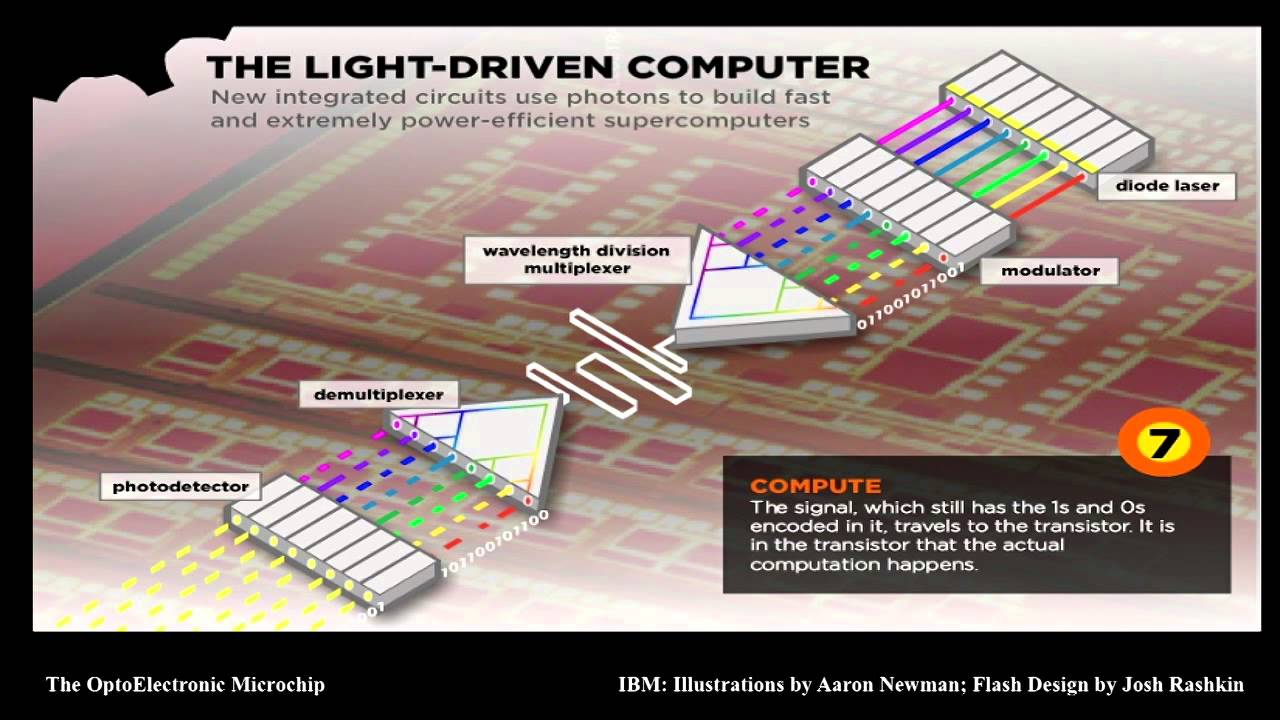
The next generation computers and servers will replace electrical signals on copper lines with optical signals on waveguides. Optical lasers and photodiodes are used to generate and receive the data signal. The chips using transmitters and receivers can communicate with each other optically. Researchers are now trying to use same principle for the communication on a chip–between cores and transistors. In future optics shall not only enhance inter and intra chip communications but also processing by Optical computers.
Optical computing is also promising for Brain like or neuromorphic computing, mimicking the human brain using electronic chips. And in turns out that optics are an excellent choice for this new brain-like way of computing. Research teams are making breakthroughs in the development of photonic computer chips that imitate the way the brain’s synapses operate. This would enable them to execute current machine learning and deep neural learning algorithms with high speed and energy efficient way.
In March 2019, Optalysys announced the FT:X 2000, the world’s first optical co-processor system for Ai computing. It is a really exciting time in optical computing,” said Dr. Nick New, Optalysys CEO and Founder. “As we approach the commercial launch of our main optical co-processor systems, we are seeing a surge in interest in optical methods, which are needed to provide the next level of processing capability across multiple industry sectors. We are on the verge of an optical computing revolution and it’s fantastic to be leading the way.”
The technology that is enabling optical processors and optical computers is silicon photonics. Silicon photonics refers to the application of photonic systems using silicon as an optical medium and yet have low manufacturing costs as a result of using conventional silicon-integrated-circuit processes. The silicon material used in such photonic systems is designed with sub micrometer precision and is deployed into the microphotonic components. Silicon photonics combines technologies such as complementary metal oxide semiconductor (CMOS), micro-electro-mechanical systems (MEMS) and 3D Stacking.