
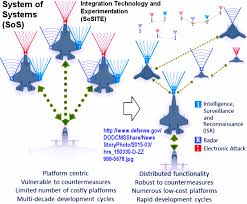

Historically, the United States has built its military capabilities on highly capable, multi-function platforms. These platforms have been expensive and have had long development times, but have incorporated sophisticated military technologies that potential adversaries have not had the ability to access or counter. This strategy has been highly successful, leading to a long period of U.S. air dominance.
However, the globalization of technology has made this strategy increasingly unsustainable. Potential adversaries are now able to access advanced technologies with relative ease and incorporate them quickly into military systems—sometimes accomplishing multiple upgrades during a U.S. weapon system’s development and acquisition period.
The adversaries are also advancing “anti-access / area denial” capabilities by employing ballistic and cruise missiles, submarines, air defenses and counter-maritime forces against American forces and keep them away from thousands of miles of coastline.
DARPA has initiated System of Systems (SoS) Integration Technology and Experimentation (SoSITE) program whose goals are to: develop SoS architectures to maintain U.S. air superiority in contested environments; demonstrate rapid integration of mission systems into existing and new architectures; and demonstrate the combat effectiveness and robustness of those architectures.
“It can take decades and cost billions of dollars to field or upgrade advanced airborne systems today,” said Nils Sandell, director of DARPA’s Strategic Technology Office (STO). “As a result, the modernization of subsystems in these complex platforms has not kept pace with the rapid advances in commercial technology. A system-of-systems approach could help overcome this inherent issue with high-cost, monolithic, multi-function platforms.”
“Autonomy, manned-unmanned teaming, the ability of dissimilar systems to connect together in a larger self-forming, self-healing network is going to be critical,” said John Hobday, Raytheon’s business development lead for advanced naval systems concept development and missile systems.
“To operate against adversaries with precision-guided weapons, the U.S. needs to disperse its forces, disaggregate its capabilities, confuse enemy sensors through decoys and deception, and swarm enemy defenses with large numbers of expendable assets,” says Paul Scharre, Senior Fellow and Director 20YY Future of Warfare
Lockheed Martin and the Defense Advanced Research Projects Agency (DARPA) recently performed a series of flight tests demonstrating how a system of systems (SoS) approach enables seamless – and rapid – integration across air, space, land, sea and cyber in contested environments.