

The U.S. Defense Advanced Research Projects Agency (DARPA) and British defense firm BAE Systems have developed a new lightweight, handheld tactical sensor that lets U.S. soldiers easily detect and identify enemy electronic jammers on the battlefield.
During Recent ongoing Syrian conflict Russia has demonstrated many advanced weapons, one of which were advanced electronic warfare systems. U.S. Air Force Gen. Philip Breedlove, commander of U.S. European Command told the House Armed Services Committee: “They [Russians] have invested a lot in electronic warfare because they know we are a connected and precise force and they need to disconnect us to make us imprecise.” During his testimony, Breedlove admitted that the Pentagon had neglected electronic warfare during the past two decades—which has allowed the Kremlin to gain an advantage.
Recently, the Pentagon seems to be refocusing on electronic warfare. The vice-chairman of the Joint Chiefs of Staff is mulling the possibility of designating the electromagnetic spectrum as a warfighting domain—like the air, sea or land. DARPA’s Computational Leverage Against Surveillance Systems (CLASS) program seeks new ways to protect their signals from increasingly sophisticated adversaries and to do so in a way that can be maintained as technology advances. The objective of the CommEx is to enhance the communication of friendly forces within a congested jamming environment by suppressing enemy jamming with “adaptive interference suppression”
The objective of the program is to make modular communications technology that is inexpensive to incorporate in existing and emerging radio systems (<$100 incremental cost) but pushes adversaries to need more than 1,000x our processing power – “supercomputer” level processing power.
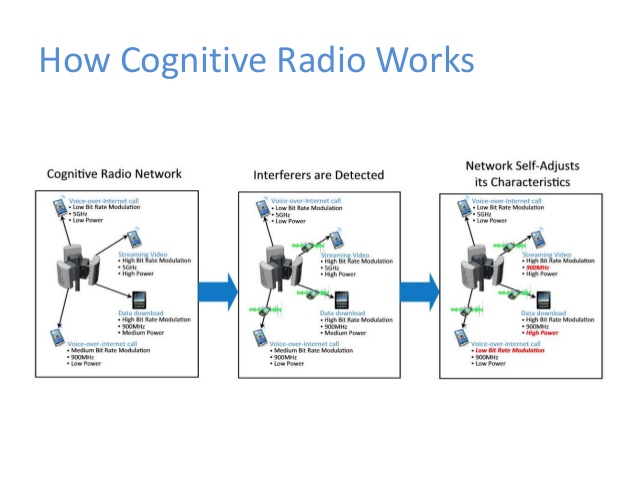
The aim is to develop cognitive system that is aware of its external environment and internal states, such as the electromagnetic/signal environment in the case of cognitive RF systems, and can autonomously decide and adjust its behavior to optimize quality of service or other operational objectives. Signal parameters of interest include modulation schemes, signal constellations, multiple access or hopping schemes, channel utilization and demodulated symbols.
DARPA envisions that this goal will be achieved by investigating and developing novel RF, analog and mixedsignal integrated circuit architectures and design techniques. The goal of CLASIC is to enable monolithic, high performance, ultra high energy efficiency, signal recognition integrated circuits (ICs) for next-generation military microsystems in areas such as cognitive communications, radar and electronic warfare.
DARPA awarded CommEx contracts to BAE Systems Company in 2011 to develop adaptive communication technologies under intense jamming, which blocks the RF receivers of military aircraft. The company worked on the project until 2015, when it demonstrated the benefits of the CommEx in a laboratory environment .Currently, the test and demonstration phase is nearly finalized. The CommEx technology is planned as an upgrade to the Link 16 air-to-air data-exchange network, which is used by several nations, According to DARPA, the CommEx will fix the vulnerability of the Link 16 network to enemy jamming. If the program passes the testing phase, the CommEx will be installed on aircraft to upgrade the Link 16 network.