

The United States armed forces expect to encounter a variety of military operations in the future that are unconventional in nature. Known as Military Operations Other Than War (MOOTW) they include such things as peacekeeping, humanitarian relief, covert operations, and hostage rescue.
The unconventional threats is further enhanced as cities have become the new battleground and Urban Warfare new warfare model, from Iraqi-led coalition forces fighting ISIS, Boko Haram is carrying out its urban terror campaign against the Nigerian Army and its allies, to Afgan security forces carrying gun battles in heavily populated areas in fighting Taliban. Indian Armed Forces and Jammu and Kashmir Police are facing Stone Pelting in Kashmir that refers to criminal rock throwing by Kashmiri youth who pelt, bombard or throw stones on them. Recently in US law enforcement agencies responded to protests formed after the death of George Floyd in Minneapolis on May 25, many are turning to weapons other than firearms to disperse crowds.
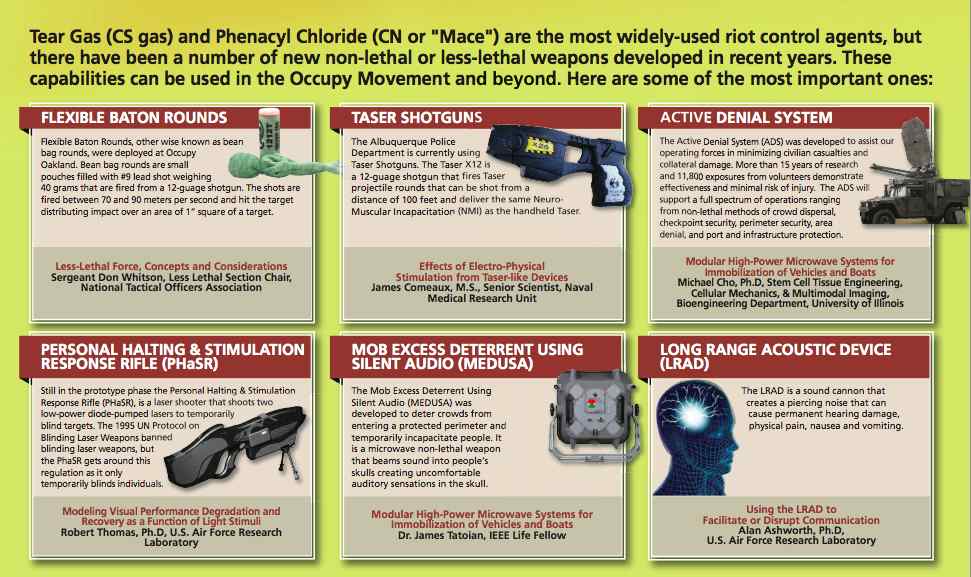
To better arm our soldiers for these type of conflicts, the military is currently pursuing an agenda of developing non-lethal weapons that incapacitate the threat instead of killing them. The security forces fighting urban warfare desire scalable effect weapons for personal incapitation, that subdue and/or incapacitate ( not kill) single or multiple targets in closed or open environments. Weapons are also required for vehicle interdiction that could stop/disable moving vehicle, up to high rates of speed, without harming vehicle occupants. Such weapons are also called Non lethal Weapons.
The US Department of Defense (DoD) defines non-lethal weapons (NLWs) as weapons, devices, and munitions that are explicitly designed—and primarily employed—to immediately incapacitate targeted personnel or materiel, while minimizing fatalities, permanent injury to personnel, and undesired damage to property in the target area or environment.
Non-lethal weapons fill gaps between verbal warnings and lethal force. Security forces use these non-lethal weapons to deter hostile crowds. They have been urgently needed and used by U.S. forces in Somalia, Kosovo, Iraq, Afghanistan, and Haiti. They have been found useful in disaster management like in the aftermath of the 2010 Haiti earthquake, where non-lethal weapons were used when riots occurred at food distribution sites. The need for non-lethal weapons is also increasing for the maritime environment where terrorists used small boats as the asymmetric weapon of choice, indistinguishable in heavily trafficked littorals.
Australian police recently have been provided with non lethal weapons that include semiautomatic rifles that fire marbles or capsicum rounds, stinger grenades that release rubber pellets when they explode in crowds and guns that fire rubber balls designed to strike at a distance of 50m with the force of a hard punch.