

The US Navy is concerned about the survivability of Navy surface ships in potential combat situations against adversaries, such as China, that are armed with large numbers of missiles, including advanced models, and large numbers of UAV. In response, the Navy surface evolved a new organizing for the Navy’s surface fleet called distributed lethality. Under distributed lethality, offensive weapons such as anti-ship cruise missiles (ASCMs) are to be distributed across a wider array of Navy surface ships, and new operational concepts for Navy surface ship formations are to be implemented.
The aim of distributed lethality is to boost the surface fleet’s capability for attacking enemy ships and make it less possible for an enemy to cripple the U.S. fleet by concentrating its attacks on a few very high-value Navy surface ships (particularly the Navy’s aircraft carriers), according to Congressional Research Service Report.
“Although Navy surface ships have a number of means for defending themselves against anti-ship cruise missiles (ASCMs) and anti-ship ballistic missiles (ASBMs), some observers are concerned about the survivability of Navy surface ships in potential combat situations against adversaries, such as China, that are armed with advanced ASCMs and with ASBMs,” observes CRS report: Navy Lasers, Railgun, and Hypervelocity Projectile: Background and Issues for Congress.
Three new ship-based weapons being developed by the Navy—solid state lasers (SSLs), the electromagnetic railgun (EMRG), and the gun-launched guided projectile (GLGP), also known as the hypervelocity projectile (HVP)—could substantially improve the ability of Navy surface ships to defend themselves against surface craft, unmanned aerial vehicles (UAVs), and eventually antiship cruise missiles (ASCMs).
The Navy since 2005 has been developing EMRG, a cannon that uses electricity rather than chemical propellants (i.e., gunpowder charges) to fire a projectile. In EMRG, “magnetic fields created by high electrical currents accelerate a sliding metal conductor, or armature, between two rails to launch projectiles at [speeds of] 4,500 mph to 5,600 mph,” or roughly Mach 5.9 to Mach 7.4 at sea level. As the Navy was developing EMRG, it realized that the guided projectile being developed for EMRG, which weighs about 23 pounds, could also be fired from 5-inch and 155mm powder guns.
Gun-launched guided projectile (GLGP), previously known as the hypervelocity projectile (HVP) is the new weapon of US Navy that could improve the ability of Navy surface ships to defend themselves against missiles, unmanned aerial vehicles (UAVs), and surface craft.
When fired from 5-inch powder guns, the GLGP projectile achieves a speed of roughly Mach 3, which is roughly half the speed it achieves when fired from Electro Magnetic Rail Guns (EMRG) , but more than twice the speed of a conventional 5-inch shell fired from a 5-inch gun. This is apparently fast enough for countering at least some ASCMs. Their impact force—their mass times the square of their velocity—can destroy expensive missiles and multiple warhead.
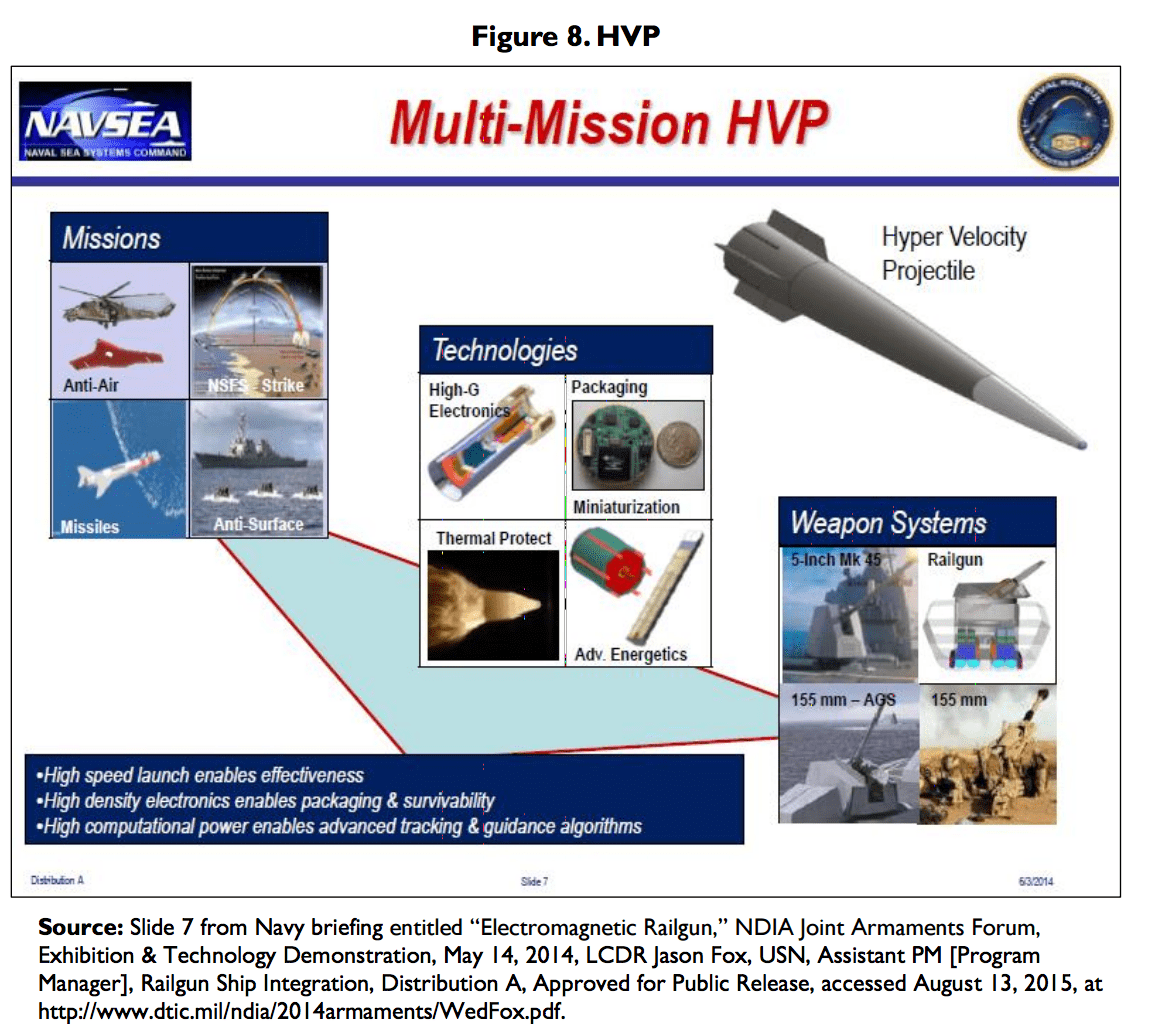
The Navy described HVP in September 2012 as is a next generation, common, low drag, guided projectile capable of completing multiple missions for gun systems such as the Navy 5-Inch, 155-mm, and future railguns. Types of missions performed will depend on gun system and platform. HVP’s low drag aerodynamic design enables high velocity, maneuverability, and decreased time-to-target. These attributes coupled with accurate guidance electronics provide low cost mission effectiveness against current threats and the ability to adapt to air and surface threats of the future.
The Navy states that “The HVP—combined with the MK 45 [5-inch gun] —will support various mission areas including naval surface fire support, and has the capacity to expand to a variety of anti-air threats, [and] anti-surface [missions], and could expand the Navy’s engagement options against current and emerging threats.”
The weapons are not only devastating in their speed, but at $86,000 per round are much cheaper than their explosive counterparts such as the Tomahawk or Harpoon, which can cost up to $1 million each. It is also cheaper compared with precision ammunition $800,000 to $1 million per Long Range Land Attack Projectile (LRLAP) round. “It is a fantastic program,” Will Roper, Strategic Capabilities Office director, said in a March 28 interview with reporters, who said the project aims “to completely lower the cost of doing missile defense” by defeating missile raids at a lower cost per round and, as a consequence, imposing higher costs on attackers.
“If you do that, you change every 155 [mm] howitzer in the U.S. Army in every NATO country into a cruise missile and tactical ballistic missile defender and, oh by the way, you extend their offensive range,” [Deputy Secretary of Defense Robert] Work said.
A May 19, 2017, press report states: An Army Howitzer is now firing a super high-speed, high-tech, electromagnetic Hyper Velocity Projectile, initially developed as a Navy weapon, an effort to fast-track increasing lethal and effective weapons to warzones and key strategic locations, Pentagon officials said.