

The prime aim of US third offset strategy, announced in November 2014, was to develop effective strateges against multiple potential competitors, from small regional states like North Korea and Iran, to large advanced states like Russia and China, to non-state adversaries and actors with advanced capabilities. In response to third offset strategy DARPA has launched several programs to enhance human-machine collaboration technologies apart from A-Teams such as Resilient Synchronized Planning and Assessment for the Contested Environment (RSPACE), Collaborative Operations in Denied Environment (CODE), Distributed Battle Management (DBM), System of Systems Integration Technology and Experimentation (SoSITE), and others.
Modern military operations are dynamic and complex—requiring, for example, that infantry squads carry out their missions simultaneously in the 3-dimensional physical world, the cyber domain, and across the electromagnetic spectrum. Similarly, complexity and tempo are challenges to team operations in other applications including scientific and drug discovery, software engineering, logistics planning, advanced hardware engineering, and intelligence forecasting. Problem solving in these complex environments exceeds the capability of any individual operator and is addressed using teams. Simultaneously, autonomy and artificial intelligence are increasingly being utilized to augment and automate operations executed by teams in these environments such as command and control/battle management or cyber/electronic warfare operations.
US DOD is considering Human-machine collaboration for these complex and dynamic environments. Human-machine collaboration, specifically the ways machines can help humans with decision-making.Deputy Secretary of Defense Bob Work said that these teams up human insight with the tactical acuity of computers by allowing machines to help humans make better, faster decisions. Pairing the two will combine the ability of humans to think on the fly with the quick problem-solving methods of artificial intelligence. Work pointed to the advanced helmet on the F-35 joint strike fighter, which fuses data from multiple systems into one layout for the pilot.
US military is also employing artificial intelligence to asist operations by forming manned unmanned teams that is much more than the sum of its parts. Some examples are armed drones that fly alongside manned fighters as expendable “loyal wingmen” or scout ahead of human soldiers, AI targeting systems that line up shots for human gunners, and a host of virtual staff officers that do the organizational grunt work on everything from maintenance schedules to strike planning.
But if soldiers are going to rely on AI in battle, they will need to trust that the AI is capable of performing the mission, and that they will be able to communicate with the AI to change plans as circumstances change. This is the heart of the Adaptive Distributed Allocation of Probabilistic Tasks, or ADAPT, a $1 million contract DARPA awarded to Aptima, a Woburn, Mass.-based engineering firm in 2020. To explore this kind of human-bot collaboration, Aptima is working on a testing environment that is entirely virtual and familiar to many: Minecraft. “Teams of humans that are going to be doing some work in Minecraft and getting advised by this AI model,” said Adam Fouse, Aptima’s ADAPT Program Manager.
The goal is to find a way for humans to communicate information to an AI agent that the AI itself might not have, perhaps because it lacks the sensors to perceive it, perhaps simply because it’s in a different place. Likewise, said Fouse, the AI needs to be able to “communicate back to humans in ways that are efficient and useful, so they can understand at a glance kind of the insights of the AI.”
“ADAPT will take a significant step forward in human-AI collaboration so warfighters and intelligent technology can reason and work together to make better, faster decisions than either could do on their own,” Dr. Adam Fouse, Aptima’s ADAPT program manager, said in a statement. “By learning from its human counterparts, taking into account their goals, preferences and constraints, these more informed agents can guide AI in forecasting, creating and adapting action plans as missions evolve.” In a search-and-rescue scenario, for example, these advanced AI models and agents will think through millions of possible scenarios for commanders to choose the best plan, minimizing casualties and risks.
“Humans excel at learning from one another but can only process so much incoming information. AI, on the other hand, has incredible computational abilities but needs to learn from and communicate with humans in order to be used effectively in dynamic team situations,” Fouse explained. “These combined attributes will elevate a commander’s expertise and decision-making in fast-changing, information-intensive environments so they can respond, and adapt quickly, while considering future possibilities.” ADAPT will collect and analyze huge influxes of data for humans, optimize strategy and reallocate assets on the fly, according to the release. It is linked to two other DARPA programs: Agile Teams (A-Teams), which is also under the contract with Aptima, and Artificial Social Intelligence for Successful Teams (ASIST), where Aptima is priming the evaluation effort.
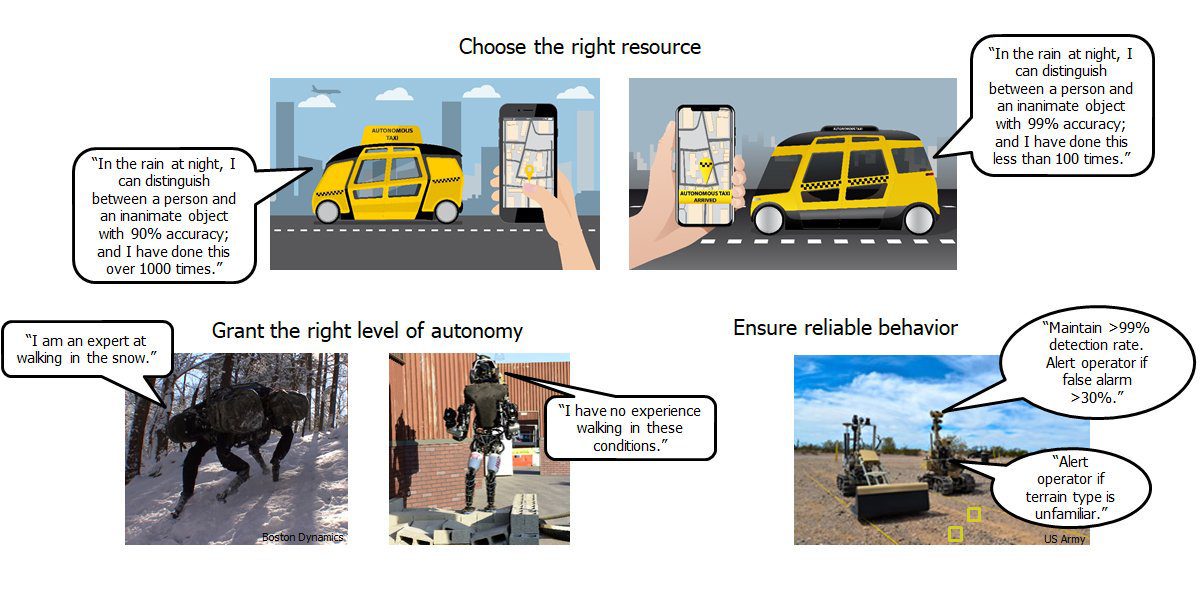
In order to transform machine learning systems from tools into partners, users need to trust their machine counterpart. One component to building a trusted relationship is knowledge of a partner’s competence (an accurate insight into a partner’s skills, experience, and reliability in dynamic environments). While state-of-the-art machine learning systems can perform well when their behaviors are applied in contexts similar to their learning experiences, they are unable to communicate their task strategies, the completeness of their training relative to a given task, the factors that may influence their actions, or their likelihood to succeed under specific conditions.
DARPA launched Competency-Aware Machine Learning (CAML) program in 2019 that addresses this challenge by enabling learning systems to be aware of their own competency. Systems will have knowledge of their learned abilities, the conditions under which those abilities were learned, knowledge of their resultant task strategies, and the situations for which those strategies are applicable.
A challenge in designing human-machine systems, however, is determining how best to meld human cognitive strengths and the unique capabilities of smart machines to create intelligent teams adaptive to rapidly changing circumstances.
To address this challenge, DARPA announced the Agile Teams (A-Teams) program in 2016, which sets out to discover, test, and demonstrate predictive and generalizable mathematical methods to enable optimized design of agile hybrid teams. A-Teams seeks to fundamentally challenge the current paradigm of human-intelligent machine systems design by changing the focus from simply using machines for automation and substitution of human capacity to an integrated fabric enabling superior collective problem solving.