

Blockchain is a transformative technology for the two billion people in the world currently underserved by financial institutions. The technology has the potential to enhance privacy, security and freedom of conveyance of data. Blockchain is based on open, global infrastructure, decentralized public ledger of transactions that no one person or company owns or controls, ensures security of transfer of funds through public and private cryptology and third parties to verify that they shook, digitally, on an agreement. Blockchain is set to play a key role in many sectors in the future, including digital finance, Internet of things, artificial intelligence and 5G.
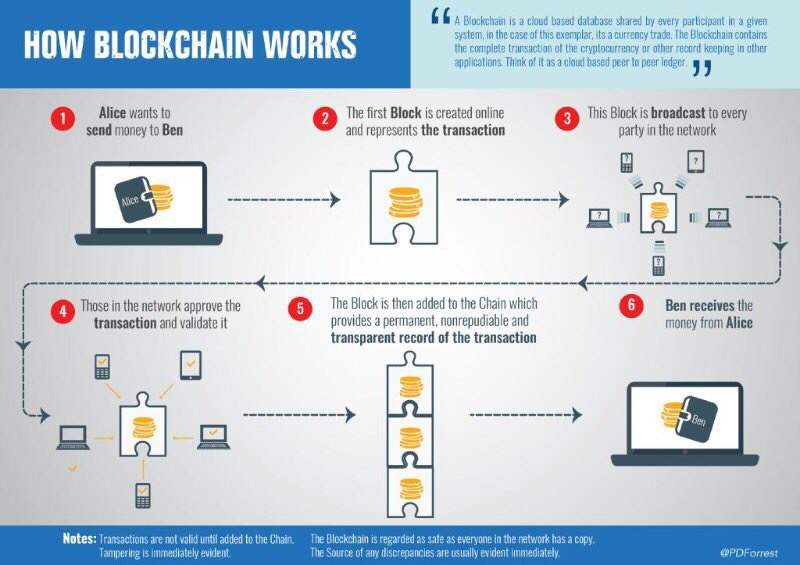
With a blockchain, many people can write entries into a record of information, and a community of users can control how the record of information is amended and updated. However, the most distinct and important feature of blockchain technology is the distributed database created by it. In the case of a blockchain, transactions are broadcast, and every node is creating their own updated version of events , with the most popular record becoming the de-facto official record in lieu of there being a master copy.
Blockchain, which is an extremely secure linked chain of digital information, has allowed private groups to create cryptocurrencies, with decentralised control among the users and no central authority to control its issuance. Facebook chief executive Mark Zuckerberg had to defend his plans to launch a digital coin called Libra to the US Congress in October, after it faced a torrent of criticism from all sides, including governments who see it as a threat to their monetary sovereignty. “I don’t think Libra will succeed,” Mr Huang Qifan, vice-director of the China Centre for International Economic Exchanges, an economic think-tank that advises Beijing, said last week in remarks widely reported by state media. The People’s Bank of China, though, has been a frontrunner in research into the technology and its use in creating a national digital currency.
Some countries including Venezuela, Iran, Russia, and China – are experimenting with cryptocurrency technology as they seek to render their economies immune to crippling US sanctions. According to the FDD – while they are exploring the development of their own state-backed crypto – China, Iran, and Venezuela also restricted access to the public cryptocurrencies that are currently available on the market. According to the FDD, Russia seeks to lessen the impact of US sanctions by focusing on blockchain technology and including it as a long-term national security and economic goal.
With the goal of facilitating trade and investment outside the grip of the United States, Russian financial institutions are running multiple blockchain pilots. The country’s Ministry of Finance is also planning to develop a regional crypto with other members of the Eurasian Economic Union (EAEU). As Iran has been hit hard by sanctions – bringing its crude oil export to a historic low – the country’s government is looking to create an alternative to SWIFT.
China has launched an ambitious effort to challenge the US dominance in blockchain technology, which it could use for everything from issuing digital money to streamlining a raft of government services to tracking Communist Party loyalty. The technology received a crucial endorsement from President Xi Jinping in Nov 2019, a signal that the government sees blockchain as an integral part of the country’s plan to become a high-tech superpower. Beijing is the latest in a handful of countries to have adopted a law strictly governing the encryption of data, particularly blockchain technology, which allows the storage and direct exchange of data without going through an intermediary.
In addition to its state-backed crypto development, the People’s Bank of China (PBOC) and Chinese authorities are researching blockchain’s use for credit, finance, and real estate projects, as well as a blockchain-powered securities trading platform
The People’s Daily, the mouthpiece of the ruling Communist Party, renewed its warning this week on the dangers of blockchain-based crypto asset speculation. “Blockchain is still in the early stages of development, and needs to be improved in terms of safety, standards, regulation and so on. The major direction is not wrong, but we must avoid a rush, and redundancy and have orderly competition,” said an editorial published in Nov 2019.
The same technology used for virtual currencies is now being researched by the Department of Defense to create tamper-proof military computer systems, including those systems used to control America’s nuclear weapons. The Department of Defense also looking to blockchain for development of a secure messaging system that would use the standard encryption and security features of current messaging apps such as WhatsApp, Signal, or Ricochet, but also use a decentralized Blockchain-like backbone structure that would be more resilient to surveillance and cyberattacks.
The U.S. Navy is concerned about vulnerability of its supply chain due to compromised parts and systems production for its warships. According to Richard Spencer, the U.S. Navy’s top civilian contractors have been reduced to relying on political adversaries like China and Russia for the production of these components. For example, China’s Belt to Road initiative creates debt structures in developing countries. However, this could lead to unhelpful levels of control over manufacturers in those nations.
US Navy is considering Blockchain for making its supplychain secure. Blockchain delegates access to information to the holders of private keys. A blockchain that protected the information and limited access only to private key holders would offer complete security for governmental data. Blockchain technology could also help to protect parts and limit any kind of tampering in the manufacturing and transportation processes. By stamping each individual component with its own key, each movement would be logged as an immutable transaction. The result would be complete data certainty over multiple venues.