
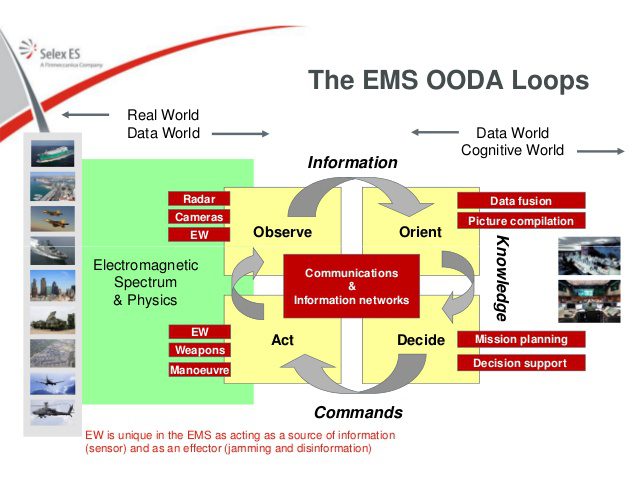

Electronic warfare provide means to counter adversary’s radar and communication systems while protecting one’s own systems through Electronic Attack (EA), Electronic Protection (EP) and Electronic Support (ES). Jamming systems still rely on classified databases of known emitter signals. As radars emit energy, an onboard receiver characterises the incoming signal and and compares it against the database of threats. If there’s a match, the system develops a pre-determined countermeasure that can be used to jam that signal.
Current airborne electronic warfare (EW) systems must first identify threat radar to determine the appropriate preprogrammed electronic countermeasure (ECM) technique. This approach loses effectiveness as radars evolve from fixed analog systems to programmable digital variants with unknown behaviors and agile waveforms. Future radars will likely present an even greater challenge as they will be capable of sensing the environment and adapting transmissions and signal processing to maximize performance and mitigate interference effects.
Current electronic warfare techniques are still very similar to the original ones created in the Vietnam era, even as the systems have become more advanced, said Yiftach Eisenberg, deputy director of the Defense Advanced Research Projects Agency’s microsystems technology office. Essentially, the military’s approach has been to study enemy systems for vulnerabilities, figure out ways of disrupting them and then building a “playbook” filled with different EW tactics. “That approach has worked well for us in the past when the adversaries systems were relatively stable,” in other words, when it took enemies years to develop analog sensors and communication systems, he said.
In recent years, however, there has been a “fundamental shift” to systems that are digital and reprogrammable in nature, and thus can adopt different frequencies, signal characteristics and waveforms to avoid being jammed. “We need to have the ability to respond to new threats, new waveforms that those systems are using that we haven’t anticipated,” Eisenberg said. “If things are changing quickly, then we need systems that can respond in similar timeframes to enable us to protect our aircraft.” “People do a lot of low-stakes applications of machine learning and artificial intelligence, but that is very different from our world where lives are on the line,” Tranquilli technical director for signals and communications processing at BAE says. “That’s one of the big things we have to work through is bringing new capability in without bringing risks based on the ability to adapt and be cognitive.”
Similarly communication systems are also evolving from software defined radios to cognitive radios. Software defined radios allow one to program the waveforms from traditional waveforms to new waveforms that can enable voice, video and data communications. The cognitive radios are aware of their internal state and environment and can use computer intelligence to automatically and invisibly adapt themselves to the user needs and band conditions.
Now US DOD is planning to employ AI and machine learning methods to develop adaptive and cognitve EW technology which would be able to take countermeasures against these dynamic threats. With AI, intelligent machines work and respond much like humans. Machines can therefore perform smarter tasks using capabilities like signal recognition. Machine learning takes AI one step further, allowing machines to continuously learn from data and adapt as a result. These computers learn over time at a very rapid rate. Threats using machine learning continue to learn from every conflict, determining ways to be more effective so that they prevail against future countermeasures.