

Service members are subject to extreme physical injury and mental stress. Wounded soldiers often experience substantial pain, which must be addressed before returning to active duty or civilian life. Pain represents a serious and widespread problem both over the short term for wounded soldiers on the battlefield and during rehabilitation, and over the long term for many veterans. The prevalence of certain conditions associated with the development of chronic pain, including traumatic brain injury and post-traumatic stress disorder (PTSD), is higher among military veterans than among the general civilian population. PTSD is a condition in which individuals feel anxiety and panic when reminded of a traumatic event.
US Military therefore implements measures to research pain in wounded soldiers and veterans, and to improve the management of acute pain resulting from combat-related injuries and surgery, and the management of chronic pain in veterans. By providing adequate analgesia, military health care services aim to provide immediate control of pain and restore function, as well as to reduce the risk of developing complications associated with under-managed pain, which may be serious and require extended care. Improvement of acute pain management for combat-related injuries in the military has largely focused on determining which pain control methods can be readily administered and provide adequate pain relief during immediate field hospital care, transport and subsequent care at military treatment facilities.
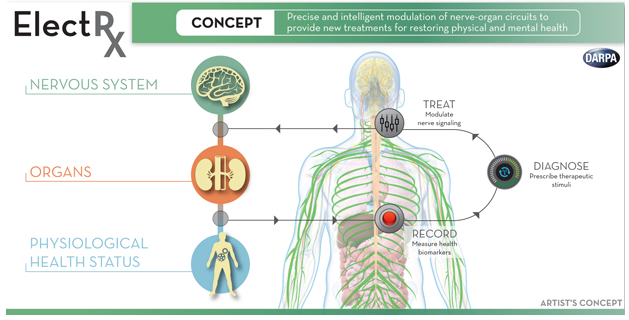
DARPA’s BTO is developing capabilities to better prepare warfighters for their missions by improving readiness and resilience, and creating technologies to restore function to injured warfighters when necessary. DARPA launched Electrical Prescriptions (ElectRx) program in 2015, a blanket program for a diverse range of research being conducted in using electrical stimulation of the peripheral nerves to treat conditions such as chronic pain, inflammation, and post-traumatic stress disorder (PTSD).
ElectRx seeks to deliver non-pharmacological treatments for pain, general inflammation, post-traumatic stress, severe anxiety, and trauma that employ precise, closed-loop, non-invasive modulation of the patient’s peripheral nervous system. “Much like a thermostat monitors, an ElectRx device would monitor and recognize when the system is moving away from homeostasis and into a diseased state. Eventually, a regulator would provide therapeutic stimulus, then a modulator would signal nerves,” Wu said
“The peripheral nervous system is the body’s information superhighway, communicating a vast array of sensory and motor signals that monitor our health status and effect changes in brain and organ functions to keep us healthy, “said Doug Weber, the ElectRx program manager and a biomedical engineer who previously worked as a researcher for the Department of Veterans Affairs. “We envision technology that can detect the onset of disease and react automatically to restore health by stimulating peripheral nerves to modulate functions in the brain, spinal cord and internal organs.”
“Through the combination of a growing understanding of how the nervous system regulates many aspects of our health and advancing technology to measure and stimulate nerve signals, I believe we’re poised to make fundamental changes to the way we diagnose and treat disease,” Weber said. “To that end, DARPA has assembled a performer team and outlined a research way-ahead that we anticipate can move us toward a capability to safely and reliably modulate the peripheral nervous system to fight disease.”
The Electrical Prescriptions (ElectRx) program aims to support military operational readiness by reducing the time to treatment, logistical challenges, and potential off-target effects associated with traditional medical interventions for a wide range of physical and mental health conditions commonly faced by our warfighters. However, DARPA’s goals go beyond treatment and into prevention. “We envision technology that can detect the onset of disease and react automatically to restore health by stimulating peripheral nerves to modulate functions in the brain, spinal cord and internal organs.”
“Using the peripheral nervous system as a medium for delivering therapy is largely new territory and it’s rich with potential to manage many of the conditions that impact the readiness of our military and, more generally, the health of the nation,” Weber said. “It will be an exciting path forward.”
In 2018, DARPA announced that following successes in early proof-of-concept studies, the ElectRx devices and therapeutic systems under development are entering into clinical studies. If successful, such precise neuromodulation capability technology would reduce dependence on traditional drugs and create new treatments that could be automatically and continuously tuned to the needs of warfighters without side effects. The technology could also help doctors evaluate and predict various physiological states, and characterize host response in patients with severe infections, providing a quantitative framework to guide operations and therapy.