
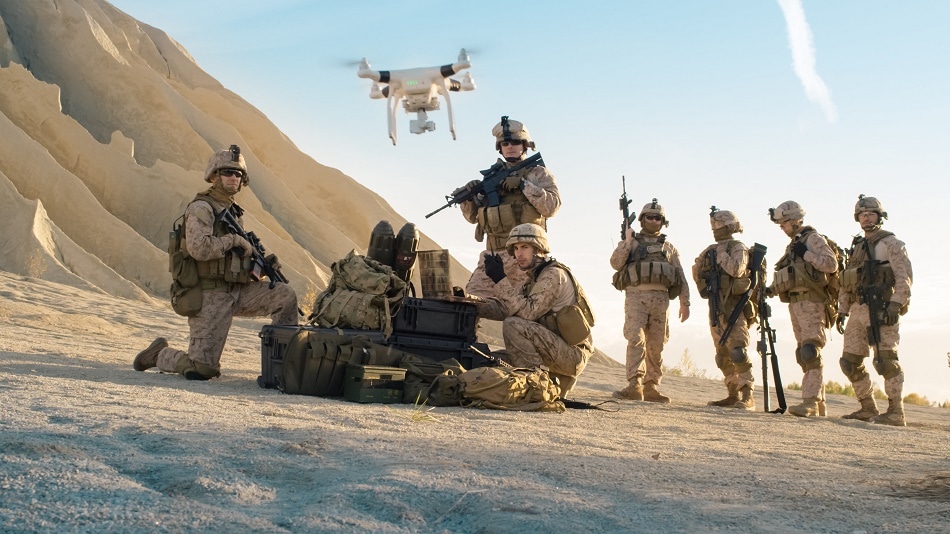

Large UAVs, such as Global Hawk, General Atomics MQ-9 Reaper, and predecessor MQ-1 Predator have already become indispensable to modern militaries in providing intelligence, near-real-time reconnaissance and surveillance to commanders, and offering warfighters greater battlespace awareness. They have proven effective in electronic combat support, battle damage assessment, and even in national security operations like border surveillance, low-intensity conflict, and guerilla / terrorist warfare.
Militaries are now employing Micro, Mini & Nano UAVs into their operations. People classify them by size, range and endurance, and use a tier system that is employed by the military. Weight categories : Nano – Less than or equal to 250 gms. Micro – more than 250 gms to 2 kgs. Small – more than 2 kgs to 25 kgs. Medium – more than 25 kgs to 150 kgs. Large – More than 150 kgs.
US military as part of a new Army program “Soldier Borne Sensors” plans to deploy tiny pocket-sized drones to the battlefield. These sensors will come in the form of that can be deployed in seconds to survey the surrounding area. U.S. Marine Corps special operations teams are already started using modified Black Hornet by 2015. The Black Hornet Nano is a military micro unmanned aerial vehicle (UAV) developed by Prox Dynamics AS of Norway, and in use by the Norwegian and British Army. Prox Dynamics delivered a PD-100, an upgraded version of black Hornet with enhancements like reconfiguring the data-link, giving it night vision, and improving navigational capability. In December 2016, Prox Dynamics was acquired by FLIR Systems in a deal worth US$134M.
In July 2020, Pro-regime social accounts claimed that Syrian troops recovered the Black Hornet near the town of Tal Tamr in the country’s northeastern Al Hasakah Governorate, which borders Turkey to the north and Iraq to the south. It’s not clear who was operating the drone in Syria before the Syrian troops captured it, but last year the U.S. Army began issuing Black Hornet 3s to various units.
Black Hornet micro UAV have been employed in Afganistan by UK’s soldiers to fly into enemy territory and take video and still images before returning to the operator. Designed to blend in with the muddy grey walls in Afghanistan, and capable of flying for 20 minutes on quiet electric motors, it has been used to look around corners or over walls and other obstacles to identify any hidden dangers and enemy positions.
The Australian Army is planning to equip every combat platoon with PD-100 Black Hornet micro-unmanned aerial vehicles (UAVs) and each combat team with RQ-12 Wasp mini-UAVs, the service’s head of land capability has indicated. The PD-100 is already in use by the Norwegian, British and German Armed Forces. The fact that it is small enough to fit into the hand of most soldiers means that it can be used very discreetly allowing troops to spy on potential threats to military personnel by offering intelligence, surveillance and reconnaissance support during critical mission operations.
The Australian Army (AA) will soon roll out the PD-100 Black Hornet Personal Reconnaissance System (PRS) across one of its brigades in Brisbane, the Department of Defence (DoD) in Canberra announced. “UASs are a game-changer for the army, providing enhanced situational awareness for better mission execution for Australian soldiers,” said the brigadier, adding that the rollout of these micro UASs to AA soldiers is an “exciting example of adopting tactical robotic technology”. It was developed initially in Norway by Prox Dynamics AS, whom were acquired by FLIR in 2016 for £134m.
Nano drones have become a major military tool over the past few years, and the most recent announcement (June 2020) of FLIR Systems being awarded an additional $20.6 million contract for their Black Hornet 3 Personal Reconnaissance Systems (PRS) by the U.S. Army is one big example of that. FLIR Systems Inc. will supply the US Army with its next-generation nano drone, the company recently announced. This extremely light and nearly silent drone can fly up to 25 minutes, and provide many military advantages in combat. With this second contract, FLIR Systems will be providing the service with additional miniature reconnaissance drones as part of the ongoing soldier-borne sensor program, National Defense reports.
Originally, FLIR Systems was awarded a $39.7 million contract with the service in January 2019 to supply the Black Hornet 3s. Those systems are currently being delivered for fielding as part of the Soldier Borne Sensor program. Flir said the army has signed up to use the Black Hornet version 3, which it says has the ability to navigate GPD-denied environments, which allows the drone to maintain situational awareness. It includes threat detection and surveillance ‘no matter where the mission takes them’.
The British army has been using the device for about a year and it has reportedly gone down well with the troops. ‘It allows them to do things they couldn’t do before,’ said Prior. ‘If I was a grunt on the frontline and my platoon sergeant said “that house over there, we’re going to kick the door down and see who’s inside”, instead I could fly my UAV over the compound and have a look around first just to see if anyone’s waiting for me.’
In addition to the U.S. Army, the Australian, French, Canadian and Norwegian militaries will also be equipped with the Black Hornet 3, Aguirre said. The Army, Navy, Marine Corps and Air Force, along with 30 other countries have used Black Hornet variants in the past, he added.