

In an Aug. 17 memorandum from Mick Mulvaney, director of the Office of Management and Budget, and Michael Kratsios, deputy assistant to the president in the Office of Science and Technology Policy, the Trump administration outlines its technology-related research and development priorities for fiscal year 2019.
It calls for Agencies to invest· in R&D that can support the military of the future, including in technologies related to the development of missile defense capabilities, a modern strategic deterrent, hypersonic weapons and defenses, autonomous and space-based systems, trusted microelectronics, and future computing capabilities.
“Agencies should invest in R&D to increase the security and resilience of the Nation’s critical infrastructure from both physical threats and cyber-attacks, which have increased rapidly in number and complexity in recent years,” the memo says. “Special attention should be paid to R&D that can support the safe and secure integration into society of new technologies that have the potential to contribute significantly to American economic and technological leadership.”
In November 2014, then–Secretary of Defense Chuck Hagel announced a new Defense Innovation Initiative, which included the Third Offset Strategy. Hagel said, “This new initiative is an ambitious department-wide effort to identify and invest in innovative ways to sustain and advance America’s military dominance for the 21st century.”
“Adversaries are devising ways to counter our technological over-match. So across the board, we see rapid developments in nuclear weapons, modernization of nuclear weapons; new anti-ship, anti-air missiles; long-range strike missiles; counter-space capabilities; cyber capabilities; electronic warfare capabilities; special operations capabilities that are operated at the lower end. All are designed to counter our traditional military strengths and our preferred way of operating,” said Deputy Secretary of Defense Bob Work.
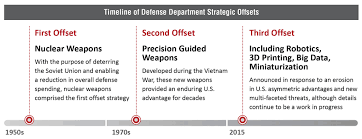
The US’s first Offset strategy was recommended in the 1950’s to counter Soviet conventional superiority with large increase in its nuclear weapons and their delivery systems like bombers, missiles and submarines to provide a credible deterrence even with reduced military budget. The Second Offset took shape in the 1970’s when the US developed precision-guided weapons, night vision devices and stealth technology in response to the Soviet Union’s nuclear parity.
Third Offset will leverage new technologies such as artificial intelligence, autonomous systems and human-machine networks to equalise advances made by the nations opponents in recent years. More than technology the third offset is about architectural innovations and massive changes in doctrine, operations, training and organization. Deputy Secretary of Defense Bob Work said “Offset is about operational and organizational constructs which are ‘enabled’ by new technology but not simply a matter of technology” during Air, Space & Cyber Conference.
Pentagon has dedicated $18 billion in its Future Years Defense Program (FYDP) to researching and developing third offset technologies and operational concepts in the years to come. Money allocated includes $3 billion on researching Anti-Area/Access-Denial (A2/AD) technologies, $3 billion on submarine and undersea challenges, $3 billion on human-machine collaboration and teaming, $1.7 billion on cyber and electronic warfare, $500 million on guided munitions challenges, and $500 million on wargaming and the testing of third offset operational concepts
Air Force Gen. Paul Selva, Vice Chairman of the Joint Chiefs of Staff, said his way of looking at the strategy “isn’t an answer; it’s a question,” comparable to a journey rather than a destination. “But we have to ask the right questions” through experimentation to determine success or failure, then develop doctrine and distribute that doctrine across the joint force and share with allies, and keep refreshing it over time. An example of that would be long-range precision strike at volume across every domain from cyber to undersea, he added.