

Search and Rescue (SAR) is receiving a lot of attention recently due to several high-profile incidents on land, in the air and at sea. Flight MH370 left Kuala Lumpur was bound for Beijing in March 2014 when it disappeared, with 239 people on board. Even after the largest and most expensive search in aviation history, to date, neither any confirmed debris from the aircraft nor any survivors have been found.
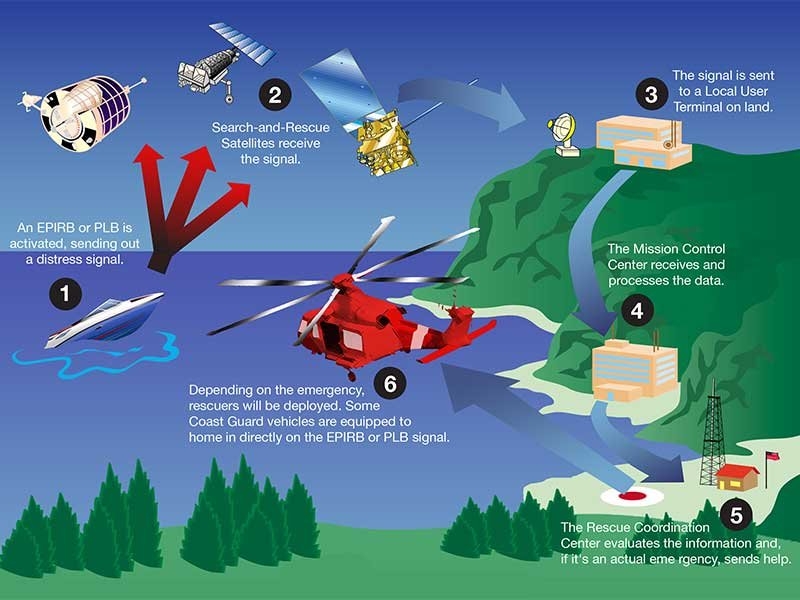
After that incident, because of potential features of the new Cospas-Sarsat system, the International Civil Aviation Organization asked Cospas-Sarsat to work on the Emergency Locator Transmitters (ELT) capabilities, particularly during a distress event in order to avoid future incident like the one of MH370. Cospas-Sarsat, an international, humanitarian satellite based search and rescue system, has helped saved more than 44,000 lives since its inception in 1982. Cospas-Sarsat is a non-profit satellite-based search and rescue distress alert detection and information distribution system. It provides accurate, timely, and reliable distress alert and location data to SAR authorities, increasing the survival chances for people in distress by reducing the time it takes to locate them and relay this information to responders.
Established in 1979 by Canada, France, the USA and the former Soviet Union, the Cospas-Sarsat Programme currently has 45 countries and organisations that maintain, co-ordinate and operate the interoperable ground and space segments in line with Cospas-Sarsat specifications and performance standards. Today, about 1.4 million beacons are currently estimated to be in use worldwide, some 500,000 ships and 150,000 aircraft are equipped with COSPAS/SARSAT distress beacons.
Todate such signals have been tracked using hosted payloads on a combination of polar-orbiting Low Earth Orbit (LEO) satellites and Geostationary Orbit (GEO) satellites, but the international community is now implementing such capability on Global Navigation Satellite Systems (GNSS) in Medium Earth Orbit (MEO). The system is now undergoing a profound evolution, the future Cospas-Sarsat will rely on Satellites in Medium Earth orbit, MEOSAR and GEO, replacing the LEO/GEO design, and lead to improved performance, precision and responsiveness.
The MEOSAR system offer the advantages of both the LEOSAR and GEOSAR systems without their limitations by providing transmission of the distress message and independent location of the beacon, with near-real-time worldwide coverage. Users benefit from Global coverage; Single burst detection and location capability; Reduced detection time from hours to just minutes after the distress beacon is activated; Improved independent GNSS localisation of the distress alert under 5 km or better 95% of the time; Improved availability with increased satellite redundancy; Better signal detection in difficult terrain and weather conditions; and Automatic acknowledgment to the person in distress thanks to SAR/Galileo RLS. The MEO segment for SAR is also referred to MEOSAR. MEOSAR, when fully implemented, will be hosted on GNSS constellations including the U.S. Global Positioning System (GPS), Europe’s Galileo, Russia’s GLONASS, and possibly China’s BeiDou.
A particular area of interest to NASA is the use of MEOSAR for search and rescue of astronauts in the event of a launch-abort and during landing. This capability was demonstrated on Oct. 11, 2018, during the launch-abort of the Soyuz MS-10 carrying a new U.S.-Russia crew to the International Space Station. During this event the MEOSAR Local User Terminal (MEOLUT) at GSFC was the only ground station that received the Soyuz emergency beacon transmissions relayed from one Galileo and one GPS Distress Alerting Satellite System (DASS) -capable spacecraft. Initial location was determined upon parachute deployment, and final position was determined upon landing with a 1.6 km location error.
Canada’s Department of National Defence (DND) has a requirement for the procurement of the Space System for the Search of Vessels in Distress (COSPAS), Search and Rescue Satellite Aided Tracking (SARSAT) programme. It is an international initiative for the development of a coordinated satellite system for Search and Rescue (SAR). The objectives of the Canada Medium Earth Orbit Search and Rescue (MEOSAR) project are to implement and commission the Canadian contributions to the international COSPAS-SARSAT MEOSAR system in collaboration with the United States of America (USA). The MEOSAR Project is composed of 2 segments: a space segment and a ground segment. The work required under this procurement applies only to the space segment.
The mandate of the space segment of the MEOSAR project is to deliver up to 22 flight ready Search and Rescue/Global Positioning System (SAR/GPS) repeaters with a single flight ready spare repeater. These repeaters and associated test equipment will be delivered to the US Government for integration in the next generation of United States Air Force GPS-III satellites. The delivery of these SAR/GPS repeaters will fulfill Canada’s obligations with respect to the International COSPAS-SARSAT Programme Agreement (ICSPA). The expected duration of the project is fifteen years.