
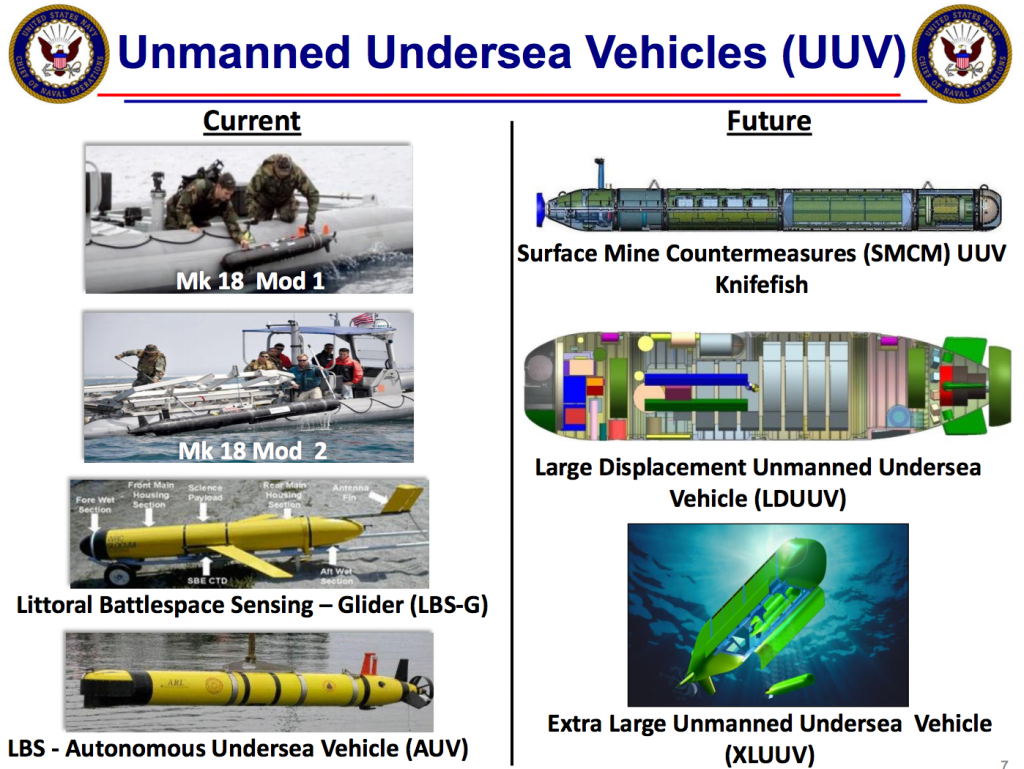

USN has revised its Maritime strategy, for decisive war fighting advantage, in anti-access, area denial environment. US Navy’s vision is to achieve an integrated hybrid force of manned and unmanned systems with the ability to sense, comprehend, predict, communicate, plan, make decisions and take collaborative action to achieve operational goals. The employment of these systems will reduce risk for Sailors and Marines and increase capability.
US Navy vision is for naval platforms that are agile, fuel efficient, flexible and capable of operating cost effectively in varied environments. Enable manned and unmanned naval platforms and forces to seamlessly operate in hostile environments while avoiding, defeating and surviving attacks
Under his strategy, the Navy has taken several new steps in its development of several large underwater drones designed to conduct undersea reconnaissance, share combat essential data with submarine “motherships,” search for and destroy mines and – in some cases – launch attacks on enemy surface and undersea vessels. The Navy has launched Large Displacement Unmanned Underwater Vehicle (LDUUV) program that will design, fabricate, and field a new class of large displacement highly autonomous, Unmanned Undersea Vehicles (UUVs) to provide increased endurance, long range, and payload hosting.
The Navy in FY2021 and beyond wants to develop and procure three types of large unmanned vehicles (UVs). These large UVs are called Large Unmanned Surface Vehicles (LUSVs), Medium Unmanned Surface Vehicles (MUSVs), and Extra-Large Unmanned Undersea Vehicles
(XLUUVs). The Navy wants to acquire these large UVs as part of an effort to shift the Navy to a more distributed fleet architecture. Compared to the current fleet architecture, this more distributed architecture is to include proportionately fewer large surface combatants (i.e., cruisers and destroyers), proportionately more small surface combatants (i.e., frigates and Littoral Combat Ships), and the addition of significant numbers of large UVs
The two new undersea drones, to be configured with advanced sensors and weapons, are called the Orca Extra Large Unmanned Undersea Vehicle (XLUUV) and the Large Diameter Unmanned Undersea Vehicle (LDUUV). The LDUUV would be a vehicle launched from either a Virginia-class fast attack submarine or from a surface ship. LDUUVs could perform similar missions as the XLUUV, however, the LDUUV would need to remain relatively close to the mother ship instead of operating autonomously like the XLUUV. Meanwhile, the Navy is now prototyping the LDUUV. “Next year we deliver a prototype (LDUUV) for integration with submarines,” Small said. Production of the LDUUV is currently slated for 2020 and 2021.
“These will help consolidate Navy vision to bring UUVs (Unmanned Underwater Vehicles) and USVs (Unmanned Surface Vessels) to the fleet, and integrate them with surface vessels and submarines,” Capt. Pete Small, Program Manager for Unmanned Systems, said at the Surface Navy Association.
The US Navy needs to strengthen and enhance naval power-projection capabilities and integrated layered defense by improving manned and unmanned platforms, payloads and weapons. This enables U.S. and our partner nations’ forces to complete missions at extended ranges within hostile environments by avoiding, defeating and surviving attacks. Rear Adm. Robert Girrier, director for Unmanned Warfare Systems, re-affirmed the importance of UUVs as a part of the Navy’s undersea dominance vision.