

The rising tensions between the US and China has put Australia is a very awkward position. Its defence traditionally relied on the US which is now challanged by China. United States Defence Secretary General James Mattis released the National Defense Strategy Commission’s assessment of the Pentagon’s defence strategy, warned that the global security environment was at its most dangerous “in decades” and America’s military superiority had “eroded to a dangerous degree”.
You’ve got the rise of an assertive China that is challenging US strategic primacy in Asia [and] the US is not going to give up its status easily” Dr Malcolm Davis from Canberra think tank the Australian Strategic Policy Institute told SBS News. “So you’re seeing the stage set for major power competition between a rising China and established US that could intensify in coming years in Australia’s neighbourhood.”
The nature of warfare is also changing along with enhanced lethality of future combat according to the Australian Army’s new chief, Lieutenant General Rick Burr who termed it as “accelerated warfare” and the need it brings to prepare troops and equipment to ensure the army’s sustained readiness for war. “The threats against us are accelerating in terms of the speed of cyber, the lethality of the weaponry, and the way in which information space is being exploited, and therefore we need to accelerate our response to these threats,’’ Burr says. “We can’t just continue along the way we’ve always done business.” Adapting in time to the threats likely to emerge over the next 10 to 20 years is the biggest challenge the Australian Defence Force faces, Burr says.
Major General Gus McLachlan, Commander Forces Command has helped to shape the ever-evolving nature of the Army, the doctrine and technology now transforming Australia’s Army and its role as part of the ‘joint force’ concept of the ADF. “Let’s keep abreast of our adversary.” The Accelerated Warfare, I think, is starting off with describing this world that he wants us to be a more agile and adaptable Army. Bcause I think we had a vision of where this digital connected Army could be in terms of increasing our tempo of decision making, being more precise with the application of our force.The future now is to create that so called internet of things, that connected deployed land combat system, so that new systems can be acquired and plug into that relatively seamlessly. And then the big question for us is then how do we plug into the joint environment and leverage the huge power of the F-35, the AEW&C (airborne early warning and control), and the air warfare destroyer?
At present though, Australia’s small defence force relies on technology for its regional combat and deterrent edge. Yet the challenge for Australia is the new technologies are already challenging the traditional superiority of conventional defence assets and the West does not necessarily have a lead in developing and exploiting them. Dr Marcus Hellyer of the Australian Strategic Policy Institute says, but “once you start injecting new things like cyber or stealth or artificial intelligence, or things like that, it’s much harder to understand the calculus there, and the outcomes. So, it increases the uncertainty.” The first corollary to this is that advantage accrues to the defence force that adopts capabilities based on these new technologies fastest. So, procurement agencies are re-examining their acquisition processes to exploit the fruits of industrial research and innovation more quickly.
The second corollary is that traditional, “high-tech inhabited platforms such as ships and combat aircraft, while not obsolete, are increasingly vulnerable to a range of new threats,” Hellyer says. Hence Australia’s keen interest in anything that reduces threats or provides an asymmetric advantage: quantum computing, for example, or electronic warfare, directed energy weapons or hypersonic missiles. These are some of Australia’s technology research priorities under the new Next Generation Technologies Fund (NGTF).
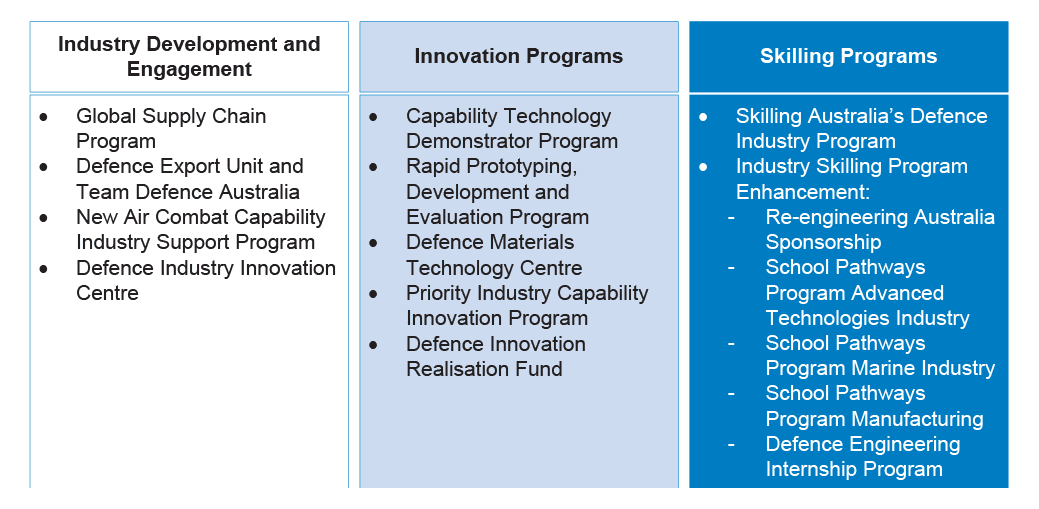
Defence’s approach to innovation complements the Government’s broader strategy. The increasing pace of geopolitical, economic and technological change means it is critical that Defence ensures it has continued access to the best innovation Australia has to offer. Investment in innovation helps to ensure Defence remains resilient to emerging threats, including the possible use of disruptive technologies by adversaries. It also enables us to take advantage of new or developing areas of technology that have the potential to provide a capability edge for Australia’s relatively small force.
A big focus is robotics and autonomous systems, and how soldiers partner with them. “With manned and unmanned teaming, we can generate more capacity to do more things at scale and, where possible, we can reduce risk and be safer in the way we prosecute our operations.”
Boeing is partnering with Australia’s Trusted Autonomous Systems Defence Cooperative Research Centre (DCRC) to develop artificial intelligence (AI) technologies to create unmanned systems for global forces. Boeing Australia’s first innovation project with the DCRC will examine an unmanned system’s route planning, location, and identification of objects and the platform’s subsequent behavioral response. Boeing will work with Australian university partners and Brisbane-based supplier RF Designs to flight-test and evaluate the capability with autonomous high-performance jets.
The DCRC for Trusted Autonomous Systems, announced by the Australian Government in 2017, was to support the rapid creation and transition of industry-led trustworthy smart-machine technologies through the innovation ecosystem to the Australian Defence Force.
Australian defence companies have pitched ideas related to network assurance to the Australian Army at the sixth Innovation Day. Australia Defence Industry Minster Melissa Price stated that Army Innovation Day presents an opportunity for companies to propose novel capability options to tackle challenges in the land combat environment. Melissa Price said: “This year’s theme, network assurance, will ensure the army’s communication networks are more resilient, agile and protected against adversaries. The objective is to find solutions capable of advancing ‘army’s network resilience, boost network defences or deceive adversaries about the disposition and characteristics of land networks’.