
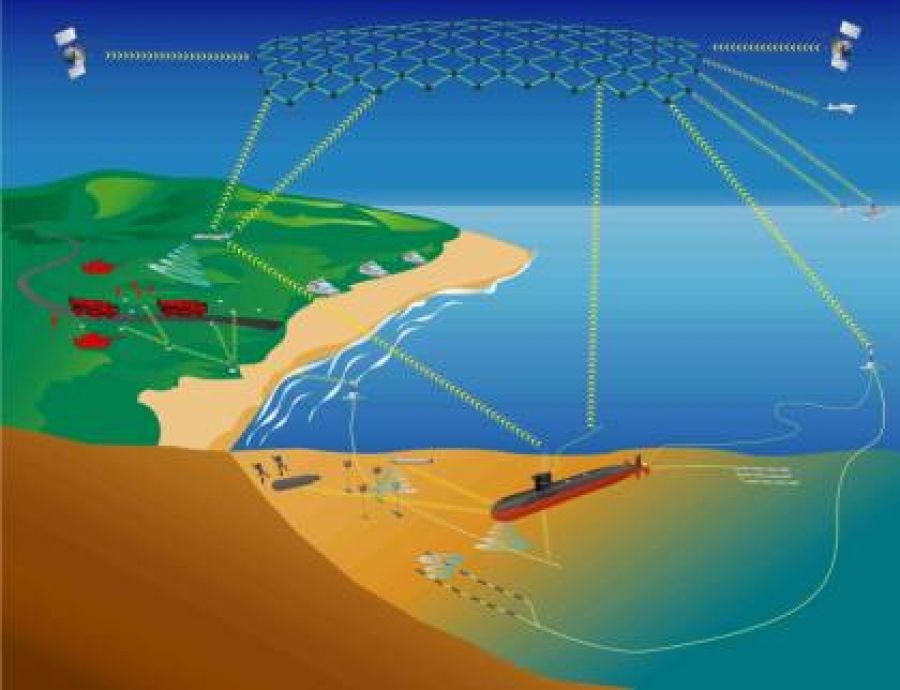

Underwater communication is vital for undersea exploitation and modern communication. Conventional ways which employ acoustical technique for underwater communication have their drawbacks including high path loss, narrow bandwidth, high bit error rate, among which unconditional security is more demanding due to commercial and secure interest.
Submarine communications have always been a challenge because radio waves can’t penetrate sea water. The obvious solution is to surface and raise an antenna above the sea level, then use ordinary radio transmissions. However, a submarine is most vulnerable when on the surface. Early submarines mostly travelled on the surface because of their limited underwater speed and endurance; they dived mainly to evade immediate threats. During the Cold War, however, nuclear-powered submarines were developed that could stay submerged for months. To communicate with submerged submarines several techniques are used.
Submarine communications are currently carried out while submerged using ELF or VLF radio waves because only very low or extremely low frequencies can penetrate the water at those depths.
Using ELF and VLF presents a number of disadvantages, however. These frequencies offer a very high path loss, narrow bandwidth, and high bit error rate. The VLF and ELF frequencies only offer a very low bandwidth: VLF supports a few hundred bits a second while ELF sustains just a few bits each minute which is too low to support high bandwidth data such as video.
These systems also impose severe operational limitations: these are extremely low bandwidth one-way systems that require towed antennas or buoys, and submarines need to steer specific courses and reduce their speed. The transmission sites have to be very large, meaning the submarine must tow cumbersome antenna cables, plus it usually has to align on a specific orientation and reduce speed to obtain optimal reception. The options such as submarines briefly surfacing or the use of towed antennae compromise the ability of the vessel to remain stealthy. For a submarine to retain all its tactical advantage, it must remain submerged in the mixed layer, which is around 60 to 100 metres deep, below which surface sonars cannot detect them.
The U.S. Navy operates 14 Ohio-class ballistic missile submarines, with at least five to six at sea at any given time. A typical deterrent patrol lasts an average of 70 days, during which time the submarines do their best to hide in the vastness of the world’s oceans and await orders to fire their missiles. An Ohio-class submarine at sea is America’s ace in the hole, ensuring that hundreds of nuclear warheads can survive a surprise nuclear attack on the U.S. The idea is that this strategy deters an enemy from launching an attack in the first place. All of this makes secure, reliable communications with submarines extremely important. A third party that could read messages between the “boomers” at sea and the Pentagon could determine their position and sink them.
“Secure communications with submarines are critical to maintain our nuclear deterrence capability and to enact the Network Centric Warfare doctrine of naval operations. As a consequence, the deployment of efficient and secure communication links with submarines is one of the greatest technological challenges presently confronted by the US Navy”, says Marco Lanzagorta, ITT Corporation.
“Indeed, due to their strategic and tactical importance, submarine communications require perfectly secure cryptographic protocols such Vernam (one-time) pads. Clearly, this solution not only presents the problem of efficient distribution of secret keys before the submarine departs the base, but also imposes a limit on the number of secret keys available onboard a submarine during prolonged seaborne missions,” he further says
Researchers are now exploring the possibility of provably secure communications with submerged submarines using quantum key distribution over an underwater optical channel. Quantum cryptography exploits the quantum properties of particles such as photons to help encrypt and decrypt messages in a theoretically unhackable way. Scientists worldwide are now endeavoring to develop satellite-based quantum communications networks for a global real-time quantum Internet. QKD promises to guarantee secure communication through the principles of quantum mechanics, without sacrificing speed or forcing the submarine to rise nearer the surface.
China is also reportedly looking into quantum communications to communicate with its submarines, and other undersea nuclear powers will likely follow suit.