
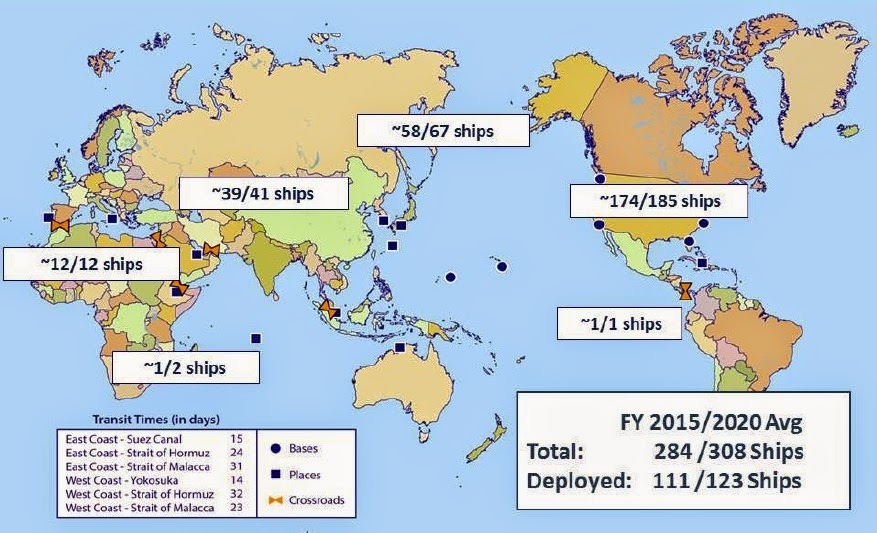

China is developing ever-advancing anti-access, area denial capacity and capabilities, through deployment of long-range aircraft equipped with anti-ship cruise missiles, submarines, surface ships with long-range missiles, and land-based ballistic missiles, putting into risk, any carrier operating within 1,000 miles of the Chinese coast. It is also employing advanced integrated air defense systems, electronic warfare (EW), cyber, and space capabilities.
In response to these threats, USN revised its Maritime strategy to include a new function called “all domain access” which underscores the challenges forces face in accessing and operating in contested environments. The new strategy titled, “A Cooperative Strategy for 21st Century Sea power: Forward, Engaged, Ready, “emphasizes operating forward and engaging partners across the globe, especially in the Indo-Asia-Pacific region.
The S&T Vision of USN is “The decisive technological advantage and influence for our naval forces can only be provided by cutting-edge scientific research and technology.” The Office of Naval Research, has released its ” The Naval S&T Strategy ” to align S&T with naval mission and future capability needs, balance and manage the S&T investment portfolio , communicate the S&T vision and approach to senior decision makers, key stakeholders, partners, customers and performers.
U.S. naval forces require a broad spectrum of core capabilities to assure access across the global maritime domain. Accordingly the S&T Strategy is, “To discover, develop and deliver decisive naval capabilities, near- to long-term, by investing in a balanced portfolio of breakthrough scientific research, innovative technology and talented people.”
“[We will] develop concepts and capabilities to provide more options to national leaders, from non-conflict competition to high-end combat at sea. Operations short of conflict should be designed to contain and control escalation on terms favorable to the U.S. Combat at sea must address “blue-water” scenarios far from land and power projection ashore in a highly “informationalized” and contested environment,” says Admiral John Richardson Chief of Naval Operations