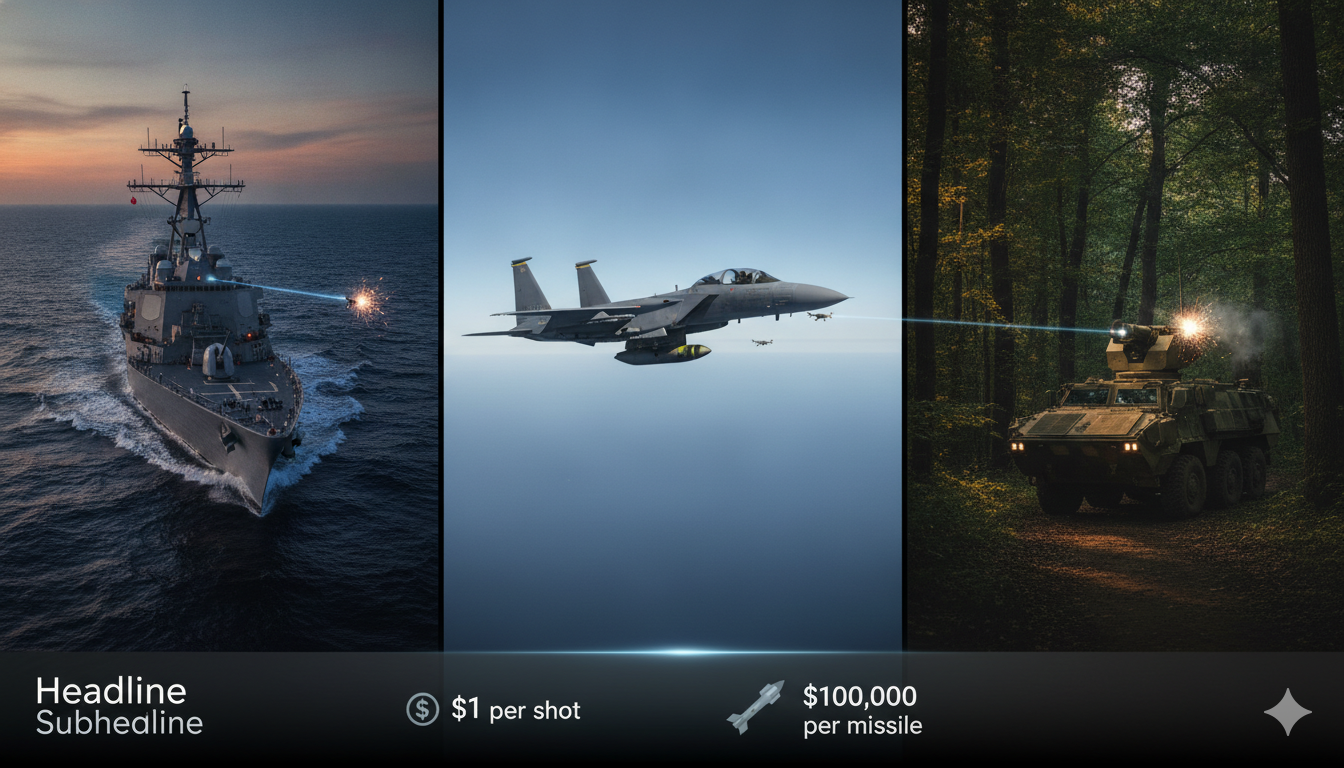
Countries developing Laser Directed Energy Weapons on Aircrafts, Drones and Satellites to shoot down enemy’s aircrafts, missiles, and satellites

Laser weapons use high power lasers to  damage or destroy adversary equipment, facilities, and personnel. The technology provides major advantages for military applications due to High precision and rapid on-target effect, precise and scalable effects, Avoidance of collateral damage caused by fragmenting ammunition, Low logistics overhead and minimum costs per firing.


Laser weapons have already been employed on warships and military trucks. In 2014, US Navy’s deployed 30-kilowatt Laser Weapon System (LaWS) on USS Ponce, the first laser weapon to have attained Initial Operating Capability (IOC) by virtue of being deployed in a combat theater. The system, offers military leaders precision accuracy at cost as low as a dollar per shot. ONR showed off a video in which the LaWS system — mounted on the ship’s super structure above the bridge — disabled a small Scan Eagle-sized UAV, detonated a rocket propelled grenade (RPG) and burned out the engine of a rigid hull inflatable boat (RHIB).


After warships US has plans to employ laser weapon on on Aircrafts and drones for missile defense.  There is also increased interest in defending against Unmanned Aerial Systems (UAS) and hypersonic weapons. Today’s fighter jets are largely limited to passive defenses against incoming missiles. Pilots can take evasive action to try and fly outside an incoming missile’s sensor arc, launch flares to distract an infrared missile seeker, or spread strips of aluminum foil, known as “chaff,” to confuse a missile guided by radar.


Enemy surface-to-air threats to manned and unmanned aircraft have become increasingly sophisticated, creating a need for rapid and effective response to this growing category of threats. High power lasers can provide a solution to this challenge, as they harness the speed and power of light to counter multiple threats.  A laser can be powered by the airplane’s engine, removing the need for an onboard gun magazine and providing a theoretically unlimited number of shots. Laser energy travels at the speed of light, removing ballistics from the targeting equation and making it impossible to dodge. Laser weapon systems provide additional capability for offensive missions as well—adding precise targeting with low probability of collateral damage.


US Air Force is pursuing laser weapons systems (LWS) along with high powered electromagnetics (HPEM) to enable operations in a possible future battlespace involving a technologically advanced adversary, one with the ability to prevent or deny access to their ability to operate in a given area. However, for consideration as a weapon system on today’s air assets though, these laser weapon systems must be lighter and more compact than the state-of-the-art has produced. The laser must be powerful enough to fry an incoming missile’s electronics or cause damage to the skin or control systems, inducing aerodynamic failure.


Air Force Research Lab thinks it can put laser weapons on aircraft starting in 2021. The service will start with larger C-130 and C-17 aircraft at first, then fighter-sized aircraft such as the F-15 and F-35 once technology inevitably shrinks the size of the weapon. Having had some previous success in shooting down a missile with direct energy, the Pentagon is weighing up a number of options, including using manned aircraft such as F-15s or F-35s, unmanned aerial vehicles (UAVs) flying at a higher altitude, or a space-based system. Each have their pros and cons, but Griffin suggested space would be his favoured option for boost phase interception.


The aim is to develop and deploy a laser weapon capable of operating at high altitude and with long endurance by 2023. A laser-equipped HALE drone would be operating around sites of interest, ready to shoot down ballistic missiles at the boost phase. That’s the concept at least, supported by $563m of investment across a number of research programmes.


US is not alone in working to perfecting laser weapons. Russia, UK,  China and other countries also have similar programs. Russian Deputy Defense Minister Yuri Borisov has also revealed that the Russian military has commissioned several types of laser weaponry. Borisov said that laser weapons are no longer a novelty for the Russian armed forces, with the military already in the process of commissioning and even adopting several types of laser-based weapons systems.   According to Interfax, defence companies have been working on the plane-mounted laser, which if confirmed to be true, will be capable of hitting enemy satellites. Russia will “actively use the developments gained in the creation of the aircraft with laser weapons A-60” it said. Russia is planning to mount  Aircraft lasers on IL-76 and MIG-35.


Dr Malcolm Davis, senior analyst in defence strategy and capability at the Australian Strategic Policy Institute, said it was certainly technically possible the Russians were developing such a system. “The US had the YAL-1 Airborne Laser on a modified Boeing 747 some years back to try and shoot down ballistic missiles, but it was scrapped for cost reasons even though the technology worked,” he said.


“Firing from high in the atmosphere eases a lot of problems associated with laser weapons because there is not much air to undermine targeting and beam quality, and expands the time available to target and attack a satellite.” Dr Davis also pointed out that developing anti-satellite (ASAT) weapons was a key focus for both China and Russia because “they recognise our dependency on space capabilities to undertake military operations”.


The UK Ministry of Defence has officially awarded a £30m contract to produce a prototype laser weapon. The aim is to see whether “directed energy” technology could benefit the armed forces, and is to culminate in a demonstration of the system in 2019. The contract was picked up by a consortium of European defence firms comprising the companies MBDA, Qinetiq, Leonardo-Finmeccanica GKN, Arke, BAE Systems and Marshall ADG.


China too is involved in  the work on laser weapons.  China, presented its Silent Hunter laser system at the International Defense Exhibition and Conference in the United Arab Emirates in February 2017. The system is capable of disabling car engines at a distance of one mile and has a capacity of 50-70 kilowatts. Research firm Technavio last year predicted the Chinese would surpass the U.S. in research and development spending on laser systems by 2022.


A space-based laser weapon defence capability has been the long-term goal for the US, and others, for many years. “If you deploy a space-based interceptor constellation, which is something we’ve studied in excess of 30 years, I think the effectivity is beyond doubt, it’s not technically hard to do,” Michael Griffin, undersecretary of defence research and engineering, told reporters in August 2018.

IDST Monthly Access Membership Required

You must be a IDST Monthly Access member to access this content.

Join Now

Already a member? Log in here