
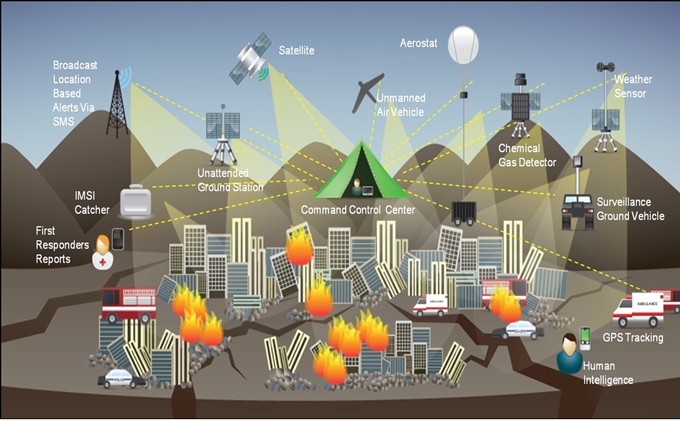

Today U.S. soldiers are being killed because the Defense Department cannot deploy all the sensors it would like to. DoD could deploy sensors every few yards to detect buried improvised explosive device (IED). As it is, every sensor deployed today has to be battery powered, so even if vast sensor nets were deployed it would put more soldiers in jeopardy by forcing them to expose themselves to ambush attacks while changing sensor batteries.
By 2018 the DARPA’s N-Zero initiative aims to have deployable sensor networks that require near-zero standby-power, a goal the team quickly found that was impossible without microelectromechanical systems (MEMS). In addition the teams discovered an extra benefit of MEMS — an advantage the team had never imaged possible. MEMS provides not just near-zero standby power, but can be configured for absolute zero standby power by using the power from the signal to be detected itself to power-up the transmitter. And in some situations, the transmitter too can be powered without a battery, by storing up energy on a super-capacitor from renewable sources — from solar to vibration harvesters.
The Department of Defense has an unfilled need for persistent, event-driven sensing capabilities, where physical, electromagnetic and other sensors can remain dormant, with near zero-power consumption, until awakened by an external trigger or stimulus. Current state-of-the-art sensors use active electronics to monitor the environment for the external trigger, consuming power continuously and limiting the sensor lifetime to months or less.
The N-ZERO program intends to extend the lifetime of remotely deployed communications and environmental sensors from months to years, by supporting projects that demonstrate the ability to continuously and passively monitor the environment, waking an electronic circuit only upon the detection of a specific trigger signature. Specifically, N-ZERO seeks to extend unattended sensor lifetime from weeks to years, cut costs of maintenance and the need for redeployments. Alternatively, N-ZERO could also reduce battery size for a typical ground-based sensor by a factor of 20 or more while still keeping its current operational lifetime.
“We wanted to learn how to reduce our sensors power envelope so that we could deploy them right at the tactical edge with a battery that does not need to be replaced for a long period of time,” said DARPA program manager Roy (Troy) Olsson in his keynote address titled Event Driven Persistent Sensing.
A team of researchers at Northeastern University have developed a new sensor powered by the very infrared energy it’s designed to detect. The device, which was commissioned as part of DARPA’s Near Zero Power RF and Sensor Operation (N-ZERO) program, consumes zero standby power until it senses infrared (IR) wavelengths. The sensor shall have many military applications that can detect vehicles and tanks and even identify them weather it is a truck, a car, or an aircraft by detecting heat emitted by them in IR spectra and analysing the heat or IR signature which is different because of engines that burn gasoline or diesel fuels produce emissions made up of different chemical compounds.