
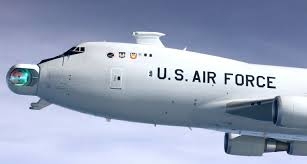

Directed-energy weapons are among a handful of maturing disruptive or asymmetric technologies that could confer game-changing technological advantages both as a superior defensive capability and as an effective electronic attack option. For operations in anti-access/area-denial environments, they could strengthen U.S. power projection assets and defend fixed-site installations and/or expeditionary forces from attack. In the Middle East, DE weapons could help enhance force protection against small-boat swarms, unmanned aerial vehicles or rocket, artillery, mortar or missile attack.
Joint doctrine defines directed energy (DE) as an umbrella term covering technologies that produce concentrated electromagnetic energy and atomic or subatomic particles. A DE weapon is a system using DE primarily as a means to incapacitate, damage, disable or destroy enemy equipment, facilities and/or personnel. Directed energy has the potential to yield cost effective weapons that can deliver precise, scalable effects – and at long ranges – with a large magazine capacity.