

In 2015, the People’s Republic of China’s (PRC, China) Ministry of National Defense published its military strategy which highlighted the increasing importance of maritime dominance stating that “the traditional mentality that land outweighs sea must be abandoned, and great importance has to be attached to managing the seas and oceans and protecting maritime rights and interests.”
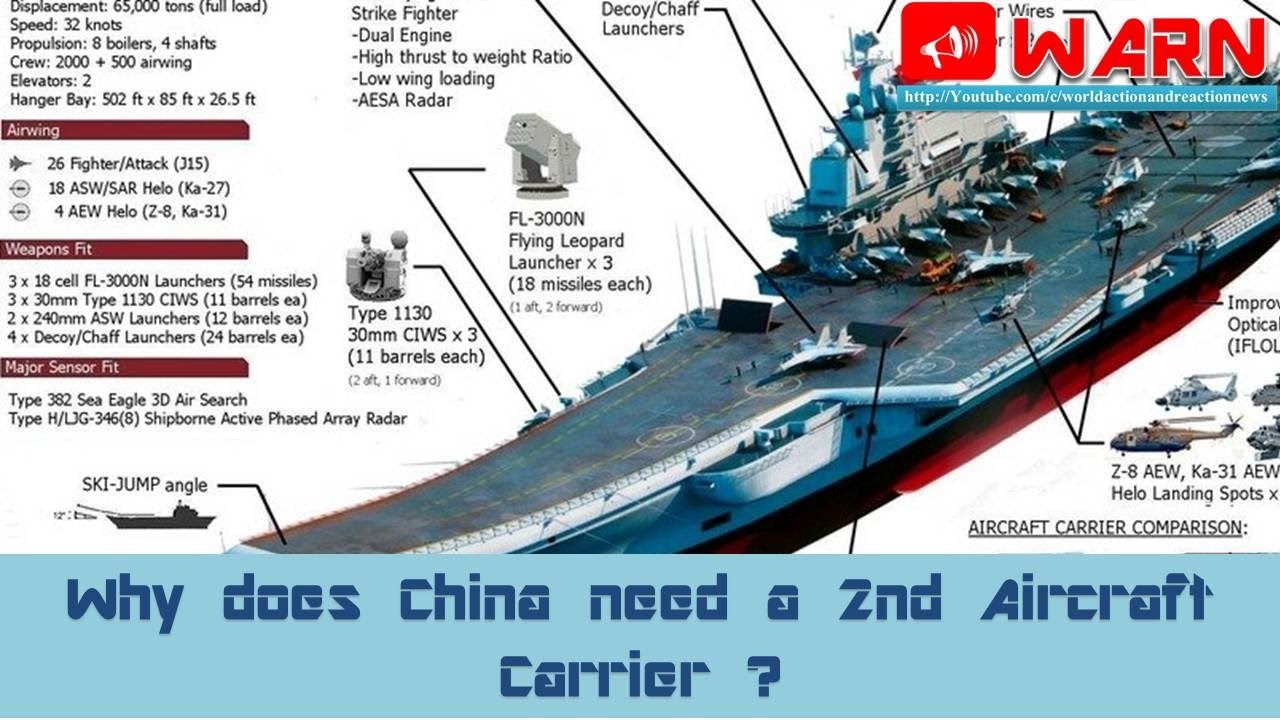
In line with this strategy, China has ramped up the development of aircraft carriers, launching its first home-grown carrier, the Type 100A, on April 26, 2017 and with a third carrier on the way. China’s first aircraft carrier is in operation, the second has entered the service in Dec 2019 and third indigenous carrier is currently under advanced stage of construction and fourth is in the planning phase. China’s two aircraft carriers, the Liaoning and the Shandong, recently completed military drills in the South China Sea, according to a statement by the Chinese Ministry of Defense in Sep 2020. It was the first time the Chinese navy has sent two carriers to sea at once, though the ships did not train together. The Shandong was commissioned in December 2019; the Liaoning was commissioned in 2012. The Shandong, which uses conventional rather than nuclear propulsion, is the second carrier in the Chinese fleet.

China’s first aircraft carrier, the Liaoning, a retrofitted Soviet-era vessel, was purchased from the Ukrainian government in 1998. Liaoning – with a full load displacement of almost 60,000 tons, carrying J-15 fighters and helicopters, was deployed to the western Pacific in April 2018 for her first realistic war game. The Liaoning’s air wing may consist of 24 J-15 fighters, six anti-submarine warfare helicopters, four airborne early warning helicopters, and two rescue helicopters, for a total of 36 aircraft. China has also strengthened its battle capabilities and is training its own carrier-borne fighter pilots. It is one of the few countries to do so.
China needs at least three aircraft carriers to defend its 14,500 kilometer coastline as well as dealing with threats in the South and East China seas, said Cao Weidong, a Chinese military expert. With tensions escalating in the South China Sea, China has embarked upon steady naval building and modernization program. It now has 29 submarines armed with antiship cruise missiles. It added 10 new vessels to the PLA Navy in 2016 including guided missile destroyers, frigates and minesweepers such as the Qingzhou. “The number of new warships that are put into service annually in China has overtaken the U.S. and has become the first in the world,” China Military Online said.
As China continues to feel threatened by the growing US presence in the region who is also arming its neighbors with advanced US technology, China could possibly launch its third aircraft carrier by end of 2020 or early 2021, according to reports. Earlier, there were reports that China is aggressively working on its third and fourth aircraft carriers at the Jiangnan shipyard in Shanghai which many media outlets in China including state-run Global Times predicted could be launched by 2025. “The Type 002 aircraft carrier—the country’s third carrier and the second to be domestically developed—has started the final assembly process,” the SCMP had reported, citing its sources. It reported that work on the third aircraft carrier had slowed down due to the COVID-19 pandemic which could delay the process.
Xu Guangyu, a senior advisor to the China Arms Control and Disarmament Association, told the Global Times, “In the long run, China needs to develop its own aircraft carrier battle teams, with at least six aircraft carriers, maritime forces led by guided missile destroyers, as well as attack submarines.” Xu said China will build about 10 more bases for the six aircraft carriers. He explained that they could be built around countries friendly to China, such as Pakistan. He added that the bases could also be built in every continent, but this would depend on whether the countries would want to cooperate with China.
The aircraft carriers are further expected to increase in future. “In order to protect China’s territories and overseas interests, China needs two carrier strike groups in the West Pacific Ocean and two in the Indian Ocean. So we need at least five to six aircraft carriers,” a Chinese defence analyst recently told the People’s Daily.
China’s next generation of carriers will probably have greater endurance and be capable of launching more varied types of fixed-wing aircraft, including [electronic warfare], early-warning and [anti-submarine warfare] aircraft,” the U.S. Defense Department explained in the 2018 edition of its annual report on Chinese military power. “By 2020, carrier-based aircraft will be able to support fleet operations in a limited air-defense role,” Jesse Karotkin, the Office of Naval Intelligence’s top China analyst, said in 2014.”These improvements would increase the striking power of a potential carrier battle group in safeguarding China’s interests in areas beyond its immediate periphery,” the Pentagon explained in its 2018 China report.
China’s warships have carried out a high-seas training in the Indian Ocean. Chinese navy’s increasing presence in the Indian Ocean comes following the release of a White Paper published by the PLA in 2015 outlining a new military strategy enhancing its navy’s duties for the first time to “open seas protection” far from its shores. The large number of aircraft carriers, successful use of catapult systems and atomic propulsion and long experience in operating carriers would confer Beijing true blue open ocean capability and expand its global reach.