
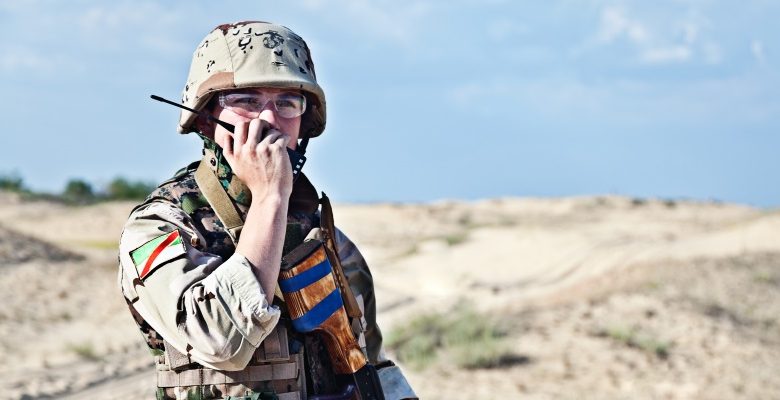

Communications is vital for War fighters to exchange voice and data, command and control and situational awareness data and video. The vision of Communications area is to provide reliable communication from anywhere to everywhere from war fighters to supreme commander with demanded rate and least latency by exploiting complete electromagnetic spectrum through nodes deployed under water, water surface, land, air and space. Military Communication systems demand flexibility, adaptability & cognitive controllability of bandwidth, frequency and information rate to ensure robust communications in congested and contested environments.
In Army tactical environments, highly efficient and secure communications among armed personnel and vehicles are of utmost importance. With the variation of military missions with respect to physical conditions and the complexity of tasks, high-throughput and resilient wireless communication techniques are required not only in battlefield, but also in catastrophe relief, peacekeeping, etc.
In an era of constant technological advances, defence agencies are falling short of battlefield expectations when it comes to military communications technologies, according to a study released by Government Business Council (GBC), the research division of Government Executive Media Group, in partnership with Viasat. Based on a survey of over 300 U.S. active military and Department of Defense (DoD) participants across the nation, this study investigated the role of military connectivity and evaluated the practicality and effectiveness of U.S. military communications technologies.
Respondents noted that the three biggest challenges facing their organizations’ network modernization efforts are an inability to keep pace with commercial technology, procurement inefficiencies and limited funding.
Next-generation MILCOM platforms face the challenge of closing some of the gaps between military and commercial communications systems. These MILCOM platforms will need to change from voice-only systems by adding data and text capability. This shift will enable the delivery of data such as mapping, images, and video to a soldier in the battlefield.
The military communications is also vulnerable to the disruptions from Jamming, attacks on fiber-optic undersea cables as well as satellites, cyberattacks on the software of the radios to a high-altitude, nuclearinduced electromagnetic pulse.
Even when communications systems within a small unit survive enemy attack, or find themselves outside the targeted zone of intense jamming, communications with central authority may suffer. It is because of such concerns, for example, that the Army’s Maneuver Warfare Center of Excellence at Fort Benning, Georgia is examining concepts of future operations in which a brigade might be cut off from divisional or corps headquarters for an extended period, and have to function entirely on its own during that time.