


The effectiveness of anti-tank weapons used by Ukraine against Russian tanks revives old questions as well as generates new ones about armoured fighting vehicles and their future. Oryx, an open-source site tracking military-equipment losses around the world, has reported that Moscow has lost 5,020 military vehicles since the beginning of its invasion. According to the latest figures, 3,202 of those vehicles were destroyed, 103 damaged, 323 abandoned and 1,392 captured by Ukranian troops. Among the Russian losses listed by Oryx, there are 916 tanks, 556 of which are estimated to have been destroyed.
Russia’s army was estimated to have over 12,000 tanks and 20,000 armored fighting vehicles before the war in Ukraine began, far outnumbering Ukraine’s estimated force of an estimated total of over 2,500 tanks and over 2,800 armored vehicles. Since then, it’s been estimated that Russia has already lost over a quarter of its available tanks for its campaign in Ukraine, and rumors have spread about Moscow’s inability to repair its damaged tanks and its capacity to build new tanks.
According to Western military experts, Russian tanks are being destroyed because of a fatal design flaw in the vehicles where troops and ammunition share the same space. In April, CNN reported that Western militaries had known for years about a design flaw within Russian tanks called the “jack-in-the-box effect,” which makes the vehicles highly susceptible to catch fire and explode.
Prior to Russia’s invasion of Ukraine, the struggling Turkish Leopard 2A5s in Syria and American M1A1s against ISIS in Iraq showed that heavily armoured vehicles lack mobility and adaptability and thus struggle in urban settings.
The next-generation armored vehicles will face threats from near-peer and insurgent warfare. Modern main battle tanks and infantry fighting vehicles and their occupants are facing increasing threats from all sides: Rocket Propelled Grenades (RPGs) that are thrown from short distances. Anti-Tank Guided Missiles (ATGMs) that use infrared or radar guidance to attack the tops or engine compartments of vehicles. Mines or improvised explosive devices (IEDs) designed to attack the weaker bottoms of vehicle.
However, the next-generation light-anti tank weapon (NLAW), the FGM-148 Javelin anti-tank missiles system and the Turkish Bayraktar TB2 drone using anti-tank missiles, appear to be quite effective against heavily armoured Russian vehicles. Contributing factors include bad Russian tactics, the failure to establish air superiority and successful and determined Ukrainian ambushes and guerrilla tactics.
The traditional protection technique depends on the amount of armor, has reached a practical limit for today’s threat environments, as main battle tanks and infantry fighting vehicles have reached weights approaching 70 tons. The trend of increasingly heavy less mobile and more expensive combat platforms has limited Soldiers’ ability to rapidly deploy and maneuver in theater and accomplish their missions in varied and evolving threat environments. Moreover, larger vehicles are limited to roads and bridges they are able to travel on, require more logistical support and are more expensive to design, develop, field and replace.
One of the ways to enhance survivability without increasing weight is new lighter armor materials like composites. Composites can be designed to be far stronger than aluminum or steel. Metals are equally strong in all directions. But composites can be engineered and designed to be strong in a specific direction. By using composites to decrease weight, armored vehicles can make more space to carry fuel, ammunition, and crew if needed. Since composites will not rust or suffer from fatigue like its metal counterparts, it also helps drive down lifetime maintenance costs while increasing service life
Another technology being used to enhance the survivability is Active Protection Systems, or APS, that uses sensors and radar, computer processing, fire control technology and interceptors to find, target and knock down or intercept incoming enemy fire such as RPGs and Anti-Tank Guided Missiles, or ATGMs.
The US Army is speeding up development work on its future Modular Active Protection System for combat vehicles. The MAPS is being developed as an open architecture system with a common controller, and will be capable of installation on a variety of ground vehicles. Vehicles slated for use of APS systems are infantry fighting vehicles such as Bradleys along with Stykers, Abrams tanks and even tactical vehicles such as transport trucks and the emerging Humvee replacement, the Joint Light Tactical Vehicle.
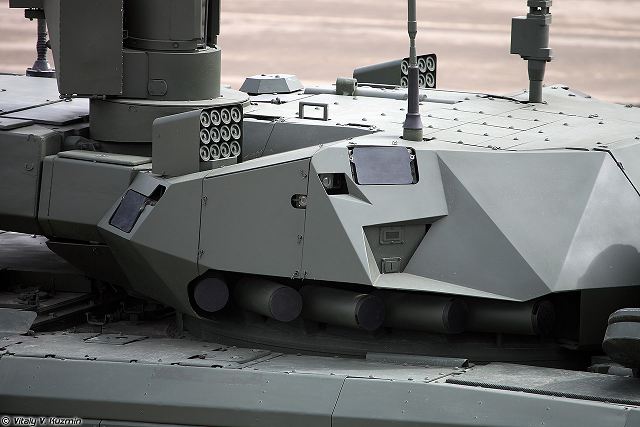
Russian Armata T-14 will incorporate several active protection system called Afganit designed to kill incoming missiles before they even strike the tank. Milley also wants a tank that could be driverless, allowing the remaining crew to concentrate on fighting the enemy, or even completely crewless.
The U.S. Army is planning to bring new vehicle protection technologies to the fleet as early as 2020 to include reactive armor tiles, as well as laser warning and signature management capabilities, according to Col. Glenn Dean, the program manager for the service’s Stryker combat vehicle.
The service will also continue its work on advanced reactive armor tiles for Armored Multi-Purpose Vehicle, or AMPV as part of its base vehicle protection. But that advanced technology will be shared across multiple other platforms in the Army’s fleet, Dean said.
The first program will look into signature management capabilities to address “all of the various signatures — visual, infrared, radar, sound, electromagnetic — that a vehicle puts off,” Dean said. The capability will begin to “control and reduce those to reduce the detectability of the platform and its vulnerability to threats,” he added.
Out of the three main technology programs the Army is advancing, signature management is the most mature, according to Dean: “Frankly, we could deploy that next year if we were funded right now. It’s not in the 2019 budget, so we are looking for opportunities.” The Army will also devote effort to a laser warning program “that will provide the ability to detect, identify and then locate laser sources” such as laser range finders or beam-riding anti-tank missiles, Dean noted.
The three programs underway as part of the VPS portfolio are meant to roll out to the fleet before its future Modular Active Protection System, or MAPS, architecture is ready for delivery, Dean said. Depending on the long-term strategy, the Army will decide whether to bring those capabilities into the MAPS architecture.
DARPA’s has launched Ground XVehicle Technology (GXV-T) program has developed revolutionary technologies to enable a layered survivability approach, which is not entirely armor-based, against multiple classes of threats to armored vehicles. A layered approach should consist of technologies that: reduce vehicle detection, reduce the likelihood of a vehicle being engaged, reduce the chances of both guided and unguided rounds hitting the vehicle and reduce the effectiveness of modern threats to armored vehicles.