
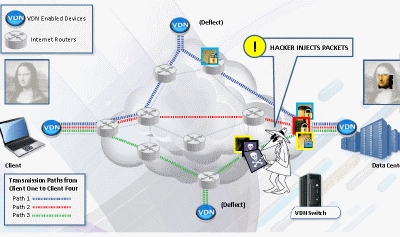

“United States adversaries are launching increasingly sophisticated cyberattacks on the complicated web of networked systems upon which our military relies,” explained Robert W. Twitchell, Jr., President and CEO of Dispersive Technologies. “These attacks impair connectivity, degrade mission effectiveness and threaten lives.
“While the means of cyber attacks vary, the pattern of targets has been relatively consistent. Large databases, as well as point-of-sale systems, continue to be targeted for financial gain. Hackers with possible ties to nation-states continue to target infrastructure as well as systems for political insight,” writes Riley Walters in Heritage.
Twitchell, a subject matter expert for the Department of Defense, feels innovation is crucial to defeating cyberterrorists. “Whether it’s the military, government or corporate world, everyone has relied on basically the same network defense capabilities for years,” he said. “Not surprisingly, rogue nations and hackers have developed a playbook for how to hack U.S. networks. As the headlines reflect, they’re succeeding.
Dispersive Technologies, Inc. won the Most Innovative Solution award at the Armed Forces Communications and Electronics Association (AFCEA) Defensive Cyber Operations Symposium in Washington, D.C. April 20-22, 2016.
The Dispersive Technologies company has developed a unique approach to cybersecurity, inspired by military frequency hopping spread-spectrum technique, wherein a signal is transmitted in short bursts, “hopping” between frequencies in a pseudo-random sequence. Only the receiving radio possessing that code is able to can receive the signal properly, for any other eveteaser the signal appears as noise.
As long as humans are writing software, there will be coding mistakes for malicious hackers to exploit. A single bug can open the door to attackers deleting files, copying credit card numbers or carrying out political mischief. A new program called Shuffler tries to preempt attacks on code errors by allowing programs to continuously scramble their code as they run, effectively closing the window of opportunity for an attack.
“Shuffler makes it nearly impossible to turn a bug into a functioning attack, defending software developers from their mistakes,” said the study’s lead author, David Williams-King, a graduate student at Columbia Engineering. “Attackers are unable to figure out the program’s layout if the code keeps changing.”