
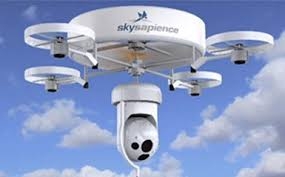

Militaries have long recognized the advantages of height for surveillance platforms to overcome the Horizon limitations because of curvature of earth, therefore it has been using many such platforms like baloons, and aerostats. Security forces have also found that countering today’s asymmetric threats, which can occur at any time and place, requires reliable, cost-effective persistent surveillance systems and platforms.
The increased demand for remote communications and intelligence, surveillance, and reconnaissance (ISR) has driven interest in drones. ISR is the coordinated and integrated acquisition, processing and provision of timely, accurate, relevant, coherent and assured information and intelligence to support commander’s conduct of activities. Land, sea, air and space platforms have critical ISR roles in supporting operations in general. Effective ISR data can provide early warning of enemy threats as well as enable military forces to increase effectiveness, coordination, and lethality, and demand for ISR capabilities to support ongoing military operations has increased. Examples of ISR systems include surveillance and reconnaissance systems ranging from satellites, to manned aircraft such as the U-2, to unmanned aircraft systems such as the US Air Force’s Global Hawk and Predator and the US Army’s Hunter and PSST Aerostats, to other ground-, air-, sea-, or space-based equipment, and to human intelligence teams.
Tethered Unmanned Aircraft systems, towed parafoil systems and tethered Aerostats have emerged as low cost, local area surveillance systems that can provide surveillance for many days and can provide on demand launch over area of interest. The tethers allow them to carry long range surveillance, provide them power so that they can fly for long as well as help them withstand high winds. These systems can provide wide range of long-range surveillance and observation applications such as law enforcement, search-and rescue (SAR), homeland security and defence.
The military, law enforcement, and border patrol use tethered drones as an integral part of their remote security drone operations. Drones can cover a large area at once. The operators can monitor activity from the live feedback transmitted to a corresponding tablet or screen on the ground. This real-time feedback and video aids in criminal aerial surveillance, crowd safety, and military tactics. A mobilized drone station allows operators to move the flight area without having to land the drone first.
In 2016 Summer Olympics in Rio de Janeiro, Brazil, the ADB-150 Aerostat was deployed above the Olympics area to support the Brazilian Air Force security. The SHAPO’s gyro-stabilised three gimbal EO/IR surveillance payload was deployed on the ADB-150 aerostat to provide continuous surveillance, monitoring and public security. That military-grade security system gives Border Patrol agents a bird’s eye view of the Rio Grande Valley. Recently in March 2019 Sheriffs from around the country were granted a behind-the-scenes look at security operations at the Southern border. “This Aerostat has assisted Border Patrol in Rio Grande City by providing a higher level of surveillance and detection and increasing our situational awareness,” Olivares said, “Thereby allowing us to appropriately respond to threats as they’re crossing the river and even before they cross the river.”
Tethered drones are especially helpful for search and rescue missions. When tragedy strikes, a drone is a quick and efficient way to gather information about the scene. Drones equipped with radar and thermal sensors give first responders the needed information for understanding the scope of the disaster and locating trapped survivors. Their small size also allows them to get close-ups of areas a helicopter would not be able to and drop in needed supplies to rescuers and survivors.