
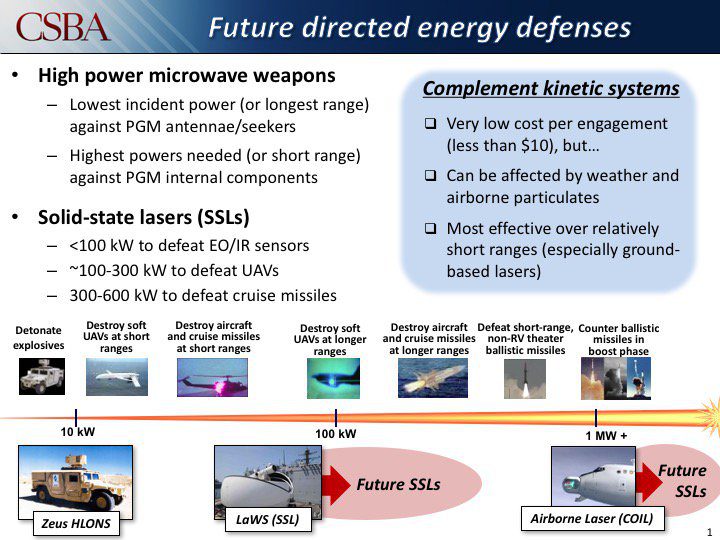

The Laser Directed Energy Weapons (DEWs) offer a transformational ‘game changer’ to counter asymmetric and disruptive threats, while facing increasingly sophisticated traditional challenges. Laser technology provides major advantages for military applications over kinetic weapons due to High precision and rapid on-target effect, precise and scalable effects, avoidance of collateral damage caused by fragmenting ammunition, Low logistics overhead and minimum costs per firing.
The US Navy estimates the “cost per shot” of a laser at less than a dollar: missiles used for ship defense cost $800 thousand up to $15 million dollars each. Compared with conventional anti-missile weapons systems in deployment, the laser DEW would be the most efficient and the most cost-effective, roughly dollar per shot.
Many countries are developing laser based directed energy weapons for battlefield and counter-terrorism operations. Some countries like US, Russia and China have reached high degree of maturity in developing laser based directed energy weapons. “Laser weapons are no longer a technological problem, It’s one of integration at the service level,” according to Lockheed executives. “The technologies now exist,” said Paul Shattuck, company director for Directed Energy Systems. “They can be packaged into a size, weight, power and thermal which can be fit onto relevant tactical platforms, whether it’s a ship, whether it’s a ground vehicle or whether it’s an airborne platform. “That doesn’t mean that giant city-melting lasers are on their way. Right now, the weapons are limited to the 15-30 KW scale; going much further requires figuring out how to deal with atmospheric interference, an issue which becomes more complicated with weapons mounted on airborne systems.”
The Air Force Research Laboratory (AFRL) completed a major milestone under the Self-Protect High Energy Laser Demonstrator (SHiELD) Advanced Technology Demonstration (ATD) Program, in which the surrogate laser weapon system successfully shot down multiple air launched missiles in flight. During the series of tests at the High Energy Laser System Test Facility at White Sands Missile Range, the Demonstrator Laser Weapon System (DLWS), acting as a ground-based test surrogate for the SHiELD system, was able to engage and shoot down several air launched missiles in flight.
The SHiELD program is developing a directed energy laser system on an aircraft pod that will serve to demonstrate self-defense of aircraft against surface-to-air (SAM) and air-to-air (AAM) missiles.The demonstration is an important step of the SHiELD system development, by validating laser effectiveness against the target missiles.
“The successful test is a big step ahead for directed energy systems and protection against adversarial threats,” says Maj. Gen. William Cooley, AFRL commander. “The ability to shoot down missiles with speed of light technology will enable air operation in denied environments. I am proud of the AFRL team advancing our Air Force’s directed energy capability.”
The US Army is moving forward with a new 100-kW laser weapon, awarding US$10 million to Lockheed Martin and Dynetics to continue development of the High Energy Laser Tactical Vehicle Demonstrator (HEL TVD). Designed to counter low cost, high volume threats, the new mobile battlefield laser is the latest in the American effort to produce incrementally more powerful and accurate directed energy weapons. “Laser weapons provide a compliment to traditional kinetic weapons in the battlefield,” Lockheed Martin said. “In the future, they will offer reliable protection against threats such as swarms of drones or large numbers of rockets and mortars.”
Russian Deputy Defense Minister Yuri Borisov has also revealed that the laser weapons are no longer a novelty for the Russian armed forces, with the military already in the process of commissioning and even adopting several types of laser-based weapons systems. China too is involved in the work on laser weapons. In 2014, it was reported that an experiment by the Chinese Academy of Engineering Physics resulted in the downing of a small drone hit from a distance of two kilometers.”
Israeli investments in laser technology have led to the ability to focus laser beams precisely on long-range targets, while overcoming atmospheric disturbances. Encouraged with the new technology breakthrough DDR&D embarked on three parallel high-energy laser weapons demonstrator programs with Elbit Systems and Rafael, designed to demonstrate new laser weapons capabilities.
The UK Ministry of Defence has officially awarded a £30m contract to produce a prototype laser weapon. The aim is to see whether “directed energy” technology could benefit the armed forces, and is to culminate in a demonstration of the system in 2019. The contract was picked up by a consortium of European defence firms comprising the companies MBDA, Qinetiq, Leonardo-Finmeccanica GKN, Arke, BAE Systems and Marshall ADG.