
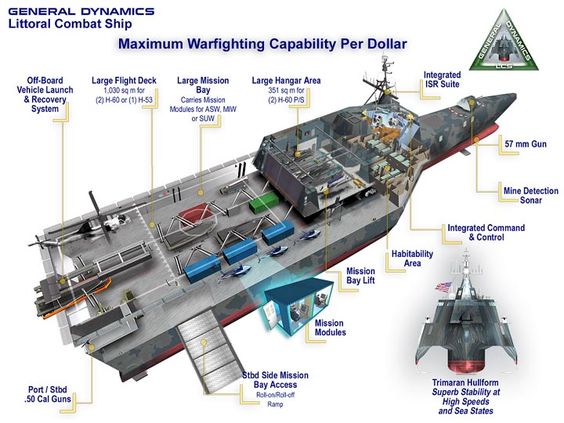

The US Navy’s $35+ billion “Littoral Combat Ship” program is intended to create a new generation of affordable surface combatants that could operate in dangerous shallow and near-shore environments, while remaining affordable and capable throughout their lifetimes. The littoral combat ship is a modular, reconfigurable ship, with three mission packages (surface warfare, mine countermeasures, and anti-submarine warfare).
LCS was designed for countering growing Asymmetric and A2/AD threats. That requires the ability to counter threats like coastal mines, quiet diesel submarines, global piracy, and terrorists on small fast attack boats. It also requires intelligence gathering and scouting, some ground combat support capabilities, and the ability to act as a local command node, sharing tactical information with other Navy aircraft, ships, submarines, and joint units.
At the same time, US Navy needs ships that can act as low-end fillers in other traditional fleet roles, and operate in the presence of missile-armed enemy vessels and/or aerial threats. The littoral combat ships also assumed to provide critical role in dealing with anti-access and the area denial weapons, under US Air-Sea Battle (ASB) concept.
However according to experts expressed doubt about its power projection capability. In October 2015, Russian warships belonging to the Russian Navy’s Caspian Sea Strike Group launched 26 cruise missiles against Islamic State targets located in Syria.”To put things in perspective, the two variants of the U.S. Littoral Combat Ship, Freedom and Independence, are substantially larger at roughly 2,900 tons and 3,100 tons respectively—but they do not possess any cruise missile or similar power projection capability,” wrote Garrett I. Campbell Federal Executive Fellow, Brookings Institution. Therefore LCS do not currently possess the power-projection capabilities recently demonstrated by Russia’s Caspian Sea fleet.
The Navy is considering at least three over-the-horizon missile weapons for its Littoral Combat Ship — Harpoon, Naval Strike Missile, Long-Range Anti-Ship Missile and an Extended Range Griffin Missile. Specifically, the USN is considering a proposal for an OTH missile offered by a Raytheon-Kongsberg team featuring the Naval Strike Missile (NSM).
Vice Adm. Thomas Rowden, commander, Naval Surface Forces, said this month that that he is relying on an over-the-horizon missiles to “increase offensive firepower on surface warships by continuing to modify existing over-the-horizon surface weapons by expanding procurement of improved anti-ship, anti-air antisubmarine and surface strike missiles.” Rowden, speaking at the annual Surface Navy Association symposium,” emphasized that increasing attack technology for the surface fleet was vital to the service’s future strategy.