
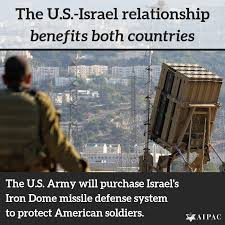

The United States and Israel have maintained strong bilateral relations based on a number of factors, including robust domestic U.S. support for Israel and its security; shared strategic goals in the Middle East; a mutual commitment to democratic values; and historical ties dating from U.S. support for the creation of Israel in 1948.
Israel and the US have for decades held a strong military relationship that has defined the countries’ foreign policies. Israel is the largest cumulative recipient of U.S. foreign assistance since World War II. To date, the United States has provided Israel $142.3 billion (current, or noninflation-adjusted, dollars) in bilateral assistance and missile defense funding. Almost all U.S. bilateral aid to Israel is in the form of military assistance, although from 1971 to 2007 Israel also received significant economic assistance.
In 2016, the U.S. and Israeli governments signed a new 10-year Memorandum of Understanding (MOU) on military aid, covering FY2019 to FY2028. Under the terms of the MOU, the United States pledges to provide $38 billion in military aid ($33 billion in Foreign Military Financing grants plus $5 billion in missile defense appropriations) to Israel. This MOU replaced a previous $30 billion 10-year agreement, which ran through FY2018.
U.S. military aid has helped transform Israel’s armed forces into one of the most technologically sophisticated militaries in the world. U.S. military aid for Israel has been designed to maintain Israel’s “qualitative military edge” (QME) over neighboring militaries. 7 The rationale for QME is that Israel must rely on better equipment and training to compensate for being much smaller in land area and population than its potential adversaries.
Israel is the first international operator of the F-35 Joint Strike Fighter, the Department of Defense’s fifth-generation stealth aircraft, considered to be the most technologically advanced fighter jet ever made. To date, Israel has purchased 50 F-35s in three separate contracts.
U.S. military aid also has helped Israel build its domestic defense industry, which ranks as one of the top global suppliers of arms. Israel exports missile defense systems, unmanned aerial vehicles, cyber security products, radar, and electronic communications systems to, among others: India, Azerbaijan, Vietnam, Thailand, South Korea, Singapore, Philippines, Australia, France, Germany, Italy, Russia, Brazil, and the United States. In addition to a planned U.S. purchase of Iron Dome, the United States has purchased, among other items, the following Israeli defense articles: Trophy active protection systems for M1 Abrams tanks, helmets for F-35 fighter pilots, and an electronic fence along the U.S.-Mexico border.
In 1989, the United States agreed to establish munitions stockpiles in Israel for use by the United States and, with U.S. permission, by Israel in emergency situations. The United States European Command (EUCOM) manages the War Reserves Stock Allies-Israel (WRSA-I) program. The United States stores missiles, armored vehicles, and artillery ammunition in Israel. According to one Israeli officer, “Officially, all of this equipment belongs to the US military…. If however, there is a conflict, the IDF [Israel Defense Forces] can ask for permission to use some of the equipment.
Israeli officials periodically express concern over U.S. sales of sophisticated weaponry, particularly aircraft, airborne radar systems, and precision-guided munitions, to Arab Gulf countries. Although in recent times Israel and the Arab Gulf states have coalesced against a commonly perceived Iranian threat, U.S. arms sales to Arab Gulf states still periodically raise Israeli QME concerns. The Trump Administration reportedly has agreed to enter into preliminary talks with the UAE on procurement of the F-35.
Retired Israeli Defense Force Colonel Shimon Arad has been a vocal critic of selling the F-35 to the UAE, saying: “The release of F-35s to the Gulf states is a fundamental military game-changer that, in combination with the advanced fourth generation fighters and the tens of thousands of sophisticated munitions, will cancel out Israel’s QME.”
Israel is a major global manufacturer of armaments, it also possesses significant quantities of major U.S.-origin defense equipment stemming from its decades-old security partnership with the United States. At times, third parties have sought to procure U.S. equipment used by Israel, and U.S. approval of retransfer have at times caused friction in the U.S.-Israeli relationship.
Amidst ongoing global U.S.-Chinese competition in various fields, Israel’s defense and technology trade with China has at times come under U.S. scrutiny. Since the middle of the last decade, Israeli defense exports to China have nearly ceased. Though Israeli-Chinese defense ties have ended, there is still some concern that Israeli technology transfer in the commercial sphere will be used by China to compete with the United States and potentially threaten its national security in various fields, such as cyber security, artificial intelligence, and robotics.
Chinese investment in Israel also has raised some concern within the Administration and Congress. According to one Israeli analysis, President Trump reportedly warned Prime Minister Netanyahu in March 2019 that U.S. security assistance for and cooperation with Israel could be limited if Chinese companies establish a 5G communications network in Israel, in line with similar warnings that the Administration has communicated to other U.S. allies and partners.