
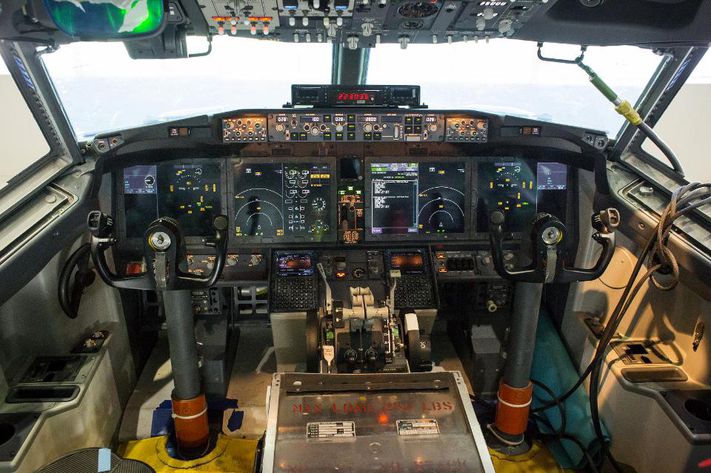

Modern commercial airliners have automated systems that can augment or even replace pilots’ performance, managing engine power, controlling and navigating the aircraft, and in some cases even completing landings. One of the goal of future aviation is fully autonomous flight. A fully autonomous aircraft would not require a pilot; it would be able to operate independently within civil airspace, interacting with air traffic controllers and other pilots just as if a human pilot were on board and in command.
Several companies are developing fully autonomous aircraft, including Amazon and UPS, which want to use them for deliveries. These new planes are variously described as flying taxis, passenger drones or, as the industry terms them, urban air mobility (uam) vehicles. Around 200 such craft are at various stages of development around the world, according to experts at Farnborough’s first global urban air summit in early September. Some prototypes are already carrying out test flights and operators hope to begin commercial services within the next few years.
Uber, which runs an app-based taxi-hailing service, aims to start flying passengers in Dallas, Los Angeles and Melbourne, Australia by 2023. Boeing and Airbus are designing self-flying air taxis, which would be used for flights of about 30 minutes and carry between two and four passengers, and have tested prototypes. A company called Volocopter has been testing autonomous air taxis in Germany since 2016 and plans to conduct test flights in downtown Singapore.
The development and application of increasingly autonomous (IA) systems for civil aviation are proceeding at an accelerating pace, driven by the expectation that such systems will return significant benefits in terms of safety, reliability, efficiency, affordability, and/or previously unattainable mission capabilities.
These development is being driven in many advancements of military and civil aircraft technologies including high-capability computing systems; sensor technologies; high-throughput digital communications systems; precise position, navigation, and timing information (e.g., from the Global Positioning System (GPS) and open-source hardware and software.
Airlines and manufacturers say they would save money and alleviate the current shortage of qualified pilots if they could reduce–or even eliminate–the number of pilots in the cockpit. Redesigning the front of the aircraft to be more aerodynamic could save even more money, if it didn’t need room for pilots, or could move them to another part of the aircraft. Large commercial airplanes will likely go pilotless later than smaller private aircraft, because of the amount of time and money required to produce them. But smaller air taxis simply are not economically viable if they require a human pilot on board.
Landing a plane under autopilot, known as autoland, is a different matter. According to a study by Boeing in 2017, 49% of fatal plane accidents between 2008 and 2017 occurred during final approach and landing. By removing possibilities for human error through automation, the risk of accidents can be reduced to make these phases safer. ‘If we look to the recent root causes analysis of aircraft accidents, many of them have a large contribution from human error,’ said Deschacht. While some systems already exist, efforts are underway to improve them to enable safer landings.