

Many nations are racing to achieve a global innovation advantage in artificial intelligence (AI) because they understand that AI is a foundational technology that can boost competitiveness, increase productivity, protect national security, and help solve societal challenges.
Nations wherein firms fail to develop successful AI products or services are at risk of losing global market share. As Andrew Moore, former dean of computer science at Carnegie Mellon University and current head of Google Cloud AI stated, this part of the race will determine “who will be the Googles, Amazons, and Apples in 2030.” Nations that lag in AI adoption will see diminished global market share in a host of industries, from finance to manufacturing to mining. And nations that underinvest in AI R&D, particularly for military applications, will put their national security at risk. Consequently, nations that fall behind in the AI race can suffer economic harm and weakened national security, thereby diminishing their geopolitical influence.
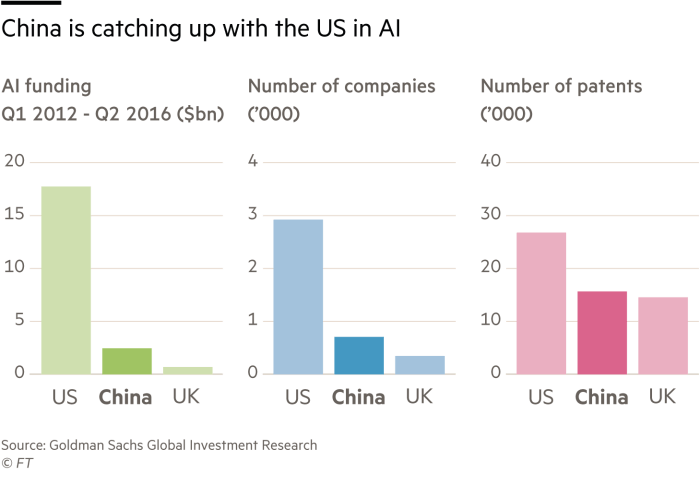
The Centre for data innovation report in August 2019 compared China, the European Union, and the United States in terms of their relative standing in the AI economy by examining six categories of metrics—talent, research, development, adoption, data, and hardware. It finds that despite China’s bold AI initiative, the United States still leads in absolute terms. China comes in second, and the European Union lags further behind.
The authors explained their rationale for choosing these categories: First, nations with the requisite AI talent will be able to better develop and implement AI systems, attract businesses, and ensure their universities have enough talented AI professors to teach the next generation of AI researchers. Second, research will help nations expand AI innovation and solve problems related to domestic priorities and industries. Third, the number of AI companies and start-ups, combined with related investment capital, lays the groundwork for a strong AI industry that will continue to innovate. Fourth, adoption of AI systems will not only allow organizations to learn how to solve problems related to implementation, but generate demand for AI services, thereby likely helping domestic AI developers. Fifth, more and higher-quality data will create new opportunities to use machine learning in AI applications. Finally, leading in hardware will reduce nations’ dependency on other nations—something that, given the current trade dispute between China and the United States, may play an important role going forward.
The United States leads in four of the six categories of metrics this report examines (talent, research, development, and hardware), China leads in two (adoption and data), and the European Union leads in none—although it is closely behind the United States in talent. Out of 100 total available points in this report’s scoring methodology, the United States leads with 44.2 points, followed by China with 32.3 and the European Union with 23.5.
As David Wipf, a lead researcher at Microsoft Research in Beijing has said, “The future [of AI] is going to be a battle for data and for talent.” Lack of talent not only limits firms’ ability to deploy and adopt AI, it increases costs, thereby reducing competitiveness. Given the increased demand for AI talent in a wide range of industries, including transportation, finance, and manufacturing, the current shortage is likely to only grow in the near to moderate term.