
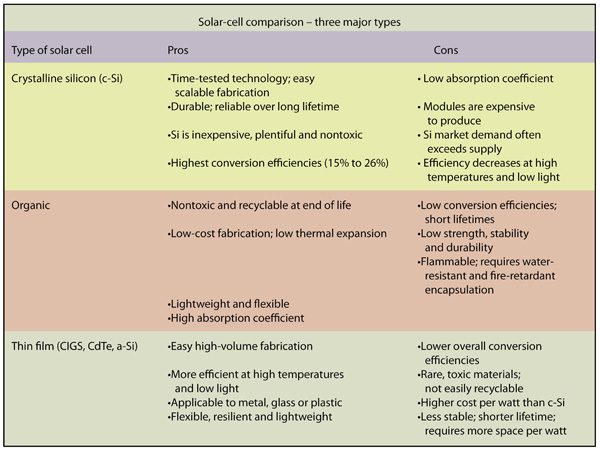

Worldwide growth of photovoltaics has been fitting an exponential curve for more than two decades. During this period of time, photovoltaics (PV), also known as solar PV, has evolved from a pure niche market of small scale applications towards becoming a mainstream electricity source. The Sun blankets the Earth with enough photons every hour to meet the entire world’s energy needs for a year. The question is how to efficiently convert them into electricity. Solar panels on the market today consist of cells made from a single semiconducting material, usually silicon. Since the material absorbs only a narrow band of the solar spectrum, much of sunlight’s energy is lost as heat: these panels typically convert less than 20 percent of that energy into electricity. Even under small-scale laboratory conditions, the world’s best single-junction solar cells—the kind found in most solar panels—still max out at capturing 29 percent of the sun’s energy.
Simply put, solar panel efficiency (expressed as a percentage) quantifies a solar panel’s ability to convert sunlight into electricity. Given the same amount of sunlight shining for the same duration of time on two solar panels with different efficiency ratings, the more efficient panel will produce more electricity than the less efficient panel. In practical terms, for two solar panels of the same physical size, if one has a 21% efficiency rating and the other has a 14% efficiency rating, the 21% efficient panel will produce 50% more kilowatt hours (kWh) of electricity under the same conditions as the 14% efficient panel. Thus, maximizing energy use and bill savings is heavily reliant on having top-tier solar panel efficiency.
There is a need for cheaper, more efficient solar cells than the traditional silicon solar cells so that more people may have access to this technology. The prices for solar panels have plummeted over the past few years, so continuing to focus on making them less expensive would have little impact on the overall cost of a solar power system; expenses related to things like wiring, land, permitting, and labor now make up the vast majority of that cost. Making modules more efficient would mean that fewer panels would be needed to produce the same amount of power, so the costs of hardware and installation could be greatly reduced.
Reserachers have been developing new architectures , techniques, materials including nanomaterials, stacking multiple layers , developing hybrid technologies and manufacturing processes to enhance the efficnecy and also reduce the cost of solar cells. MSU Foundation Professor James McCusker, Department of Chemistry, believes that the future of solar energy lies in abundant, scalable materials designed to mimic and improve upon the energy conversion systems found in nature.