

Today’s naval forces rely primarily on highly capable multifunctional manned platforms, such as ships and submarines. Even the most advanced vessel, however, can only be in one place at a time, making the ability to respond increasingly dependent on being ready at the right place at the right time. With the number of U.S. Navy vessels continuing to shrink due to planned force reductions and fiscal constraints, naval assets are increasingly stretched thin trying to cover vast regions of interest around the globe. To maintain advantage over adversaries, U.S. naval forces need a way to project key capabilities in multiple locations at once, without the time and expense of building new vessels to deliver those capabilities.
DARPA launched the Hydra program in 2013 to help address these challenges. Named for the multi-headed creature from Greek mythology, Hydra aims to develop a distributed undersea network of unmanned payloads and platforms to complement manned vessels. The Hydra would allow the U.S. Navy to deploy drones anywhere in the world without the need for either ground bases, or aircraft carriers. One such drone that would be compatible is Raytheon’s minature Switchblade “kamikaze” drone, which could conceivably launched from ports on the side of the Hydra
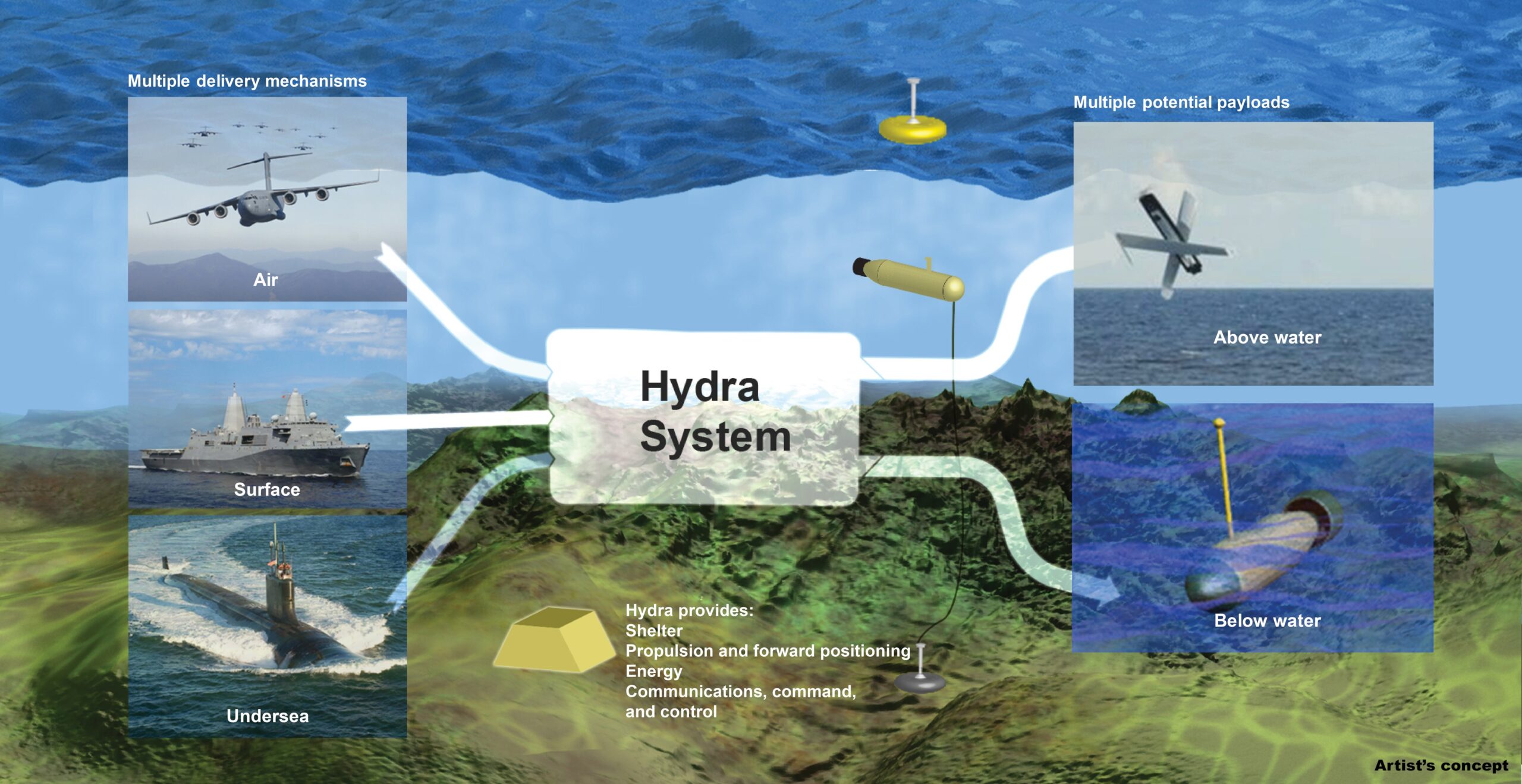
The Hydra program will develop and demonstrate an unmanned undersea system, providing a novel delivery mechanism for insertion of unmanned air and underwater vehicles into operational environments. Situated underwater, Hydra will use modular payloads within a standardized enclosure to enable scalable, cost-effective deployment of rapid response assets and will integrate existing and emerging technologies in new ways to create an alternate means of delivering a variety of payloads close to the point of use.
The goal is to create a force multiplier that enables rapid, scalable and cost-effective deployment of assets close to the point of use. The Hydra program seeks to develop and demonstrate initial examples of air and undersea payloads while leaving open the potential for accommodating additional payloads in the future. Technologies are intended to be adaptable to multiple delivery options, including airborne, surface, and subsurface. The Hydra program will enable other new capabilities not currently performed from undersea.
Hydra’s enclosures “are deployed by various means, depending on the need for speed and stealth and remain deployed until awakened for employment,” according to the Defense Advanced Research Projects Agency’s budget proposal. Hydra would “create a disruptive capability” in coastal waters, the budget proposal stated.
“The climate of budget austerity runs up against an uncertain security environment that includes natural disasters, piracy, ungoverned states and the proliferation of sophisticated defense technologies,” said Scott Littlefield, DARPA program manager. “An unmanned technology infrastructure staged below the oceans’ surface could relieve some of that resource strain and expand military capabilities in this increasingly challenging space.”
Key to the effort is the development of modular payloads that would provide key capabilities, including Intelligence, Surveillance and Reconnaissance (ISR) and Mine Counter-Measures (MCM). Each payload module would plug into a standardized enclosure that would securely transport, house and launch various payloads, while sustaining payload functionality for weeks to months. The Hydra system would emphasize scalability, rapid reconfiguration and maximization of payload. Ships, submarines or airplanes could deliver the Hydra system to littoral ocean zones (shallow international waters near shorelines).
Hydra’s communications suite would work synergistically with manned platforms, increasing their effectiveness. It would also enable remote control from over-the-horizon significantly increasing operational reach. Additionally, Hydra would enable other new capabilities not currently performed by manned platforms, such as forward-deployed airborne ISR with expendable platforms or recharging hubs for ISR-capable undersea vehicles.
“By separating capabilities from the platforms that deliver them, Hydra would enable naval forces to deliver those capabilities much faster and more cost-effectively wherever needed,” Littlefield said. “It is envisioned to work across air, underwater and surface operations, enabling all three to perform their missions better.”